
Validation Data Gallery
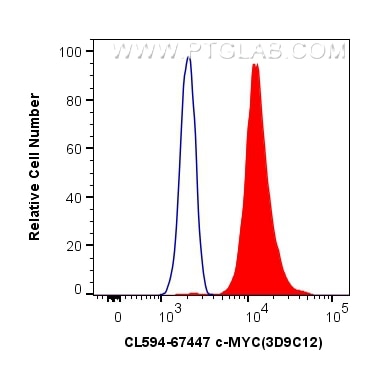
Tested Applications
| Positive FC (Intra) detected in | HeLa cells |
Recommended dilution
| Application | Dilution |
|---|---|
| Flow Cytometry (FC) (INTRA) | FC (INTRA) : 0.40 ug per 10^6 cells in a 100 µl suspension |
| It is recommended that this reagent should be titrated in each testing system to obtain optimal results. | |
| Sample-dependent, Check data in validation data gallery. | |
Product Information
CL594-67447 targets c-MYC in FC (Intra) applications and shows reactivity with human, mouse, rat samples.
| Tested Reactivity | human, mouse, rat |
| Host / Isotype | Mouse / IgG1 |
| Class | Monoclonal |
| Type | Antibody |
| Immunogen |
CatNo: Ag17519 Product name: Recombinant human MYC protein Source: e coli.-derived, PET28a Tag: 6*His Domain: 16-454 aa of BC000141 Sequence: MPLNVSFTNRNYDLDYDSVQPYFYCDEEENFYQQQQQSELQPPAPSEDIWKKFELLPTPPLSPSRRSGLCSPSYVAVTPFSLRGDNDGGGGSFSTADQLEMVTELLGGDMVNQSFICDPDDETFIKNIIIQDCMWSGFSAAAKLVSEKLASYQAARKDSGSPNPARGHSVCSTSSLYLQDLSAAASECIDPSVVFPYPLNDSSSPKSCASQDSSAFSPSSDSLLSSTESSPQGSPEPLVLHEETPPTTSSDSEEEQEDEEEIDVVSVEKRQAPGKRSESGSPSAGGHSKPPHSPLVLKRCHVSTHQHNYAAPPSTRKDYPAAKRVKLDSVRVLRQISNNRKCTSPRSSDTEENVKRRTHNVLERQRRNELKRSFFALRDQIPELENNEKAPKVVILKKATAYILSVQAEEQKLISEEDLLRKRREQLKHKLEQLRNSCA 相同性解析による交差性が予測される生物種 |
| Full Name | v-myc myelocytomatosis viral oncogene homolog (avian) |
| Calculated molecular weight | 49 kDa |
| Observed molecular weight | 55-60 kDa |
| GenBank accession number | BC000141 |
| Gene Symbol | MYC |
| Gene ID (NCBI) | 4609 |
| RRID | AB_3084767 |
| Conjugate | CoraLite®594 Fluorescent Dye |
| Excitation/Emission maxima wavelengths | 588 nm / 604 nm |
| 激发激光 | Yellow-Green Laser (561 nm) |
| Form | |
| Form | Liquid |
| Purification Method | Protein G purification |
| UNIPROT ID | P01106 |
| Storage Buffer | PBS with 50% glycerol, 0.05% Proclin300, 0.5% BSA{{ptg:BufferTemp}}7.3 |
| Storage Conditions | Store at -20°C. Avoid exposure to light. Stable for one year after shipment. Aliquoting is unnecessary for -20oC storage. |
Background Information
MYC contains a basic helix-loop-helix (bHLH) domain. This protein is a multifunctional nuclear phosphoprotein, which plays a role in cell cycle process, apoptosis and cell transformation. As a transcription factor, it regulates the transcription of specific target genes. It seems to activate the transcription of growth-related genes. It binds to DNA in a nonspecific way, but also specifically recognizes the core sequence 5'-CAC[GA]TG-3'. Mutation, overexpression, rearrangement and translocation of this gene are related to many hematopoietic tumors, leukemia and lymphoma (including Burkitt lymphoma). The antibody is a rabbit polyclonal antibody against human MYC recombinant protein. The 50kDa band recognized by antibody is the natural form of MYC, while other bands between 60 and 70 kDa are the phosphorylated form of MYC (PMID: 12189186). The latest research reveals a new key mechanism of MYC protein, which is independent of its classical transcriptional regulation function. It was found that under the stress of transcription, MYC was polymerized through its specific RNA binding domain (RBRIII), and exocrine was targeted at the nuclear R loop and double-stranded RNA. This process can effectively eliminate the immunogenic RNA-DNA hybrid from R-loop, thus preventing it from activating TLR3-TBK1 natural immune signaling pathway. This mechanism is very important for MYC to maintain tumor growth and achieve immune escape in vivo. (PMID: 41576951)
Protocols
| Product Specific Protocols | |
|---|---|
| FC protocol for CL594 c-MYC antibody CL594-67447 | Download protocol |
| Standard Protocols | |
|---|---|
| Click here to view our Standard Protocols |