Use Able AI chat for product recommendations

Validation Data Gallery

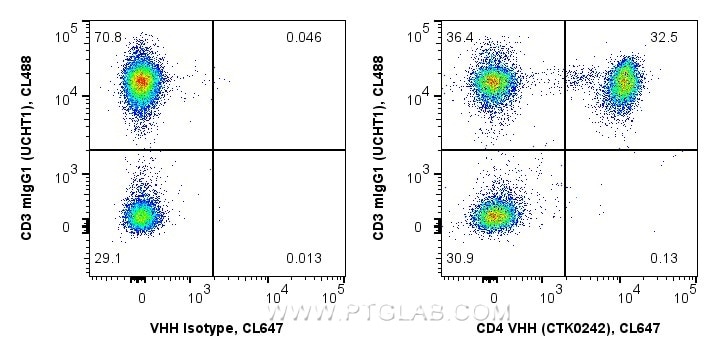
  • <b>Human PBMCs co-stained with anti-CD4 recombinant VHH and anti-CD3 UCHT1 in Flow Cytometry</b>
<br/>1x10^6 human PBMCs were surface co-stained in 100 µL with 0.25 µg anti-CD4 recombinant VHH, CoraLite® Plus 647 (MG-1229CL647, Clone: CTK0242), or 0.25 µg recombinant VHH Isotype Control, CoraLite® Plus 647 (Clone: CTK0201), mixed with 5 µL Anti-Human CD3, CoraLite® Plus 488 (CL488-65151, Clone: UCHT1). Fc-receptors were blocked. Viability Dye (PD00002) was used. Cells were not fixed. Viable lymphocytes were gated.

    Human PBMCs co-stained with anti-CD4 recombinant VHH and anti-CD3 UCHT1 in Flow Cytometry
    1x10^6 human PBMCs were surface co-stained in 100 µL with 0.25 µg anti-CD4 recombinant VHH, CoraLite® Plus 647 (MG-1229CL647, Clone: CTK0242), or 0.25 µg recombinant VHH Isotype Control, CoraLite® Plus 647 (Clone: CTK0201), mixed with 5 µL Anti-Human CD3, CoraLite® Plus 488 (CL488-65151, Clone: UCHT1). Fc-receptors were blocked. Viability Dye (PD00002) was used. Cells were not fixed. Viable lymphocytes were gated.

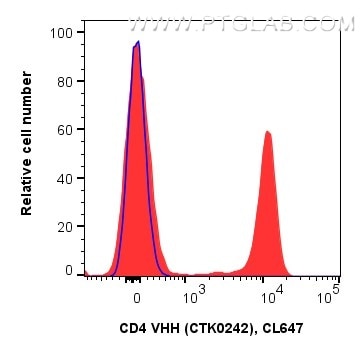
  • <b>Human PBMCs stained with anti-CD4 recombinant VHH in Flow Cytometry</b>
<br/>1x10^6 human PBMCs were surface stained in 100 µL with 0.25 µg anti-CD4 recombinant VHH, CoraLite® Plus 647 (MG-1229CL647, Clone: CTK0242) (red), or 0.25 µg recombinant VHH Isotype Control, CoraLite® Plus 647 (Clone: CTK0201) (blue). Fc-receptors were blocked. Viability Dye (PD00002) was used. Cells were not fixed. Viable lymphocytes were gated.

    Human PBMCs stained with anti-CD4 recombinant VHH in Flow Cytometry
    1x10^6 human PBMCs were surface stained in 100 µL with 0.25 µg anti-CD4 recombinant VHH, CoraLite® Plus 647 (MG-1229CL647, Clone: CTK0242) (red), or 0.25 µg recombinant VHH Isotype Control, CoraLite® Plus 647 (Clone: CTK0201) (blue). Fc-receptors were blocked. Viability Dye (PD00002) was used. Cells were not fixed. Viable lymphocytes were gated.

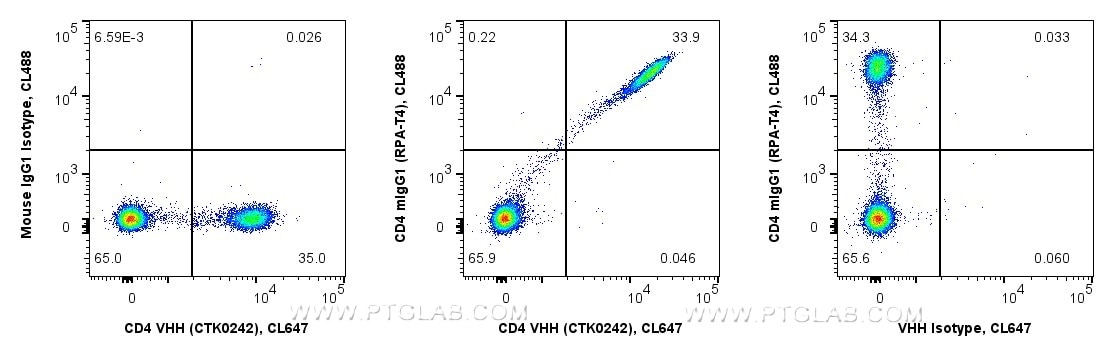
  • <b>Human PBMCs competitively co-stained with anti-CD4 recombinant VHH and anti-CD4 RPA-T4 in Flow Cytometry</b>
<br/>1x10^6 human PBMCs were surface co-stained in 100 µL with 0.25 µg anti-CD4 recombinant VHH, CoraLite® Plus 647 (MG-1229CL647, Clone: CTK0242) mixed with 5 µL Anti-Human CD4, CoraLite® Plus 488 (CL488-65143, Clone: RPA-T4) (middle). As controls 0.25 µg VHH were co-stained with 0.25 µg Mouse IgG1, κ Isotype Control, CoraLite® Plus 488 (CL488-98742-2, Clone: MOPC-21) (left), and 5 µL RPA-T4 were co-stained with 0.25 µg recombinant VHH Isotype Control, CoraLite® Plus 647 (Clone: CTK0201, right). Fc-receptors were blocked. Viability Dye (PD00002) was used. Cells were not fixed. Viable lymphocytes were gated. 
Anti-Human CD4 recombinant VHH effectively co-stains the same CD4+ population as the conventional Anti-Human CD4 clone RPA-T4 (mIgG1). Close proximity of different VHH and IgG epitopes on identical CD4 molecules likely causes a CL488 to CL647 FRET effect, observable by an increased signal intensity of the CD4 VHH-positive stained cells co-stained with RPA-T4 compared to the CD4 VHH-positive stained cells co-stained with the mIgG1 Isotype Control.

    Human PBMCs competitively co-stained with anti-CD4 recombinant VHH and anti-CD4 RPA-T4 in Flow Cytometry
    1x10^6 human PBMCs were surface co-stained in 100 µL with 0.25 µg anti-CD4 recombinant VHH, CoraLite® Plus 647 (MG-1229CL647, Clone: CTK0242) mixed with 5 µL Anti-Human CD4, CoraLite® Plus 488 (CL488-65143, Clone: RPA-T4) (middle). As controls 0.25 µg VHH were co-stained with 0.25 µg Mouse IgG1, κ Isotype Control, CoraLite® Plus 488 (CL488-98742-2, Clone: MOPC-21) (left), and 5 µL RPA-T4 were co-stained with 0.25 µg recombinant VHH Isotype Control, CoraLite® Plus 647 (Clone: CTK0201, right). Fc-receptors were blocked. Viability Dye (PD00002) was used. Cells were not fixed. Viable lymphocytes were gated. Anti-Human CD4 recombinant VHH effectively co-stains the same CD4+ population as the conventional Anti-Human CD4 clone RPA-T4 (mIgG1). Close proximity of different VHH and IgG epitopes on identical CD4 molecules likely causes a CL488 to CL647 FRET effect, observable by an increased signal intensity of the CD4 VHH-positive stained cells co-stained with RPA-T4 compared to the CD4 VHH-positive stained cells co-stained with the mIgG1 Isotype Control.

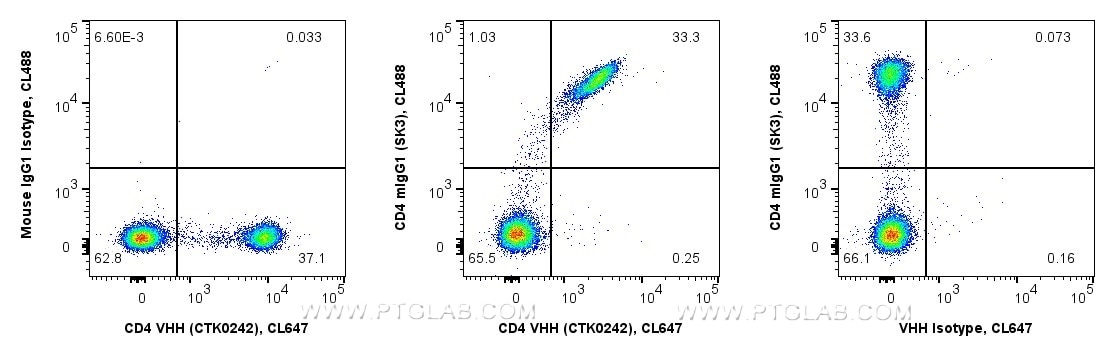
  • <b>Human PBMCs competitively co-stained with anti-CD4 recombinant VHH and anti-CD4 SK3 in Flow Cytometry</b>
<br/>1x10^6 human PBMCs were surface co-stained in 100 µL with 0.25 µg anti-CD4 recombinant VHH, CoraLite® Plus 647 (MG-1229CL647, Clone: CTK0242) mixed with 5 µL Anti-Human CD4, CoraLite® Plus 488 (CL488-65147, Clone: SK3) (middle). As controls 0.25 µg VHH were co-stained with 0.25 µg Mouse IgG1, κ Isotype Control, CoraLite® Plus 488 (CL488-98742-2, Clone: MOPC-21) (left), and 5 µL SK3 were co-stained with 0.25 µg recombinant VHH Isotype Control, CoraLite® Plus 647 (Clone: CTK0201, right). Fc-receptors were blocked. Viability Dye (PD00002) was used. Cells were not fixed. Viable lymphocytes were gated. 
Anti-Human CD4 recombinant VHH clone CTK0242 effectively co-stains the same CD4+ population as the conventional Anti-Human CD4 Mouse IgG1 clone SK3. Decreased signal intensity of CD4 VHH-positive stained cells co-stained with SK3 compared to CD4 VHH-positive stained cells co-stained with the mIgG1 Isotype Control indicate competition for an identical or overlapping epitope of CD4 bound by VHH and SK3.

    Human PBMCs competitively co-stained with anti-CD4 recombinant VHH and anti-CD4 SK3 in Flow Cytometry
    1x10^6 human PBMCs were surface co-stained in 100 µL with 0.25 µg anti-CD4 recombinant VHH, CoraLite® Plus 647 (MG-1229CL647, Clone: CTK0242) mixed with 5 µL Anti-Human CD4, CoraLite® Plus 488 (CL488-65147, Clone: SK3) (middle). As controls 0.25 µg VHH were co-stained with 0.25 µg Mouse IgG1, κ Isotype Control, CoraLite® Plus 488 (CL488-98742-2, Clone: MOPC-21) (left), and 5 µL SK3 were co-stained with 0.25 µg recombinant VHH Isotype Control, CoraLite® Plus 647 (Clone: CTK0201, right). Fc-receptors were blocked. Viability Dye (PD00002) was used. Cells were not fixed. Viable lymphocytes were gated. Anti-Human CD4 recombinant VHH clone CTK0242 effectively co-stains the same CD4+ population as the conventional Anti-Human CD4 Mouse IgG1 clone SK3. Decreased signal intensity of CD4 VHH-positive stained cells co-stained with SK3 compared to CD4 VHH-positive stained cells co-stained with the mIgG1 Isotype Control indicate competition for an identical or overlapping epitope of CD4 bound by VHH and SK3.

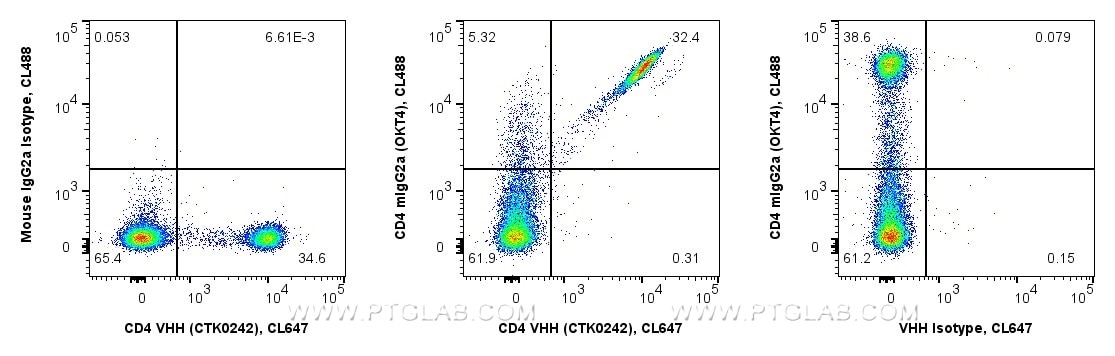
  • <b>Human PBMCs competitively co-stained with anti-CD4 recombinant VHH and anti-CD4 OKT4 in Flow Cytometry</b>
<br/>1x10^6 human PBMCs were surface co-stained in 100 µL with 0.25 µg anti-CD4 recombinant VHH, CoraLite® Plus 647 (MG-1229CL647, Clone: CTK0242) mixed with 5 µL Anti-Human CD4, CoraLite® Plus 488 (CL488-65603, Clone: OKT4) (middle). As controls 0.25 µg VHH were co-stained with 0.2 µg Mouse IgG2a Isotype Control, CoraLite® Plus 488 (CL488-65208, Clone: C1.18.4) (left), and 5 µL SK3 were co-stained with 0.25 µg recombinant VHH Isotype Control, CoraLite® Plus 647 (Clone: CTK0201, right). Fc-receptors were blocked. Viability Dye (PD00002) was used. Cells were not fixed. Viable lymphocytes were gated. 
Anti-Human CD4 recombinant VHH clone CTK0242 effectively co-stains the same CD4+ population as the conventional Anti-Human CD4 Mouse IgG2a clone OKT4. Unaltered signal intensity of the CD4 VHH-positive stained cells co-stained with OKT4 compared to CD4 VHH-positive stained cells co-stained with the mIgG2a Isotype Control indicate that CD4 binding of the VHH does not interfere with OKT4 and both epitopes are distant enough to not cause CL488 to CL647 FRET.

    Human PBMCs competitively co-stained with anti-CD4 recombinant VHH and anti-CD4 OKT4 in Flow Cytometry
    1x10^6 human PBMCs were surface co-stained in 100 µL with 0.25 µg anti-CD4 recombinant VHH, CoraLite® Plus 647 (MG-1229CL647, Clone: CTK0242) mixed with 5 µL Anti-Human CD4, CoraLite® Plus 488 (CL488-65603, Clone: OKT4) (middle). As controls 0.25 µg VHH were co-stained with 0.2 µg Mouse IgG2a Isotype Control, CoraLite® Plus 488 (CL488-65208, Clone: C1.18.4) (left), and 5 µL SK3 were co-stained with 0.25 µg recombinant VHH Isotype Control, CoraLite® Plus 647 (Clone: CTK0201, right). Fc-receptors were blocked. Viability Dye (PD00002) was used. Cells were not fixed. Viable lymphocytes were gated. Anti-Human CD4 recombinant VHH clone CTK0242 effectively co-stains the same CD4+ population as the conventional Anti-Human CD4 Mouse IgG2a clone OKT4. Unaltered signal intensity of the CD4 VHH-positive stained cells co-stained with OKT4 compared to CD4 VHH-positive stained cells co-stained with the mIgG2a Isotype Control indicate that CD4 binding of the VHH does not interfere with OKT4 and both epitopes are distant enough to not cause CL488 to CL647 FRET.

ChromoTek anti-CD4 recombinant VHH, CoraLite ® Plus 647

The small size of VHHs (~15 kDa) enables access to epitopes that may be sterically inaccessible to full size IgGs. Their reduced steric hindrance also facilitates simultaneous staining of multiple targets, making them particularly useful for applications like Nano-Flow. MG-1229CL647 is a recombinant CoraLite ® Plus 647 conjugated anti CD4 Nanobody (VHH) that targets CD4 (human).
Cat No. MG-1229CL647

Host/Type

Alpaca VHH

Reactivity

Human

Applications

FC

Conjugate

CoraLite® Plus 647

T4 VHH, CD4 VHH

Size: 

-/ -

Concentration: 0.5 mg/ml


ご購入について

国内販売は「コスモ・バイオ株式会社」を通じて行っております。お見積り・ご注文はお近くの販売代理店へご連絡ください。


国内在庫・納期について

約2万点のプロテインテック製品をコスモバイオ社物流センター(国内)に在庫しています。国内在庫の有無はコスモバイオ社ホームページの「品番検索」でカタログ番号を検索して確認できます。


保証・サポートについて

テクニカルサポートまたはご購入後1年間の交換/補填対応を承ります。詳細はこちらをご覧ください。


Product Information

The small size of VHHs (~15 kDa) enables access to epitopes that may be sterically inaccessible to full size IgGs. Their reduced steric hindrance also facilitates simultaneous staining of multiple targets, making them particularly useful for applications like Nano-Flow. MG-1229CL647 is a recombinant CoraLite ® Plus 647 conjugated anti CD4 Nanobody (VHH) that targets CD4 (human).

ApplicationsFC
ReactivityHuman
ConjugateCoraLite® Plus 647
TypeNanobody
ClassRecombinant
HostAlpaca
Affinity17 nM
CloneCTK0242
Immunogen26-396 aa
Molecular Weight14.8 kDa
FormLiquid
Excitation/Emission Maxima Wavelengths654 nm / 674 nm
RRID/
Storage Buffer10 mM HEPES pH 7.0, 500 mM NaCl, 5 mM EDTA, 0.09% sodium azide
Storage ConditionStore at -20°C
Shippingblue ice
Sizes150 µl
Amount per test (Flow Cytometry)0.5 µl per test
Total number of tests300 tests
BackgroundCD4 is a 55-kDa transmembrane glycoprotein expressed on T helper cells, majority of thymocytes, monocytes, macrophages, and dendritic cells (PMID: 9304802; 12213222). CD4 is an accessory protein for MHC class-II antigen/T-cell receptor interaction. It plays an important role in T helper cell development and activation (PMID: 9539765; 3112582). CD4 serves as a receptor for the human immunodeficiency virus (HIV) (PMID: 9304802).
||
New chat

Able™

正在加载,请稍候...