
Product Information
ZymeBright™ Site-Specific DBCO-Ready Antibody Conjugation Kit (2x Azide) is enzymatic method for the conjugation of any DBCO-functionalized conjugate, such as oligonucleotides, fluorophores, enzymes, beads, or bioactive molecules, to the Fc region of Rabbit IgG, Rat IgG1 & IgG2a, Human IgG1-4, or Mouse IgG1 & IgG3 for the use in fluorescent immunoassays. The expected degree of labeling (F/P ratio) of antibodies conjugated with this kit is 2.
Product Components
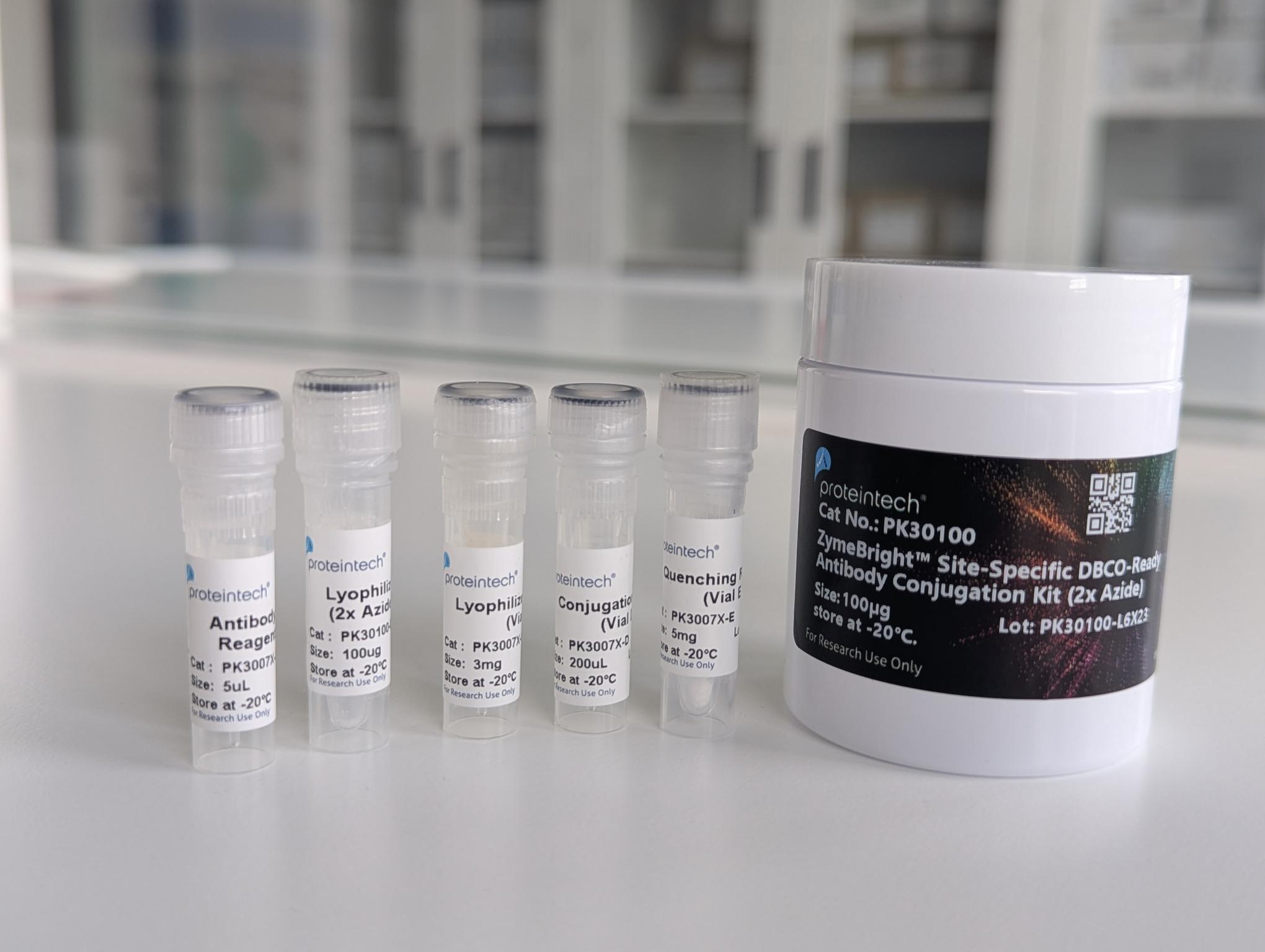
Cat No. | Name | Size |
Component A (PK3007X-A) | Antibody Modifier Reagent (Vial A) | 5 uL |
Component B (PK30100-B) | Lyophilized Linker (2x Azide) (Vial B) | 100 ug |
Component C (PK3007X-C) | Lyophilized PTGase (Vial C) | 3 mg (provided in excess) |
Component D (PK3007X-D) | Conjugation Buffer (Vial D) | 200 uL |
Component E (PK3007X-E) | Quenching Reagent (Vial E) | 5 mg |
Component F (PK3007X-F) | 0.6 mL Low Adhesion Tube | 0.6 mL*2 |
Labeling Scale: 100 ug unconjugated antibody | ||
Storage
Store at -20°C for up to 1 year. After opening, store at 2-8°C. Protect from light and moisture. Reagents must be used within 1 week of opening.
Usage
Prior to Beginning:
Antibody should be at 1 mg/mL in compatible buffer. Please refer to the table for buffer component compatibility.
The entire conjugation protocol should be performed in sterile conditions to avoid contamination. If the conjugate is a fluorescent molecule, protect the conjugate and conjugated antibody from light for the duration of the protocol and during storage.
Spin down Vials A, C, D, and E. 10-15 minutes prior to beginning, bring the Lyophilized Linker (2x Azide) (Vial B) and Conjugation Buffer (Vial D) to room temperature. Store Quenching Reagent (Vial E) at 2-8°C. Preheat the orbital thermal mixer to 37°C.
On day 2, bring Quenching Reagent (Vial E) to room temperature 10-15 minutes prior to beginning.
Protocol:
Day 1: Antibody Modification
1. Add 100 uL antibody (at 1 mg/mL) to a provided 0.6 mL low adhesion tube.
2. Add 2 uL Antibody Modifier Reagent (Vial A) to antibody in 0.6 mL low adhesion tube. Pipette for 10-15 seconds to fully mix.
3. Incubate in a 3 mm orbital thermal mixer at 37°C, 800 rpm for 30 minutes. If using a 2 mm orbital thermal mixer, mix at 1000 rpm.
Note: Avoid prolonged incubation of the antibody with the Modifier Reagent.
Prepare Lyophilized Linker and PTGase
4. Add 100 uL sterile PBS to Vial B: Lyophilized Linker. Pipette gently for 10-15 seconds to fully dissolve Lyophilized Linker.
5. Pipette entire contents of Vial B into the other 0.6 mL low adhesion tube.
6. Add 600 uL sterile PBS to Vial C: Lyophilized PTGase and pipette for 10-15 seconds to fully dissolve Lyophilized PTGase.
Note: PTGase should be used within 1 hour of dissolving to avoid a decrease in enzymatic activity and thereby a reduction of conjugation efficiency.
Antibody Conjugation
7. Add 8 uL dissolved Lyophilized Linker (Vial B), 20 uL PTGase solution (Vial C) and 47 uL Conjugation Buffer (Vial D) to the 0.6 mL low adhesion tube from step 5. Pipette for 20 seconds to mix well.
8. Incubate in a 3 mm orbital thermal mixer at 37°C, 800 rpm for 18-24 hours. If using a 2 mm orbit thermal mixer, mix at 1000 rpm.
Day 2: Quench Conjugation Reaction
9. Add 100 uL sterile PBS to Vial E: Lyophilized Quenching Reagent. Pipette for 10-15 seconds to fully dissolve.
10. Add 83 uL Quencher Reagent Solution to the 0.6 mL low adhesion tube from step 7. Pipette for 10-15 seconds to mix.
11. If not immediately proceeding to the next step, incubate at room temperature in the dark for 30 minutes.
Note: Antibody-Linker can be conjugated immediately, placed in 2-8 °C for short-term storage, or at -20°C for long-term storage.
Click Chemistry
12. After the Antibody-Linker conjugation reaction is quenched, perform a buffer exchange using a G25 desalting column or ultrafiltration tube to remove excess Linker-azide. Use at least two column volumes of sterile PBS + 2 mM EDTA buffer to equilibrate the G25 desalting column or ultrafiltration tube. Desalt the antibody reaction solution in the 0.6 mL low adhesion tube from step 11 and replace the antibody buffer.
13. Measure antibody concentration using an ultra-micro spectrophotometer.
Preparation of DBCO-modified Conjugate
14. Dissolve the DBCO-modified Conjugate in ultrapure water free of DNase/RNase.
Note: For oligonucleotide conjugation, dissolved DBCO-modified oligonucleotide can be used immediately, placed in 2-8°C for short-term storage, or at -20°C for long-term storage.
CLICK Chemistry
15. Add the DBCO-Conjugate solution slowly to the Antibody-Linker solution at a molar ratio of Antibody-Linker complex to DBCO-Conjugate of 1:3-1:6.
16. If necessary, adjust volume to 100-300 uL using sterile PBS + 2 mM EDTA. Maintain an antibody concentration > 0.2 mg/mL for efficient Click chemistry. Gently pipette or vortex to avoid air bubbles. Incubate at room temperature (25°C) for 22h.
Day 3: Antibody Purification
17. To remove unbound conjugate, appropriate methods can be used, such as Proteintech's CleanAb Kits for removing unconjugated oligonucleotides (Cat No. CK001 or CK003), or other purification methods such as G25 desalting column, dialysis, ultrafiltration, Protein A, Protein G, and ion exchange chromatography.
Conjugated Antibody Storage
18. For short-term use, store conjugated antibody in PBS at -20°C. For long-term storage, store in 30% glycerol and a small amount of BSA if compatible with subsequent experiments.
Note: A small amount of precipitation in the final conjugated antibody solution will occasionally occur and will not affect antibody performance.
Required Materials
Orbital Thermal Mixer, Pipettes, Sterile PBS, EDTA, DBCO-modified conjugate, Desalting column or ultracentrifugation tube, Ultrapure water (DNase/RNase free), Ultra-micro spectrophotometer, Method for conjugated antibody purification (see Step 16).
Buffer Compatibility
Buffer Components & Conditions | |
Purified antibody | Yes |
Antibody in ascites fluid, serum, hybridoma or tissue culture media | No |
Antibody concentration | 0.5-2 mg/mL |
pH | 6.5-8.0 |
Amine free buffer (e.g. MES, MOPS, HEPES, PBS) | Yes |
Non-buffering salts (e.g. sodium chloride) | Yes |
BSA | Yes |
Sodium Azide | Yes |
Chelating agents (e.g. EDTA) | Yes |
Glycerol | <10% |
Sugars | Yes |
Gelatin | Unknown |
Tris | Yes |
Glycine | No |
Thiomersal / Thimerosal | Yes |
Merthiolate | Yes |
Proclin | Yes |
Borate buffer | Yes |
Primary amines (e,g. lysine, peptide or ethanolamine ) | No |
Heavy metal ions (Zn²⁺, Cu²⁺, Mn²⁺, or Fe³⁺) | No |
Cited in Article as
pk30100, ZymeBright™ Site-Specific DBCO-Ready Antibody Conjugation Kit (2x Azide), Proteintech, IL, USA