
Validation Data Gallery
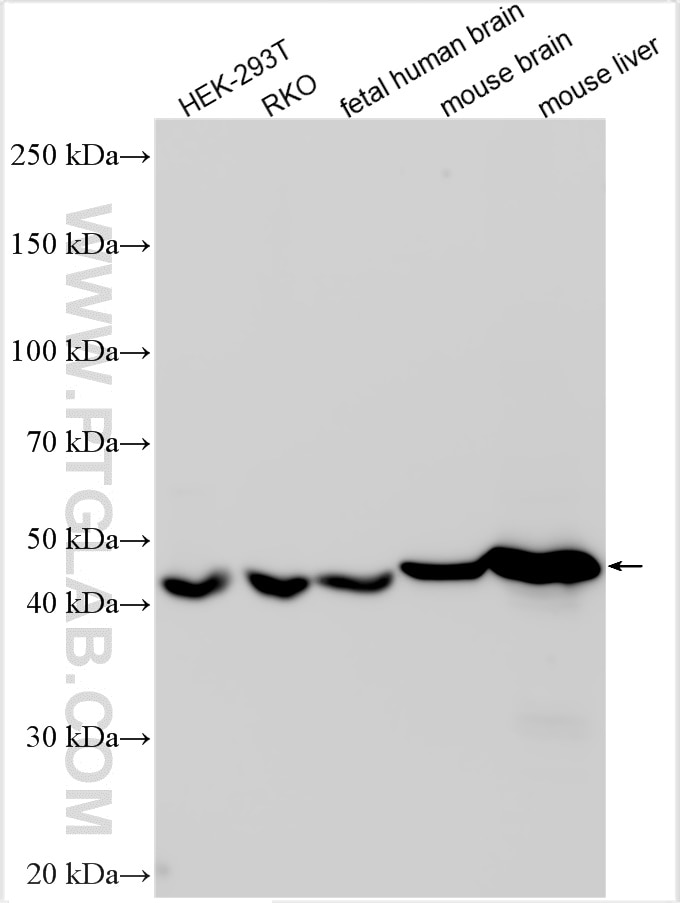
Tested Applications
Recommended dilution
| Application | Dilution |
|---|---|
| It is recommended that this reagent should be titrated in each testing system to obtain optimal results. | |
Product Information
32593-1-PBS targets SEC14L2 in WB, Indirect ELISA applications and shows reactivity with human, mouse samples.
| Tested Reactivity | human, mouse |
| Host / Isotype | Rabbit / IgG |
| Class | Polyclonal |
| Type | Antibody |
| Immunogen |
CatNo: Ag35592 Product name: Recombinant human SEC14L2 protein Source: e coli.-derived, PGEX-4T Tag: GST Domain: 1-218 aa of BC058915 Sequence: MSGRVGDLSPRQKEALAKFRENVQDVLPALPNPDDYFLLRWLRARSFDLQKSEAMLRKHVEFRKQKDIDNIISWQPPEVIQQYLSGGMCGYDLDGCPVWYDIIGPLDAKGLLFSASKQDLLRTKMRECELLLQECAHQTTKLGRKVETITIIYDCEGLGLKHLWKPAVEAYGEFLCMFEENYPETLKRLFVVKAPKLFPVAYNLIKPFLSEDTRKKIM 相同性解析による交差性が予測される生物種 |
| Full Name | SEC14-like 2 (S. cerevisiae) |
| Calculated molecular weight | 46 kDa |
| Observed molecular weight | 44 kDa |
| GenBank accession number | BC058915 |
| Gene Symbol | SEC14L2 |
| Gene ID (NCBI) | 23541 |
| RRID | AB_3742667 |
| Conjugate | Unconjugated |
| Form | |
| Form | Liquid |
| Purification Method | Antigen affinity Purification |
| UNIPROT ID | O76054 |
| Storage Buffer | PBS only{{ptg:BufferTemp}}7.3 |
| Storage Conditions | Store at -80°C. |
Background Information
SEC14L2 (SEC14-like lipid-binding protein 2) is a cytoplasmic protein that belongs to the lipid-binding protein family. It plays an important role in a variety of cellular processes, including endosome division and lipid metabolism. SEC14L2 is able to bind phosphatidylinositol (PtdIns) and regulate its intracellular distribution, which is essential for normal endosome division. It has been shown that SEC14L2 regulates the endosome division process by promoting the conversion of PtdIns4P to PtdIns3P. In addition, SEC14L2 plays a role in the cholesterol biosynthesis pathway by stimulating squalene monooxygenase activity. In terms of viral infection, SEC14L2 is essential for hepatitis C virus (HCV) replication, and its expression promotes HCV replication in cells.