
Validation Data Gallery
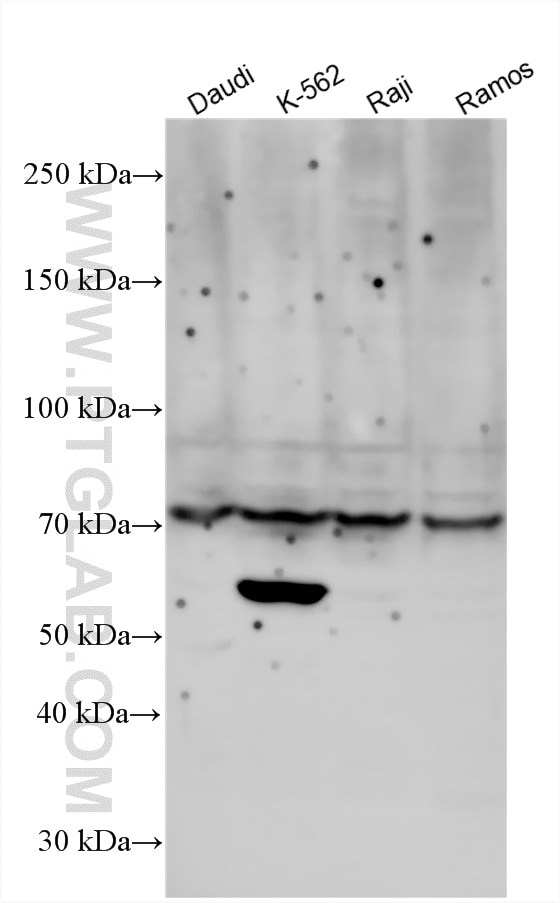
Tested Applications
Recommended dilution
| Application | Dilution |
|---|---|
| It is recommended that this reagent should be titrated in each testing system to obtain optimal results. | |
Product Information
29510-1-PBS targets RASGRP4 in WB, Indirect ELISA applications and shows reactivity with human samples.
| Tested Reactivity | human |
| Host / Isotype | Rabbit / IgG |
| Class | Polyclonal |
| Type | Antibody |
| Immunogen |
CatNo: Ag31219 Product name: Recombinant human RASGRP4 protein Source: e coli.-derived, PGEX-4T Tag: GST Domain: 108-170 aa of BC146669 Sequence: KATGDTQELRRLQICHLVRYWLMRHPEVMHQDPQLEEVIGRFWATVAREGNSAQRRLGDSSDL 相同性解析による交差性が予測される生物種 |
| Full Name | RAS guanyl releasing protein 4 |
| Calculated molecular weight | 673 aa, 75 kDa |
| Observed molecular weight | 54-75 kDa |
| GenBank accession number | BC146669 |
| Gene Symbol | RASGRP4 |
| Gene ID (NCBI) | 115727 |
| RRID | AB_3742316 |
| Conjugate | Unconjugated |
| Form | |
| Form | Liquid |
| Purification Method | Antigen affinity purification |
| UNIPROT ID | Q8TDF6 |
| Storage Buffer | PBS only{{ptg:BufferTemp}}7.3 |
| Storage Conditions | Store at -80°C. |
Background Information
RASGRP4 is a member of the RAS guanine nucleotide-releasing protein (RASGRP) family, which are crucial guanine nucleotide exchange factors (GEFs). The primary function of this family is to act as molecular switches that activate RAS signaling pathways by promoting the exchange of GDP for GTP on small GTPases. Specifically, RASGRP4 is highly and preferentially expressed in mast cells. It plays a vital role in the development, maturation, and functional activation of these immune cells by regulating key signaling cascades, such as the MAPK pathway.