
Validation Data Gallery
Filter:
Tested Applications
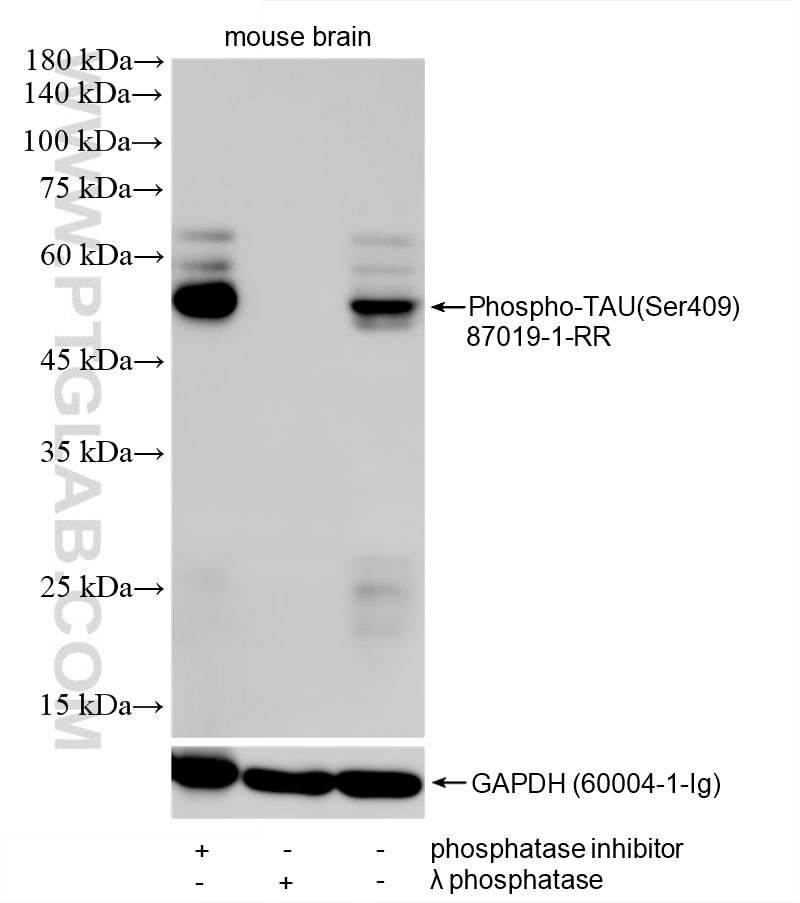
| Positive WB detected in | mouse brain tissue |
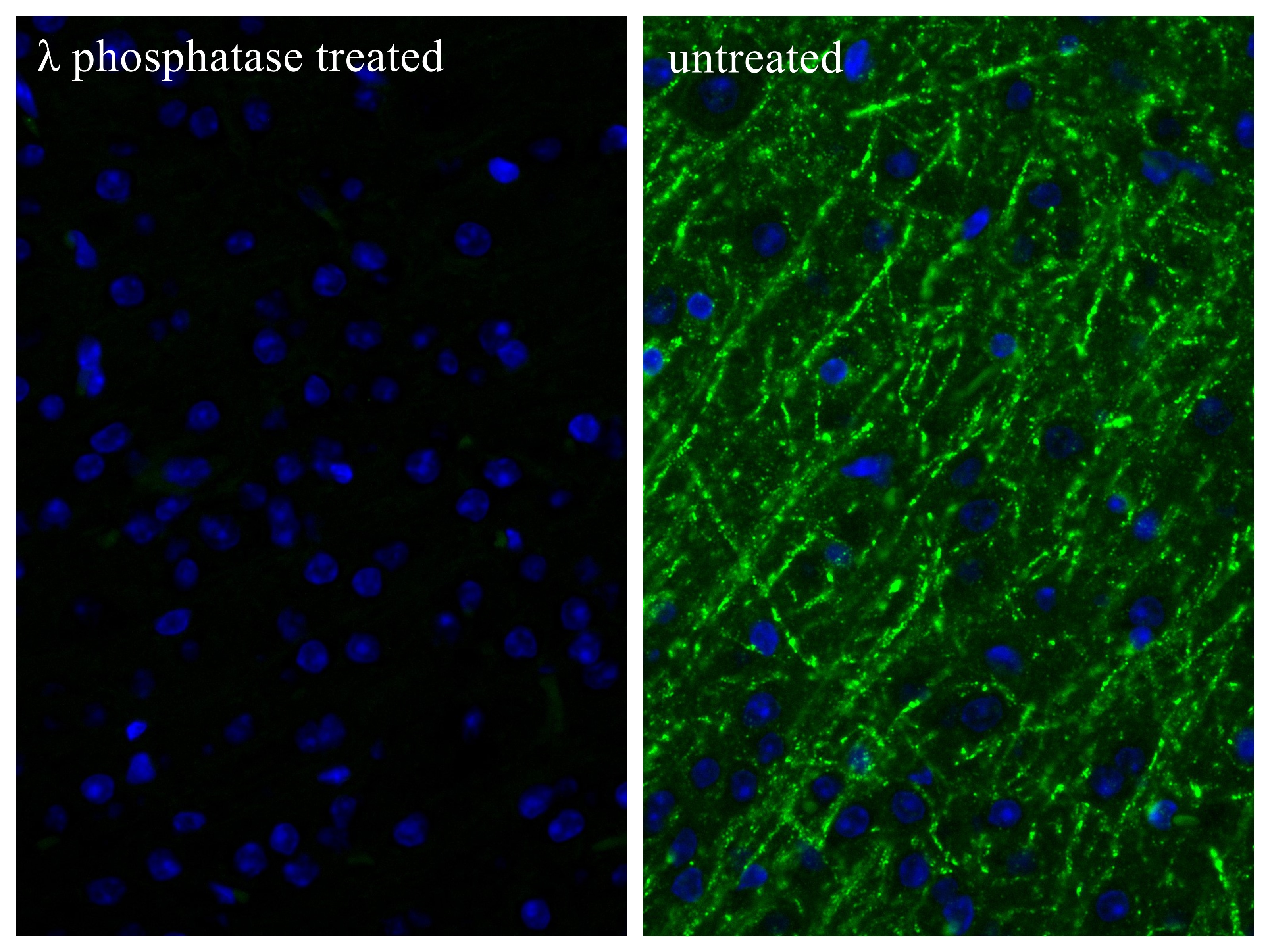
| Positive IF-P detected in | mouse brain tissue |
Recommended dilution
| Application | Dilution |
|---|---|
| Western Blot (WB) | WB : 1:5000-1:50000 |
| Immunofluorescence (IF)-P | IF-P : 1:150-1:600 |
| It is recommended that this reagent should be titrated in each testing system to obtain optimal results. | |
| Sample-dependent, Check data in validation data gallery. | |
Product Information
87019-1-RR targets Phospho-TAU (Ser409) in WB, IF-P, ELISA applications and shows reactivity with human, mouse samples.
| Tested Reactivity | human, mouse |
| Host / Isotype | Rabbit / IgG |
| Class | Recombinant |
| Type | Antibody |
| Immunogen |
Peptide 相同性解析による交差性が予測される生物種 |
| Full Name | microtubule-associated protein tau |
| Calculated molecular weight | 37-46, 79-81 kDa |
| Observed molecular weight | 45-60 kDa |
| GenBank accession number | BC000558 |
| Gene Symbol | TAU |
| Gene ID (NCBI) | 4137 |
| RRID | AB_3745278 |
| Conjugate | Unconjugated |
| Form | |
| Form | Liquid |
| Purification Method | Protein A purification |
| UNIPROT ID | P10636 |
| Storage Buffer | PBS with 0.02% sodium azide and 50% glycerol{{ptg:BufferTemp}}7.3 |
| Storage Conditions | Store at -20°C. Stable for one year after shipment. Aliquoting is unnecessary for -20oC storage. |
Background Information
Phosphorylation of tau at Ser409 is an early, disease-specific event in Alzheimer's brain. Catalyzed by PKA, this modification weakens tau-microtubule binding and acts as a molecular switch that initiates tau self-aggregation into paired helical filaments. Consequently, p-Ser409-tau is recognized as an early diagnostic epitope and a potential target for interrupting PKA-driven, oxidative-stress-linked tau pathology.
Protocols
| Product Specific Protocols | |
|---|---|
| IF protocol for Phospho-TAU (Ser409) antibody 87019-1-RR | Download protocol |
| WB protocol for Phospho-TAU (Ser409) antibody 87019-1-RR | Download protocol |
| Standard Protocols | |
|---|---|
| Click here to view our Standard Protocols |