
Validation Data Gallery
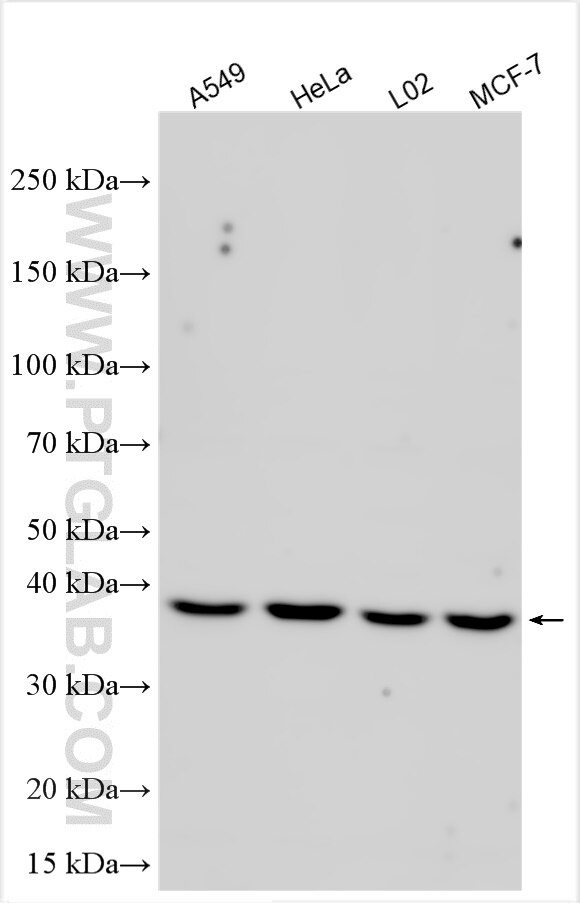
Tested Applications
Recommended dilution
| Application | Dilution |
|---|---|
| It is recommended that this reagent should be titrated in each testing system to obtain optimal results. | |
Product Information
27422-1-PBS targets PRR11 in WB, Indirect ELISA applications and shows reactivity with human samples.
| Tested Reactivity | human |
| Host / Isotype | Rabbit / IgG |
| Class | Polyclonal |
| Type | Antibody |
| Immunogen |
CatNo: Ag26636 Product name: Recombinant human PRR11 protein Source: e coli.-derived, PGEX-4T Tag: GST Domain: 181-360 aa of BC008669 Sequence: ASHFPPPPPPPPLPPPPPPLAPVLLRKPSLAKALQAGPLKKDGPMQITVKDLLTVKLKKTQSLDEKRKLIPSPKARNPLVTVSDLQHVTLKPNSKVLSTRVTNVLITPGKSQMDLRKLLRKVDVERSPGGTPLTNKENMETGTGLTPVMTQALRRKFQLAHPRSPTPTLPLSTSSFDEQN 相同性解析による交差性が予測される生物種 |
| Full Name | proline rich 11 |
| Calculated molecular weight | 360 aa, 40 kDa |
| Observed molecular weight | 38 kDa |
| GenBank accession number | BC008669 |
| Gene Symbol | PRR11 |
| Gene ID (NCBI) | 55771 |
| RRID | AB_3669600 |
| Conjugate | Unconjugated |
| Form | |
| Form | Liquid |
| Purification Method | Antigen affinity purification |
| UNIPROT ID | Q96HE9 |
| Storage Buffer | PBS only{{ptg:BufferTemp}}7.3 |
| Storage Conditions | Store at -80°C. |
Background Information
PRR11, or Proline-rich protein 11, is a protein-coding gene situated on chromosome 17q22-23, which plays a significant role in various cellular processes. The protein itself is composed of a nuclear localization signal (NLS), two proline-rich regions (PRs), and a zinc finger domain (ZFD) (PMID: 36551227). PRR11 has been implicated in the regulation of cell cycle, and it is involved in multiple aspects of cancer biology, including proliferation, migration, invasion, cell-cycle progression, apoptosis, autophagy, and chemotherapy resistance. It serves as a prognostic indicator in certain human cancers and is considered a potential target for therapeutic interventions (PMID: 36739300).