
Validation Data Gallery
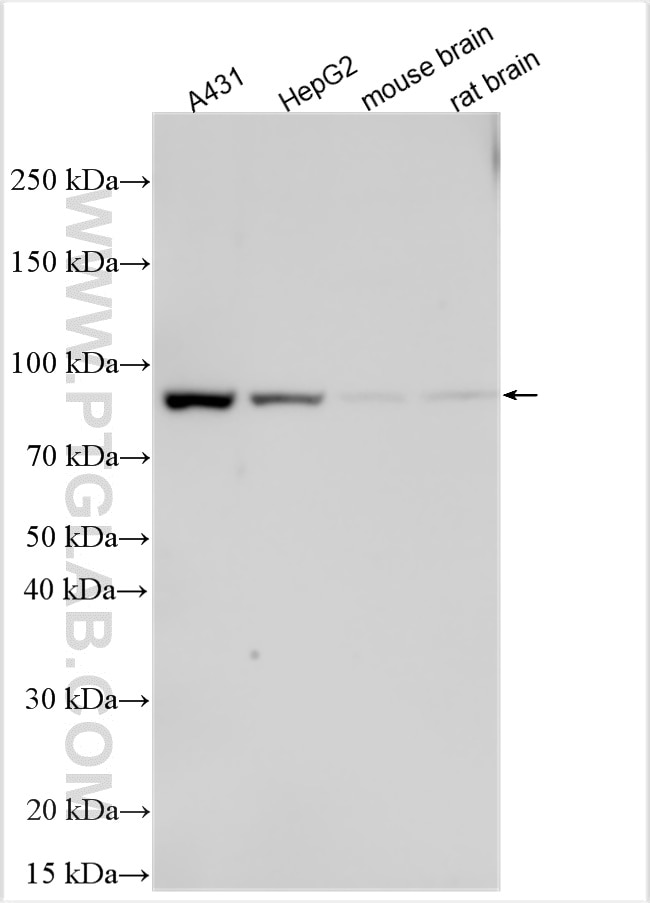
Tested Applications
Recommended dilution
| Application | Dilution |
|---|---|
| It is recommended that this reagent should be titrated in each testing system to obtain optimal results. | |
Product Information
23823-1-PBS targets CNGA2 in WB, Indirect ELISA applications and shows reactivity with human, mouse, rat samples.
| Tested Reactivity | human, mouse, rat |
| Host / Isotype | Rabbit / IgG |
| Class | Polyclonal |
| Type | Antibody |
| Immunogen |
CatNo: Ag19899 Product name: Recombinant human CNGA2 protein Source: e coli.-derived, PGEX-4T Tag: GST Domain: 575-664 aa of BC126302 Sequence: REILMKEGLLDENEVATSMEVDVQEKLGQLETNMETLYTRFGRLLAEYTGAQQKLKQRITVLETKMKQNNEDDYLSDGMNSPELAAADEP 相同性解析による交差性が予測される生物種 |
| Full Name | cyclic nucleotide gated channel alpha 2 |
| Calculated molecular weight | 664 aa, 76 kDa |
| Observed molecular weight | 80 kDa |
| GenBank accession number | BC126302 |
| Gene Symbol | CNGA2 |
| Gene ID (NCBI) | 1260 |
| RRID | AB_3742092 |
| Conjugate | Unconjugated |
| Form | |
| Form | Liquid |
| Purification Method | Antigen Affinity purified |
| UNIPROT ID | Q16280 |
| Storage Buffer | PBS only{{ptg:BufferTemp}}7.3 |
| Storage Conditions | Store at -80°C. |
Background Information
Cyclic nucleotide-gated (CNG) channels are crucial for visual and olfactory transductions (PMID: 12432397). Native CNG channels are heterotetramers composed of homologous A and B subunits. The olfactory CNG channels are composed of two CNGA2 subunits, one CNGA4 and one CNGB1b subunit, each containing a cyclic nucleotide-binding domain (PMID: 22786723). CNGA2, also named as CNCA, CNCA1 and CNCG2, is the primary subunit of the olfactory CNG channel. Odorant signal transduction is probably mediated by a G-protein coupled cascade using cAMP as second messenger. Activation of olfactory channel by cyclic nucleotides leads to a depolarization of olfactory sensory neurons.