
Validation Data Gallery
Filter:
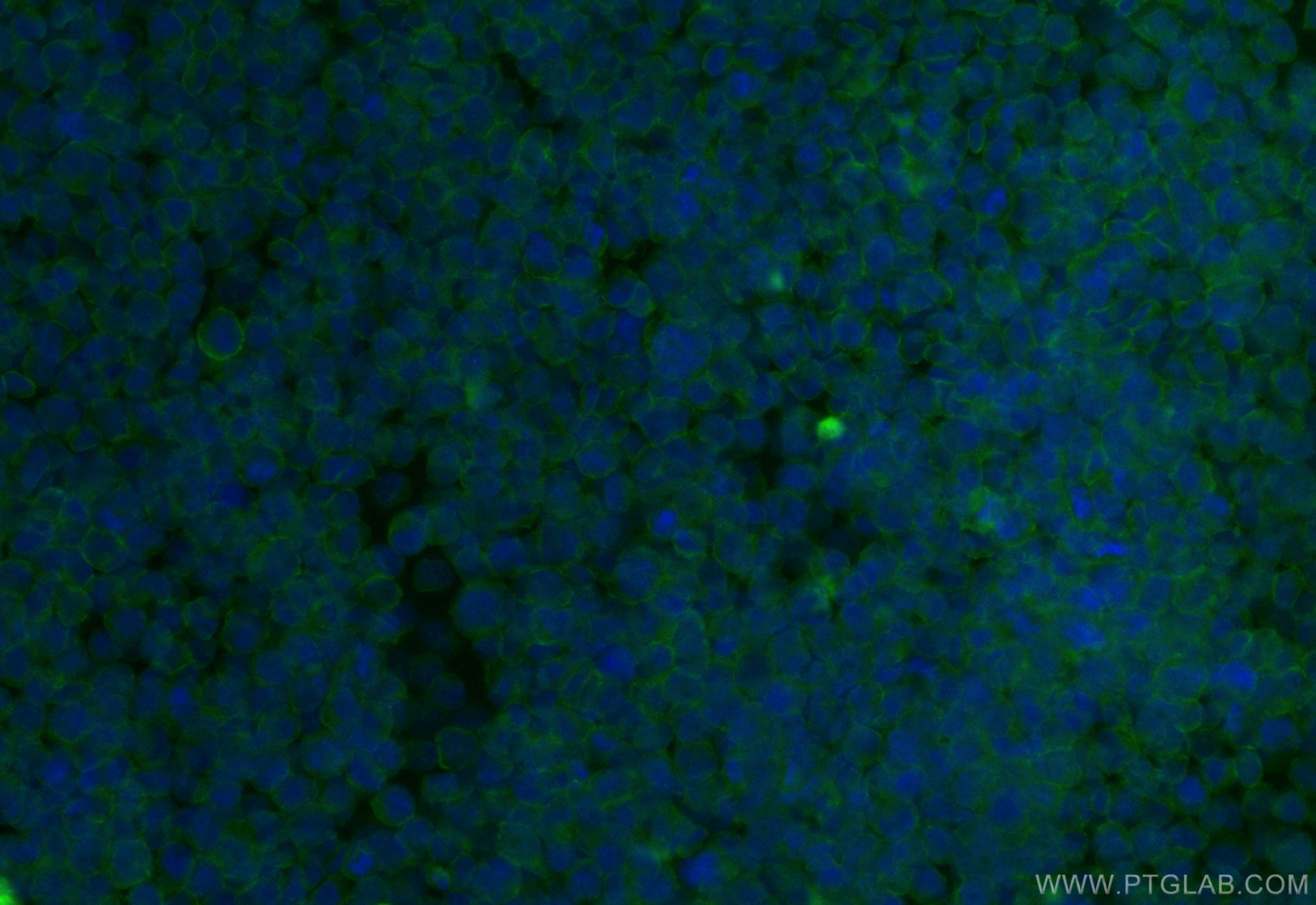
Tested Applications
| Positive IF/ICC detected in | raji cells |
Recommended dilution
| Application | Dilution |
|---|---|
| Immunofluorescence (IF)/ICC | IF/ICC : 1:50-1:500 |
| It is recommended that this reagent should be titrated in each testing system to obtain optimal results. | |
| Sample-dependent, Check data in validation data gallery. | |
Product Information
CL488-84245-2 targets CD84 in IF/ICC applications and shows reactivity with human samples.
| Tested Reactivity | human |
| Host / Isotype | Rabbit / IgG |
| Class | Recombinant |
| Type | Antibody |
| Immunogen |
Recombinant Protein 相同性解析による交差性が予測される生物種 |
| Full Name | CD84 molecule |
| Calculated molecular weight | 345 aa, 39 kDa |
| Observed molecular weight | 70 kDa |
| GenBank accession number | BC020063 |
| Gene Symbol | CD84 |
| Gene ID (NCBI) | 8832 |
| RRID | AB_3747514 |
| Conjugate | CoraLite® Plus 488 Fluorescent Dye |
| Excitation/Emission maxima wavelengths | 493 nm / 522 nm |
| 激发激光 | Blue laser (488 nm) |
| Form | |
| Form | Liquid |
| Purification Method | Protein A purification |
| UNIPROT ID | Q9UIB8 |
| Storage Buffer | PBS with 50% glycerol, 0.05% Proclin300, 0.5% BSA{{ptg:BufferTemp}}7.3 |
| Storage Conditions | Store at -20°C. Avoid exposure to light. Stable for one year after shipment. Aliquoting is unnecessary for -20oC storage. |
Background Information
CD84, also known as SLAMF5, is a member of the CD2 subfamily of the immunoglobulin receptor superfamily (PMID: 9310491). CD84 is a single-chain type-I glycoprotein composed of two extracellular Ig-like domains, a hydrophobic transmembrane region, and a cytoplasmic domain. It is broadly expressed on almost all leukocyte subsets. CD84 functions as a homophilic adhesion molecule, whose signaling can activate or inhibit leukocyte function depending on the cell type and its stage of activation or differentiation (PMID: 30522694).
Protocols
| Product Specific Protocols | |
|---|---|
| IF protocol for CL Plus 488 CD84 antibody CL488-84245-2 | Download protocol |
| Standard Protocols | |
|---|---|
| Click here to view our Standard Protocols |