
Validation Data Gallery
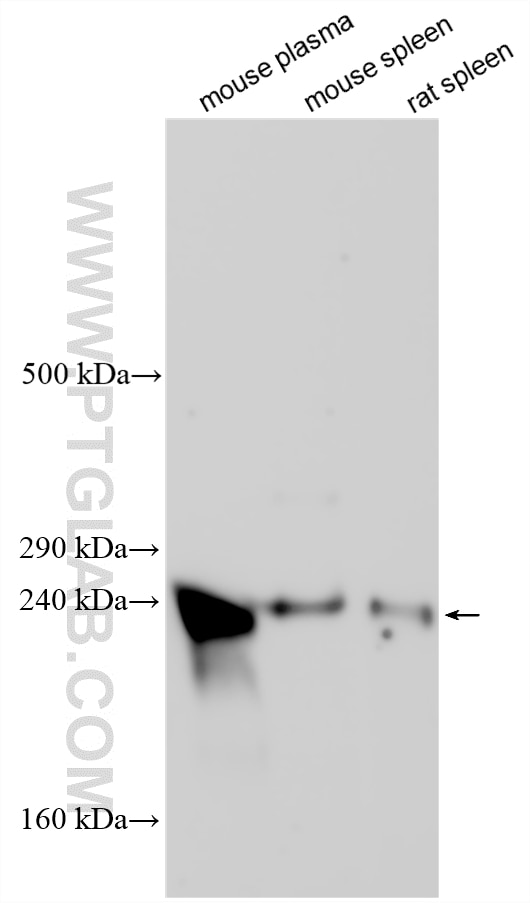
Tested Applications
| Positive WB detected in | mouse plasma, mouse spleen tissue, rat spleen tissue |
Recommended dilution
| Application | Dilution |
|---|---|
| Western Blot (WB) | WB : 1:500-1:2000 |
| It is recommended that this reagent should be titrated in each testing system to obtain optimal results. | |
| Sample-dependent, Check data in validation data gallery. | |
Product Information
34278-1-AP targets VWF in WB, ELISA applications and shows reactivity with mouse, rat samples.
| Tested Reactivity | mouse, rat |
| Host / Isotype | Rabbit / IgG |
| Class | Polyclonal |
| Type | Antibody |
| Immunogen |
CatNo: Ag41963 Product name: Recombinant mouse VWF protein Source: e coli.-derived, PGEX-4T Tag: GST Domain: 1261-1468 aa of NM_011708 Sequence: DTPEPPLHNFYCSKLLDLVFLLDGSSMLSEAEFEVLKAFVVGMMERLHISQKRIRVAVVEYHDGSRAYLELKARKRPSELRRITSQIKYTGSQVASTSEVLKYTLFQIFGKIDRPEASHITLLLTASQEPPRMARNLVRYVQGLKKKKVIVIPVGIGPHASLKQIRLIEKQAPENKAFLLSGVDELEQRRDEIVSYLCDLAPEAPAPT 相同性解析による交差性が予測される生物種 |
| Full Name | Von Willebrand factor homolog |
| Calculated molecular weight | 309 kDa |
| Observed molecular weight | 220-250 kDa |
| GenBank accession number | NM_011708 |
| Gene Symbol | Vwf |
| Gene ID (NCBI) | 22371 |
| RRID | AB_3743184 |
| Conjugate | Unconjugated |
| Form | |
| Form | Liquid |
| Purification Method | Antigen affinity Purification |
| UNIPROT ID | Q8CIZ8 |
| Storage Buffer | PBS with 0.02% sodium azide and 50% glycerol{{ptg:BufferTemp}}7.3 |
| Storage Conditions | Store at -20°C. Stable for one year after shipment. Aliquoting is unnecessary for -20oC storage. |
Background Information
Von Willebrand factor (VWF) is a large multimeric glycoprotein found in blood plasma involved in hemostasis following vascular injury.
What is the molecular weight of VWF?
Due to the multimeric nature of VWF, it can range in size from 500 to 20,000 kDa due to the differences in the number of subunits comprising the protein. Each subunit is approximately 250 kDa (PMID: 9759493).
What is the tissue specificity of VWF?
The biosynthesis of VWF in vivo is limited to endothelial cells (PMID: 4209883) and megakaryocytes (PMID: 2413071). VWF synthesized in endothelial cells is either released directly into the plasma via a secretory pathway, or tubulized and stored in organelles unique to this cell type called Weibel-Palade bodies (PMID: 16459301). Whereas VWF synthesized in megakaryocytes is stored in the alpha granules of platelets (PMID: 2046403).
What is the function of VWF?
The primary function of VWF is as an adhesive plasma glycoprotein, particularly factor VIII; an essential blood-clotting protein (PMID: 6982084). VWF is also important in platelet adhesion to wound sites by binding specifically to type I and type III collagen (PMID: 11098050), with larger VWF multimers being most effective (PMID: 24448155).
What is the importance of post-translational modifications (PTMs) on VWF function?
During the synthesis of VWF, it must undergo extensive PTMs. The VWF monomers are subsequently N-glycosylated with the addition of a 12 N-linked high-mannose-containing oligosaccharide after the cleavage of the signal peptide in the endoplasmic reticulum. Dimerization of the pro-VWF follows glycosylation via carboxyl-termini disulphide bond formation. In the Golgi apparatus, the oligosaccharide chains are further modified into complex carbohydrates and multimerization of pro-VWF dimers occurs after another round of disulphide bond formation at the amino-termini end of the subunits (PMID: 6334089).
Protocols
| Product Specific Protocols | |
|---|---|
| WB protocol for VWF antibody 34278-1-AP | Download protocol |
| Standard Protocols | |
|---|---|
| Click here to view our Standard Protocols |