
Validation Data Gallery
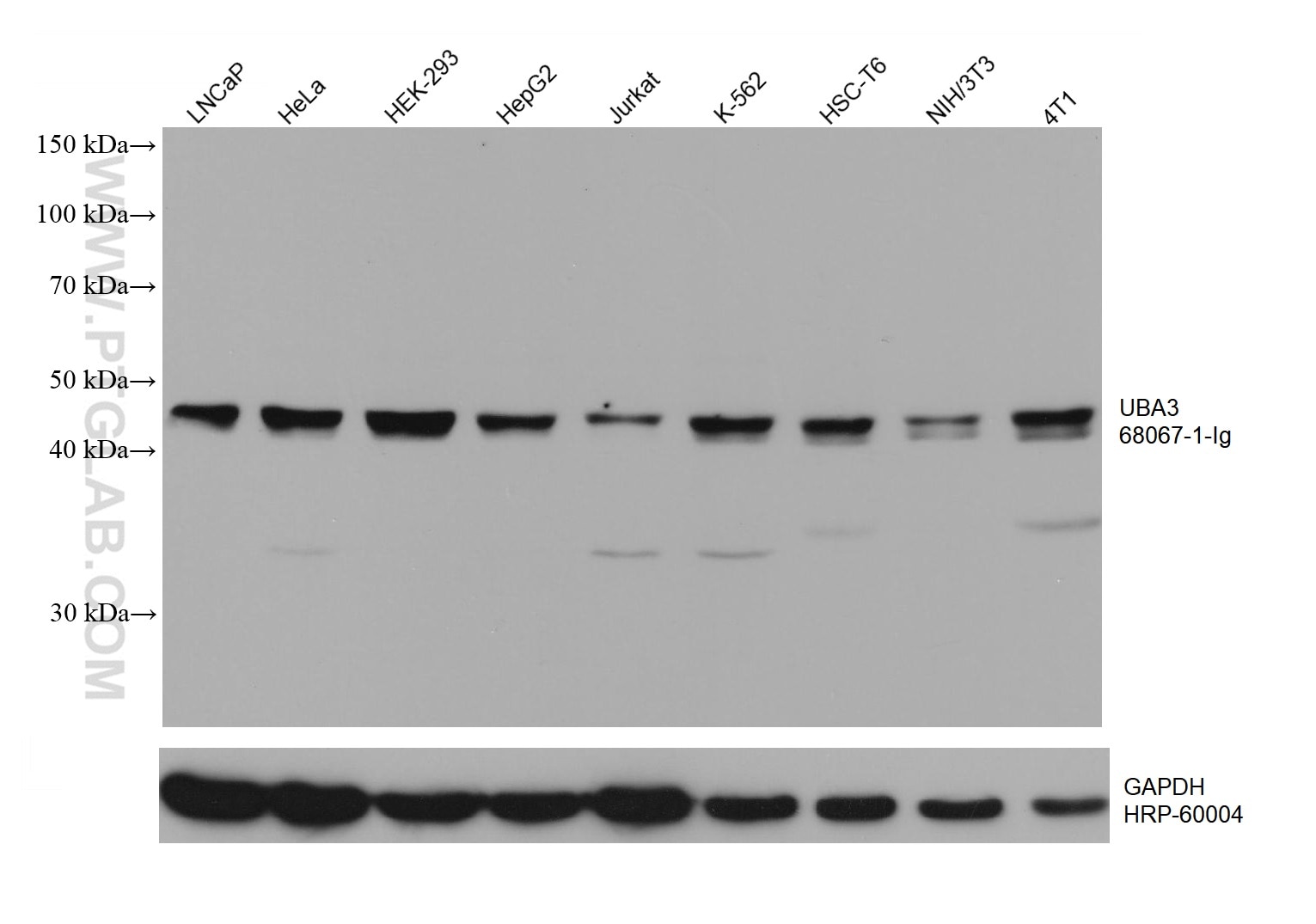
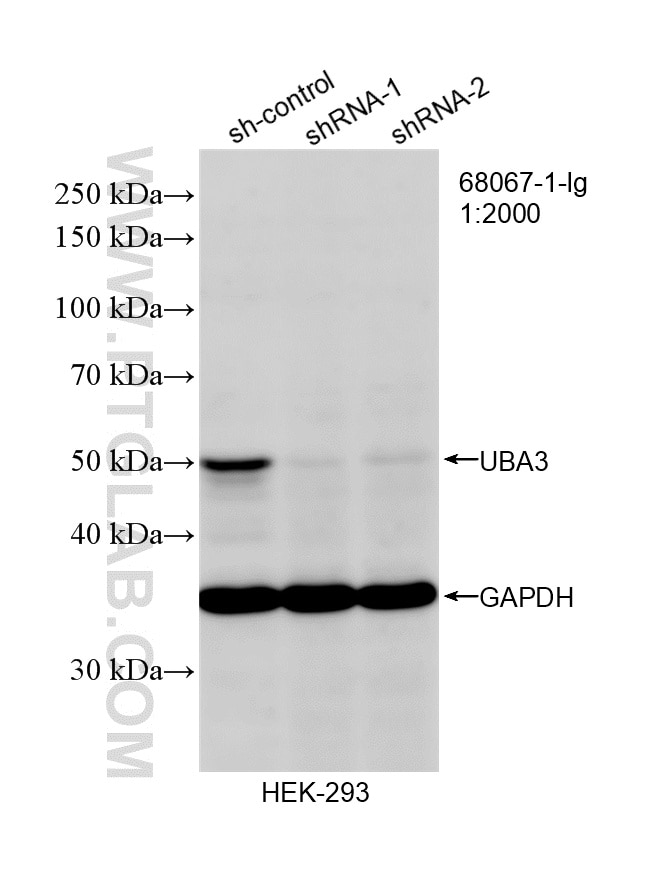
Tested Applications
Recommended dilution
| Application | Dilution |
|---|---|
| It is recommended that this reagent should be titrated in each testing system to obtain optimal results. | |
Product Information
68067-1-PBS targets UBA3 in WB, Indirect ELISA applications and shows reactivity with human, mouse, rat samples.
| Tested Reactivity | human, mouse, rat |
| Host / Isotype | Mouse / IgG1 |
| Class | Monoclonal |
| Type | Antibody |
| Immunogen |
CatNo: Ag31051 Product name: Recombinant human UBA3 protein Source: e coli.-derived, PET28a Tag: 6*His Domain: 1-300 aa of BC022853 Sequence: MADGEEPERKRRRIEELLAEKMAVDGGCGDTGDWEGRWNHVKKFLERSGPFTHPDFEPSTESLQFLLDTCKVLVIGAGGLGCELLKNLALSGFRQIHVIDMDTIDVSNLNRQFLFRPKDIGRPKAEVAAEFLNDRVPNCNVVPHFNKIQDFNDTFYRQFHIIVCGLDSIIARRWINGMLISLLNYEDGVLDPSSIVPLIDGGTEGFKGNARVILPGMTACIECTLELYPPQVNFPMCTIASMPRLPEHCIEYVRMLQWPKEQPFGEGVPLDGDDPEHIQWIFQKSLERASQYNIRGVTYR 相同性解析による交差性が予測される生物種 |
| Full Name | ubiquitin-like modifier activating enzyme 3 |
| Calculated molecular weight | 463 aa, 52 kDa |
| Observed molecular weight | 49 kDa |
| GenBank accession number | BC022853 |
| Gene Symbol | UBA3 |
| Gene ID (NCBI) | 9039 |
| RRID | AB_2918808 |
| Conjugate | Unconjugated |
| Form | |
| Form | Liquid |
| Purification Method | Protein G purification |
| UNIPROT ID | Q8TBC4 |
| Storage Buffer | PBS only{{ptg:BufferTemp}}7.3 |
| Storage Conditions | Store at -80°C. |
Background Information
The modification of proteins with ubiquitin is an important cellular mechanism for targeting abnormal or short-lived proteins for degradation. Ubiquitination involves at least three classes of enzymes: ubiquitin-activating enzymes, or E1s, ubiquitin-conjugating enzymes, or E2s, and ubiquitin-protein ligases, or E3s. This gene encodes a member of the E1 ubiquitin-activating enzyme family. The encoded enzyme associates with AppBp1, an amyloid beta precursor protein binding protein, to form a heterodimer, and then the enzyme complex activates NEDD8, a ubiquitin-like protein, which regulates cell division, signaling and embryogenesis. Multiple alternatively spliced transcript variants encoding distinct isoforms have been found for this gene.