
Validation Data Gallery
Filter:


Tested Applications
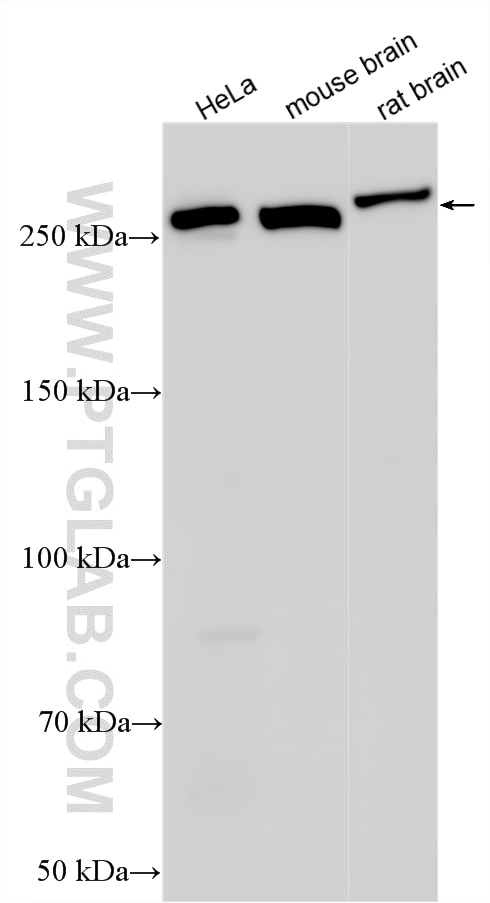
| Positive WB detected in | HeLa cells, mouse kidney tissue, mouse lung tissue, mouse brain tissue, rat brain tissue |
| Positive IP detected in | HEK-293 cells |
| Positive IHC detected in | human liver cancer tissue, human lung tissue, human kidney tissue, human pancreas cancer tissue, human normal colon Note: suggested antigen retrieval with TE buffer pH 9.0; (*) Alternatively, antigen retrieval may be performed with citrate buffer pH 6.0 |
Recommended dilution
| Application | Dilution |
|---|---|
| Western Blot (WB) | WB : 1:1000-1:4000 |
| Immunoprecipitation (IP) | IP : 0.5-4.0 ug for 1.0-3.0 mg of total protein lysate |
| Immunohistochemistry (IHC) | IHC : 1:50-1:500 |
| It is recommended that this reagent should be titrated in each testing system to obtain optimal results. | |
| Sample-dependent, Check data in validation data gallery. | |
Published Applications
| WB | See 6 publications below |
| IHC | See 2 publications below |
| IF | See 3 publications below |
| IP | See 1 publications below |
| CoIP | See 1 publications below |
Product Information
19722-1-AP targets SPTBN1-Specific in WB, IHC, IF, IP, CoIP, ELISA applications and shows reactivity with human, mouse, rat samples.
| Tested Reactivity | human, mouse, rat |
| Cited Reactivity | human, mouse |
| Host / Isotype | Rabbit / IgG |
| Class | Polyclonal |
| Type | Antibody |
| Immunogen |
Peptide 相同性解析による交差性が予測される生物種 |
| Full Name | spectrin, beta, non-erythrocytic 1 |
| Calculated molecular weight | 275 kDa |
| Observed molecular weight | 275 kDa |
| GenBank accession number | NM_003128 |
| Gene Symbol | SPTBN1 |
| Gene ID (NCBI) | 6711 |
| RRID | AB_10638469 |
| Conjugate | Unconjugated |
| Form | |
| Form | Liquid |
| Purification Method | Antigen affinity purification |
| UNIPROT ID | Q01082 |
| Storage Buffer | PBS with 0.02% sodium azide and 50% glycerol{{ptg:BufferTemp}}7.3 |
| Storage Conditions | Store at -20°C. Stable for one year after shipment. Aliquoting is unnecessary for -20oC storage. |
Background Information
SPTBN1 is the non-erythrocytic form of β-spectrin or β-fodrin. Spectrins are members of the superfamily of F-actin cross linking proteins that are important as scaffolding proteins for protein sorting, cell adhesion, and migration. Reduced expression of SPTBN1 has been found to correlate with shorter survival of patients with hepatocellular cancer, pancreatic cancer and other malignancies of the gastrointestinal tract, suggesting tumor suppression ability of this protein.
Protocols
| Product Specific Protocols | |
|---|---|
| IHC protocol for SPTBN1-Specific antibody 19722-1-AP | Download protocol |
| IP protocol for SPTBN1-Specific antibody 19722-1-AP | Download protocol |
| WB protocol for SPTBN1-Specific antibody 19722-1-AP | Download protocol |
| Standard Protocols | |
|---|---|
| Click here to view our Standard Protocols |
Publications
| Species | Application | Title |
|---|---|---|
Neuron Species-specific FMRP regulation of RACK1 is critical for prenatal cortical development | ||
Theranostics Promotion of Cx26 mutants located in TM4 region for membrane translocation successfully rescued hearing loss | ||
Adv Sci (Weinh) The E3 Ligase RNF115 Aggravates Pathological Cardiac Hypertrophy via Ubiquitin-Mediated Degradation of SPTBN1. | ||
Arterioscler Thromb Vasc Biol Valvular Leaflets Are Not Innocent Bystanders: Divergent Fibrotic Remodeling Accompanies Functional Mitral and Tricuspid Regurgitation | ||
Anal Chem Ionic Liquid-Based Extraction System for In-Depth Analysis of Membrane Protein Complexes. |