
Validation Data Gallery
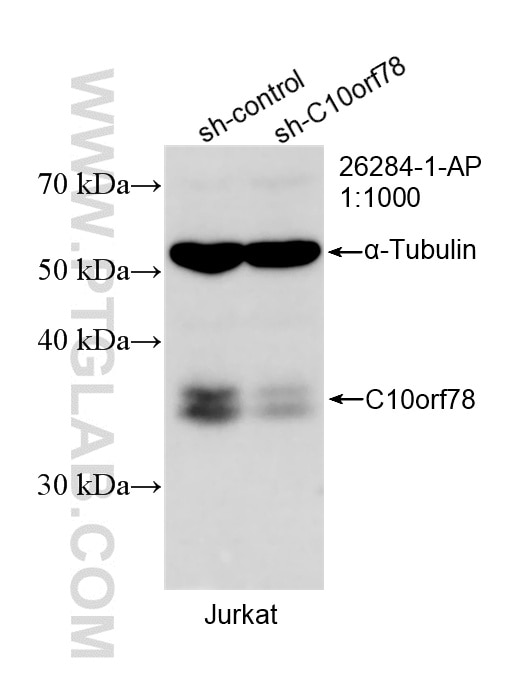
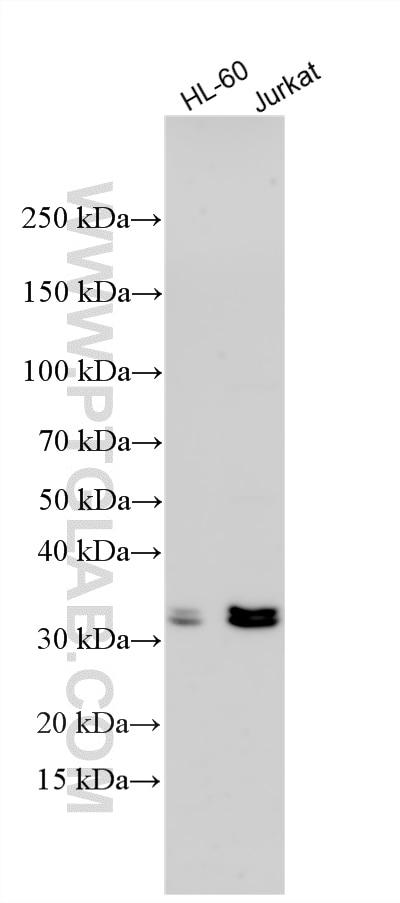
Tested Applications
| Positive WB detected in | HL-60 cells, Jurkat cells |
Recommended dilution
| Application | Dilution |
|---|---|
| Western Blot (WB) | WB : 1:1000-1:4000 |
| It is recommended that this reagent should be titrated in each testing system to obtain optimal results. | |
| Sample-dependent, Check data in validation data gallery. | |
Product Information
26284-1-AP targets SFR1 in WB, ELISA applications and shows reactivity with human samples.
| Tested Reactivity | human |
| Host / Isotype | Rabbit / IgG |
| Class | Polyclonal |
| Type | Antibody |
| Immunogen |
CatNo: Ag23332 Product name: Recombinant human C10orf78 protein Source: e coli.-derived, PET28a Tag: 6*His Domain: 1-232 aa of BC140835 Sequence: MESPSDSAVVLPSTPQASANPSSPYTNSSRKQPMSATLRERLRKTRFSFNSSYNVVKRLKVESEENDQTFSEKPASSTEENCLEFQESFKHIDSEFEENTNLKNTLKNLNVCESQSLDSGSCSALQNEFVSEKLPKQRLNAEKAKLVKQVQEKEDLLRRLKLVKMYRSKNDLSQLQLLIKKWRSCSQLLLYELQSAVSEENKKLSLTQLIDHYGLDDKLLHYNRSEEEFIDV 相同性解析による交差性が予測される生物種 |
| Full Name | chromosome 10 open reading frame 78 |
| Observed molecular weight | 35, 36 kDa |
| GenBank accession number | BC140835 |
| Gene Symbol | C10orf78 |
| Gene ID (NCBI) | 119392 |
| RRID | AB_3742177 |
| Conjugate | Unconjugated |
| Form | |
| Form | Liquid |
| Purification Method | Antigen affinity purification |
| UNIPROT ID | Q86XK3 |
| Storage Buffer | PBS with 0.02% sodium azide and 50% glycerol{{ptg:BufferTemp}}7.3 |
| Storage Conditions | Store at -20°C. Stable for one year after shipment. Aliquoting is unnecessary for -20oC storage. |
Background Information
The SFR1 protein was initially discovered in the context of DNA homologous recombination repair, and its name originates from "Swi6-interacting recombination repair protein 1." However, subsequent research has revealed its central role in the field of cell death, particularly in the process of **necroptosis**. In the classical necroptosis signaling pathway, when cells receive death signals such as tumor necrosis factor, SFR1 is recruited and phosphorylated by the upstream kinase RIPK3 as a key adaptor protein. Phosphorylated SFR1 specifically binds to and stabilizes MLKL, the core executioner protein of necroptosis, significantly promoting the phosphorylation and subsequent activation of MLKL by RIPK3. This process ultimately leads to plasma membrane rupture and inflammatory cell death. Therefore, SFR1 is considered a critical molecule that precisely regulates the amplification and execution of necroptosis signaling. The study of its function is of great importance for understanding pathological processes such as infections, inflammatory diseases, and tissue damage.
Protocols
| Product Specific Protocols | |
|---|---|
| WB protocol for SFR1 antibody 26284-1-AP | Download protocol |
| Standard Protocols | |
|---|---|
| Click here to view our Standard Protocols |