
Validation Data Gallery
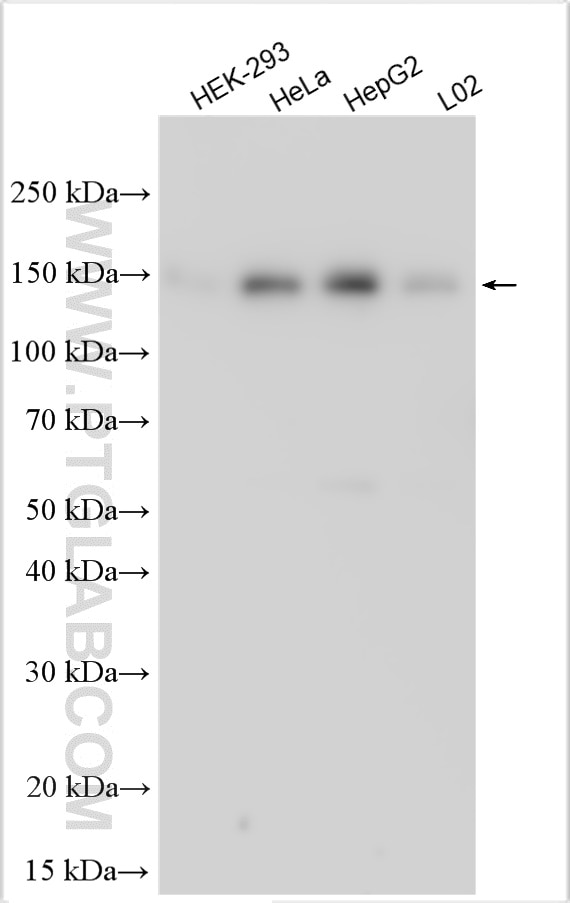
Tested Applications
| Positive WB detected in | HEK-293 cells, HeLa cells, HepG2 cells, L02 cells |
Recommended dilution
| Application | Dilution |
|---|---|
| Western Blot (WB) | WB : 1:2000-1:10000 |
| It is recommended that this reagent should be titrated in each testing system to obtain optimal results. | |
| Sample-dependent, Check data in validation data gallery. | |
Product Information
32225-1-AP targets SEC24B in WB, ELISA applications and shows reactivity with human samples.
| Tested Reactivity | human |
| Host / Isotype | Rabbit / IgG |
| Class | Polyclonal |
| Type | Antibody |
| Immunogen |
CatNo: Ag36544 Product name: Recombinant human SEC24B protein Source: e coli.-derived, PET28a Tag: 6*His Domain: 100-250 aa of NM_006323.4 Sequence: QNVTPNTVNQQPGAQQLYSRGPPAPHIVGSTLGSFQGAASSASHLHTSASQPYSSFVNHYNSPAMYSASSSVASQGFPSTCGHYAMSTVSNAAYPSVSYPSLPAGDTYGQMFTSQNAPTVRPVKDNSFSGQNTAISHPSPLPPLPSQQHHQ 相同性解析による交差性が予測される生物種 |
| Full Name | SEC24 family, member B (S. cerevisiae) |
| Calculated molecular weight | 137kDa,1268aa |
| Observed molecular weight | 140 kDa |
| GenBank accession number | NM_006323.4 |
| Gene Symbol | SEC24B |
| Gene ID (NCBI) | 10427 |
| RRID | AB_3742547 |
| Conjugate | Unconjugated |
| Form | |
| Form | Liquid |
| Purification Method | Antigen affinity Purification |
| UNIPROT ID | O95487 |
| Storage Buffer | PBS with 0.02% sodium azide and 50% glycerol{{ptg:BufferTemp}}7.3 |
| Storage Conditions | Store at -20°C. Stable for one year after shipment. Aliquoting is unnecessary for -20oC storage. |
Background Information
SEC24B is a gene that encodes a protein belonging to the SEC23/SEC24 family, which is involved in vesicle trafficking. The protein is thought to be a cargo-binding component of the COPII vesicle and is involved in the transport of secretory proteins from the endoplasmic reticulum to the Golgi apparatus.
Protocols
| Product Specific Protocols | |
|---|---|
| WB protocol for SEC24B antibody 32225-1-AP | Download protocol |
| Standard Protocols | |
|---|---|
| Click here to view our Standard Protocols |