
Rat TNF-alpha ELISA Kit
Cat no : KE20001
Synonyms
Tnf,TNF-alpha,Cachectin,TNF alpha,TNF alpha,TNF-a,
Validation Data Gallery
Product Information
KE20001 is a solid phase sandwich Enzyme Linked-Immuno-Sorbent Assay (Sandwich ELISA). The TNF-α ELISA kit is to be used to detect and quantify protein levels of endogenous TNF-α. The assay recognizes rat TNF-α. An antibody specific for TNF-α has been pre-coated onto the microwells. The TNF-α protein in samples is captured by the coated antibody after incubation. Following extensive washing, another antibody of biotinylated specific for TNF-α is added to detect the captured TNF-α protein. For signal development, Streptavidin-HRP is added, followed by Tetramethyl-benzidine (TMB) reagent. Solution containing sulfuric acid is used to stop color development and the color intensity which is proportional to the quantity of bound protein is measurable at 450 nm with the correction wavelength set at 630 nm.
| Product name | Rat TNF-alpha ELISA Kit |
| Tests | 1 X 96 well plate |
| Sample type | Cell culture supernatants |
| Assay type | Sandwich |
| Sensitivity | 7.7 pg/mL |
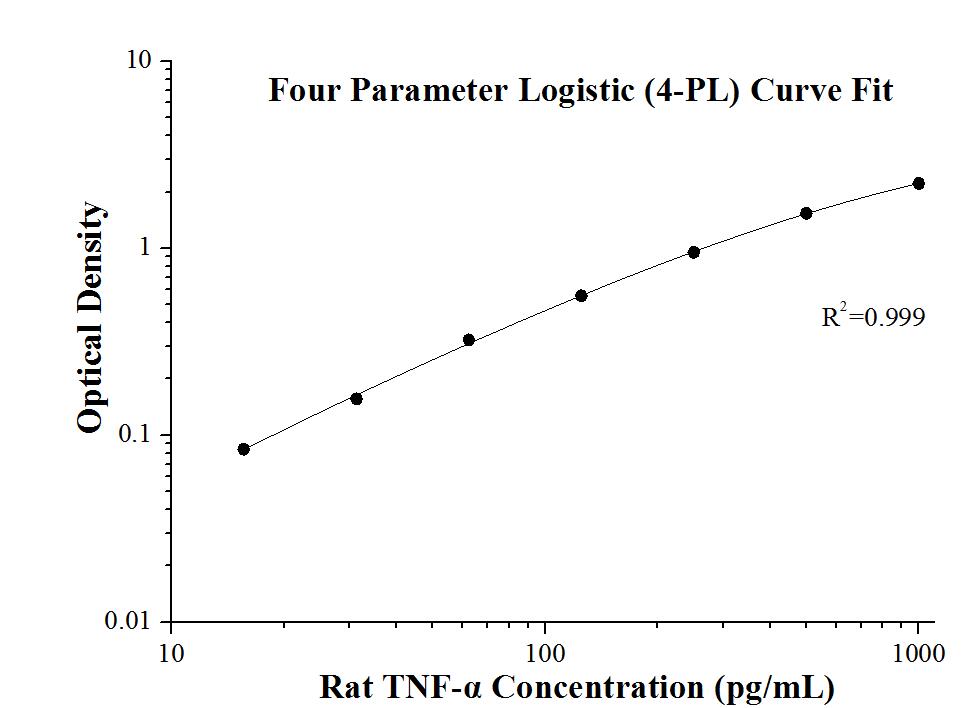
| Range | 15.6-1000 pg/mL |
| Reactivity | Rat |
| Tested applications | Sandwich ELISA |
| Gene ID (NCBI) | 24835 |
Recovery
| Sample Type | Average | Range |
|---|---|---|
| Cell culture supernatants | 84% | 71%-94% |
IntraAssay
| Sample | n | mean ( pg/mL) | SD | CV% |
|---|---|---|---|---|
| 1 | 20 | 288.8 | 17.9 | 6.2 |
| 2 | 20 | 598.9 | 40.2 | 6.7 |
| 3 | 20 | 1,088.1 | 79.8 | 7.3 |
InterAssay
| Sample | n | mean ( pg/mL) | SD | CV% |
|---|---|---|---|---|
| 1 | 24 | 238.2 | 16.9 | 7.1 |
| 2 | 24 | 374.0 | 34.2 | 9.2 |
| 3 | 24 | 716.9 | 37.2 | 5.2 |
Background Information
TNF, as also known as TNF-alpha, or cachectin, is a multifunctional proinflammatory cytokine that belongs to the tumor necrosis factor (TNF) superfamily. It is expressed as a 26 kDa membrane bound protein and is then cleaved by TNF-alpha converting enzyme (TACE) to release the soluble 17 kDa monomer, which forms homotrimers in circulation. It is produced chiefly by activated macrophages, although it can be produced by many other cell types such as CD4+ lymphocytes, NK cells, neutrophils, mast cells, eosinophils, and neurons. It can bind to, and thus functions through its receptors TNFRSF1A/TNFR1 and TNFRSF1B/TNFBR. This cytokine is involved in the regulation of a wide spectrum of biological processes including cell proliferation, differentiation, apoptosis, lipid metabolism, and coagulation. rat and human TNF-alpha share 79% amino acid sequence identity. Unlike human TNF-alpha, the rat form is glycosylated. In rat deficiency of this gene is associated with defects in response to bacterial infection, with defects in forming organized follicular dendritic cell networks and germinal centers, and with a lack of primary B cell follicles.
Properties
| Storage Instructions | All the reagents are stored at 2-8℃ for 6 months or -20℃ for 12 months. Refer to the protocol for further storage instructions. |
| Synonyms | Tnf,TNF-alpha,Cachectin,TNF alpha,TNF alpha,TNF-a, |
Publications
| Species | Sample Type | Title |
|---|---|---|
Nat Commun Adoptive cell transfer of piezo-activated macrophage rescues immunosuppressed rodents from life-threating bacterial infections | ||
Nat Commun Cordycepin prevents radiation ulcer by inhibiting cell senescence via NRF2 and AMPK in rodents. | ||
Adv Sci (Weinh) H2 S-Releasing Versatile Montmorillonite Nanoformulation Trilogically Renovates the Gut Microenvironment for Inflammatory Bowel Disease Modulation | ||
Sci Adv An injectable and adaptable hydrogen sulfide delivery system for modulating neuroregenerative microenvironment | ||
Pharmacol Res Paeoniflorin protects against intestinal ischemia/reperfusion by activating LKB1/AMPK and promoting autophagy. | ||
Phytomedicine Sedum sarmentosum Bunge extract alleviates inflammation and kidney injury via inhibition of M1-macrophage polarization. |