
Recombinant Rat IL-17A protein (rFc Tag)
Species
Rat
Purity
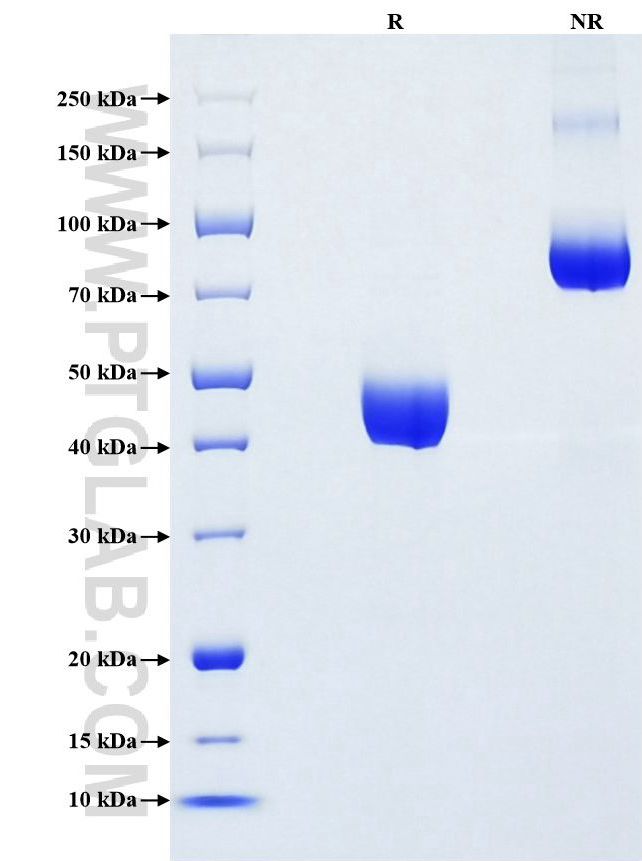
>90 %, SDS-PAGE
Tag
rFc Tag
Activity
not tested
Cat no : Eg3339
Validation Data Gallery
Product Information
| Purity | >90 %, SDS-PAGE |
| Endotoxin | <0.1 EU/μg protein, LAL method |
| Activity |
Not tested |
| Expression | HEK293-derived Rat IL-17A protein Ala18-Ser150 (Accession# Q61453) with a rabbit IgG Fc tag at the C-terminus. |
| GeneID | 301289 |
| Accession | Q61453 |
| PredictedSize | 41.3 kDa |
| SDS-PAGE | 40-50 kDa, reducing (R) conditions |
| Formulation | Lyophilized from 0.22 μm filtered solution in PBS, pH 7.4. Normally 5% trehalose and 5% mannitol are added as protectants before lyophilization. |
| Reconstitution | Briefly centrifuge the tube before opening. Reconstitute at 0.1-0.5 mg/mL in sterile water. |
| Storage Conditions |
It is recommended that the protein be aliquoted for optimal storage. Avoid repeated freeze-thaw cycles.
|
| Shipping | The product is shipped at ambient temperature. Upon receipt, store it immediately at the recommended temperature. |
Background
IL17A, also named as IL-17, is a proinflammatory cytokine. IL-17, synthesized only by memory T cells and natural killer cells, has pleiotropic effects, mainly in the recruitment and activation of neutrophils. This cytokine regulates the activities of NF-kappaB and mitogen-activated protein kinases. This cytokine can stimulate the expression of IL6 and cyclooxygenase-2 (PTGS2/COX-2), as well as enhance the production of nitric oxide (NO). High levels of this cytokine are associated with several chronic inflammatory diseases including rheumatoid arthritis, psoriasis and multiple sclerosis. The IL-17 receptor is a type I transmembrane protein, that is widely expressed on epithelial cells, fibroblasts, B and T cells, and monocytic cells. In psoriatic skin lesions, both Th17 cells and their downstream effector molecules, e.g. IL-17 and IL-22, are highly increased.
References:
1.Hynes GM, et al.(2020) ERJ Open Res.6:00364-02019.
2.Chien JW, et al.(2013) Clin Exp Allergy.43:1018-1026.
3.Molet S, et al.(2001) J Allergy Clin Immunol.108:430-438.
4.Barczyk A. et al.(2003) Respir Med.97:726-733.
5.Lai T, et al.(2019) Am J Physiol Lung Cell Mol Physiol.316:L269-L279.