
Validation Data Gallery
Tested Applications
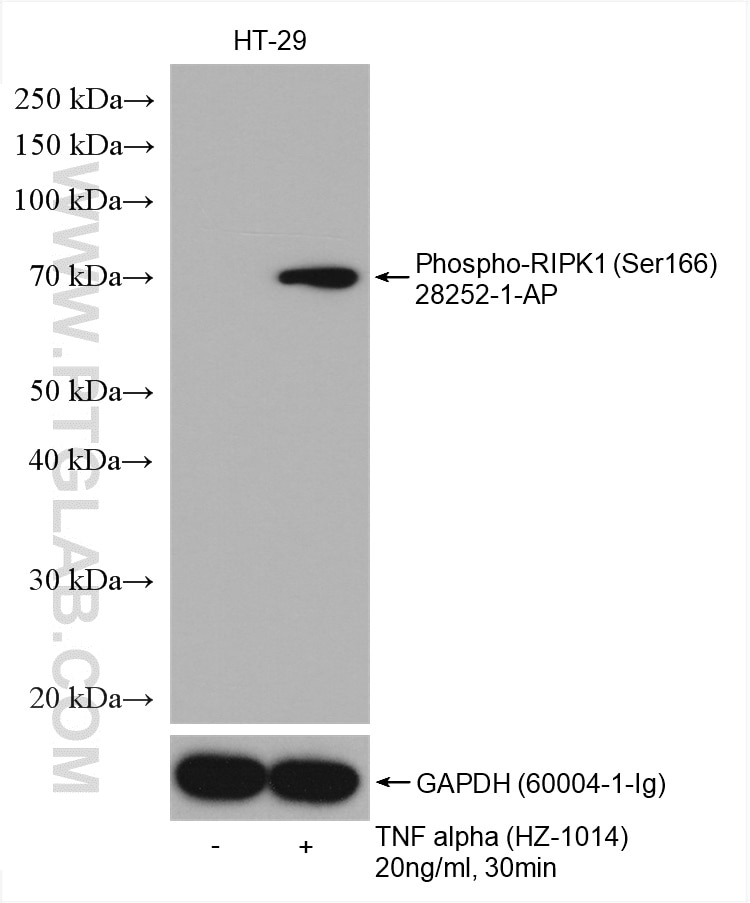
| Positive WB detected in | TNF-alpha treated HT-29 cells |
Recommended dilution
| Application | Dilution |
|---|---|
| Western Blot (WB) | WB : 1:1000-1:4000 |
| It is recommended that this reagent should be titrated in each testing system to obtain optimal results. | |
| Sample-dependent, Check data in validation data gallery. | |
Published Applications
| WB | See 23 publications below |
| IHC | See 7 publications below |
| IF | See 6 publications below |
Product Information
28252-1-AP targets Phospho-RIPK1 (Ser166) in WB, IHC, IF, ELISA applications and shows reactivity with Human samples.
| Tested Reactivity | Human |
| Cited Reactivity | human, mouse, rat |
| Host / Isotype | Rabbit / IgG |
| Class | Polyclonal |
| Type | Antibody |
| Immunogen |
Peptide 相同性解析による交差性が予測される生物種 |
| Full Name | receptor (TNFRSF)-interacting serine-threonine kinase 1 |
| Calculated molecular weight | 76 kDa |
| Observed molecular weight | 70-80 kDa |
| GenBank accession number | NM_003804 |
| Gene Symbol | RIPK1 |
| Gene ID (NCBI) | 8737 |
| RRID | AB_2881098 |
| Conjugate | Unconjugated |
| Form | |
| Form | Liquid |
| Purification Method | Antigen affinity purification |
| UNIPROT ID | Q13546 |
| Storage Buffer | PBS with 0.02% sodium azide and 50% glycerol{{ptg:BufferTemp}}7.3 |
| Storage Conditions | Store at -20°C. Stable for one year after shipment. Aliquoting is unnecessary for -20oC storage. |
Background Information
RIPK1, a 74 kDa protein, is composed of a N-terminal kinase domain, an intermediate domain (containing the RIP homotypic interaction motif, RHIM) and a C-terminal death domain. Stimulation of cells with TNFα can promote distinct cell death pathways, including RIPK1-independent apoptosis, necroptosis, and RIPK1-dependent apoptosis (RDA). TNFα induces cell necroptosis and the phosphorylation of RIPK1 at the Ser166 residue i.e. p-RIPK1 (Ser166), both of which can be effectively inhibited by Nec-1. Therefore, p-RIPK1 (Ser166) is considered a biomarker for the activation of RIPK1 kinase and necroptosis (PMID: 31440386, PMID: 29891719).
Protocols
| Product Specific Protocols | |
|---|---|
| WB protocol for Phospho-RIPK1 (Ser166) antibody 28252-1-AP | Download protocol |
| Standard Protocols | |
|---|---|
| Click here to view our Standard Protocols |
Publications
| Species | Application | Title |
|---|---|---|
Drug Resist Updat Targeting LIG1 to overcome oxaliplatin resistance by inducing PANoptosis in colorectal cancer. | ||
Bone Res Pak4-mediated crosstalk between necroptotic macrophages and tendon stem/progenitor cells contributes to traumatic heterotopic ossification formation. | ||
Nat Commun Necroptosis enhances 'don't eat me' signal and induces macrophage extracellular traps to promote pancreatic cancer liver metastasis | ||
Exp Hematol Oncol Tetrahydromagnolol targets TRIM38 to mediate PANoptosis in cancer cells and has the potential for synergistic cancer therapy. | ||
Theranostics Oxidative stress-mediated PANoptosis and ferroptosis: Exploration of multimodal cell death triggered by an AIE-active nano-photosensitizer via photodynamic therapy. | ||
Biomaterials Radiation-triggerable bioreactors enable bioenergetic reprograming of cancer stem cell plasticity via targeted arginine metabolism disruption for augmented radio-immunotherapy |