
Validation Data Gallery
Tested Applications
Recommended dilution
| Application | Dilution |
|---|---|
| It is recommended that this reagent should be titrated in each testing system to obtain optimal results. | |
Product Information
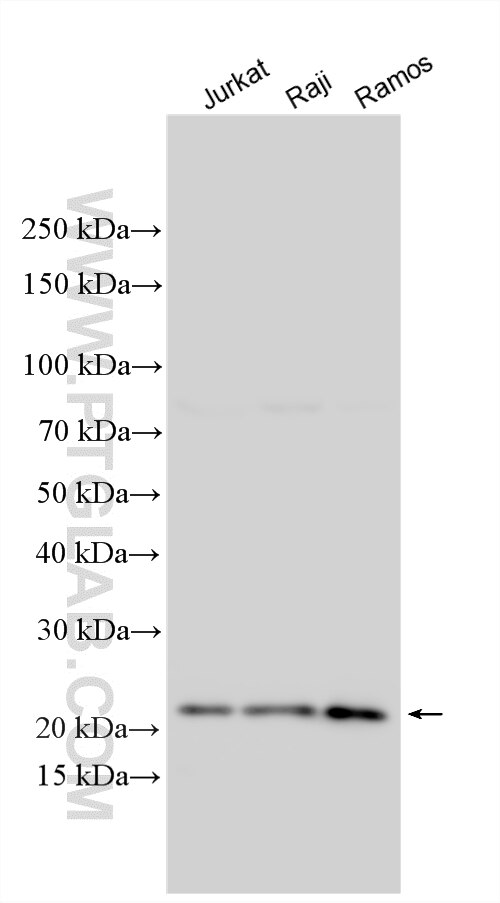
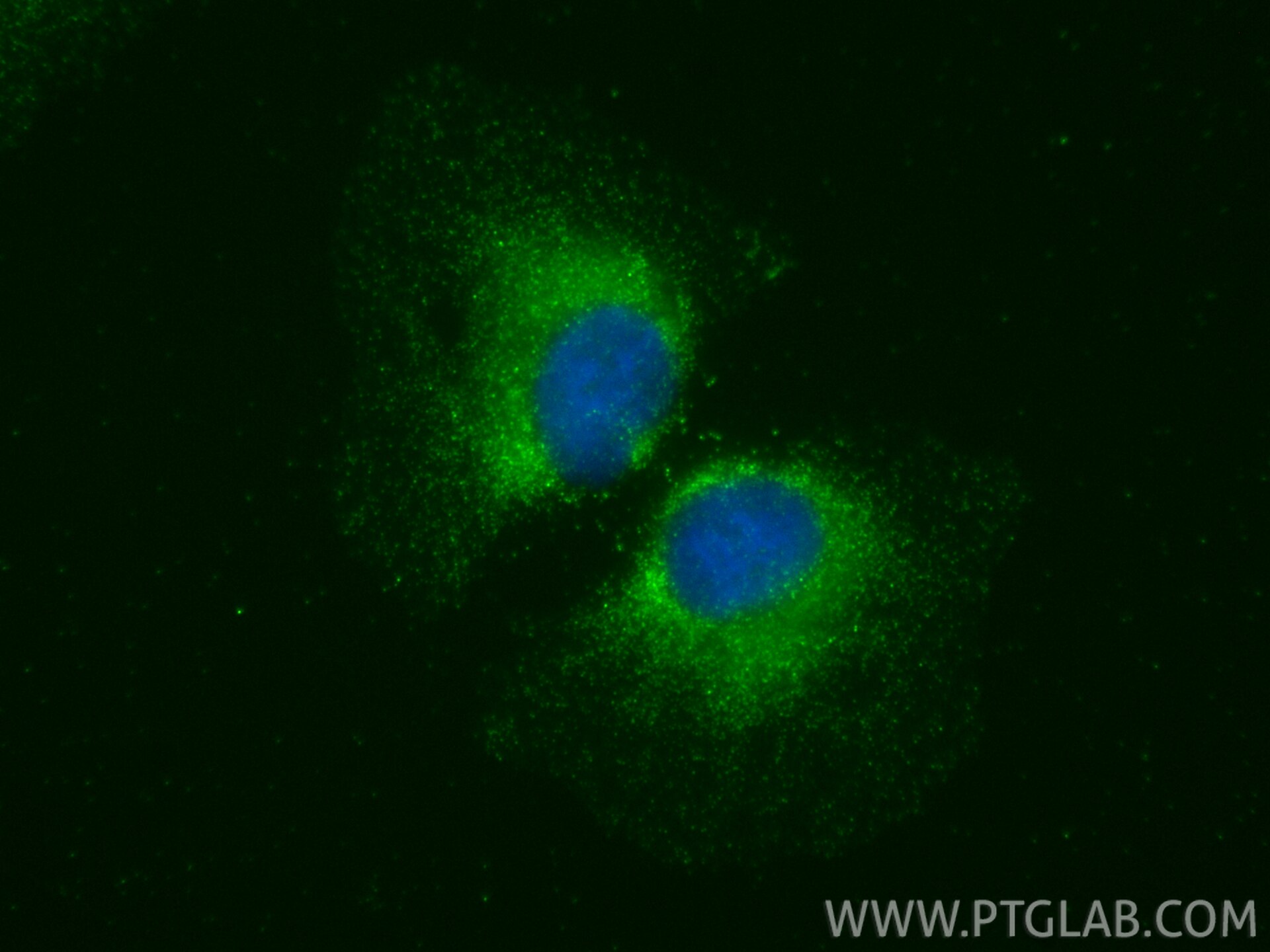
27263-1-PBS targets RHOH in WB, IF/ICC, Indirect ELISA applications and shows reactivity with human samples.
| Tested Reactivity | human |
| Host / Isotype | Rabbit / IgG |
| Class | Polyclonal |
| Type | Antibody |
| Immunogen |
CatNo: Ag26127 Product name: Recombinant human RHOH protein Source: e coli.-derived, PGEX-4T Tag: GST Domain: 116-188 aa of BC014261 Sequence: TQTDQREMGPHRASCVNAMEGKKLAQDVRAKGYLECSALSNRGVQQVFECAVRTAVNQARRRNRRRLFSINEC 相同性解析による交差性が予測される生物種 |
| Full Name | ras homolog gene family, member H |
| Calculated molecular weight | 191 aa, 21 kDa |
| Observed molecular weight | 21 kDa |
| GenBank accession number | BC014261 |
| Gene Symbol | RHOH |
| Gene ID (NCBI) | 399 |
| RRID | AB_3742224 |
| Conjugate | Unconjugated |
| Form | |
| Form | Liquid |
| Purification Method | Antigen affinity purification |
| UNIPROT ID | Q15669 |
| Storage Buffer | PBS only{{ptg:BufferTemp}}7.3 |
| Storage Conditions | Store at -80°C. |
Background Information
RHOH is also named ARHH and TTF. RHOH is a member of the RHO GTPase family, which orchestrates a wide range of cellular processes, such as cytoskeletal reorganization, vesicle trafficking, cell cycle, cell polarity, and cell migration (PMID: 33547421, PMID: 29233866). Unlike typical RHO GTPases that undergo cycling between inactive GDP-bound and active GTP-bound conformation, RHOH lacks intrinsic GTPase activity and remains in a constitutively GTP-bound form (PMID: 11809807). RHOH exhibits high expression in T cells and plays crucial roles in T cell development, activation and differentiation, and undergoes degradation in lysosomes following TCR stimulation (PMID: 17119112, PMID: 30339851, PMID: 19950172). RhoH has been found to regulate proliferation, survival, migration and engraftment of hematopoietic progenitor cells (HPCs), IL-3 signaling in a B cell line, FcεRI-dependent signal transduction in mast cells, and differentiation in eosinophils (PMID: 36108062).