
Validation Data Gallery



Tested Applications
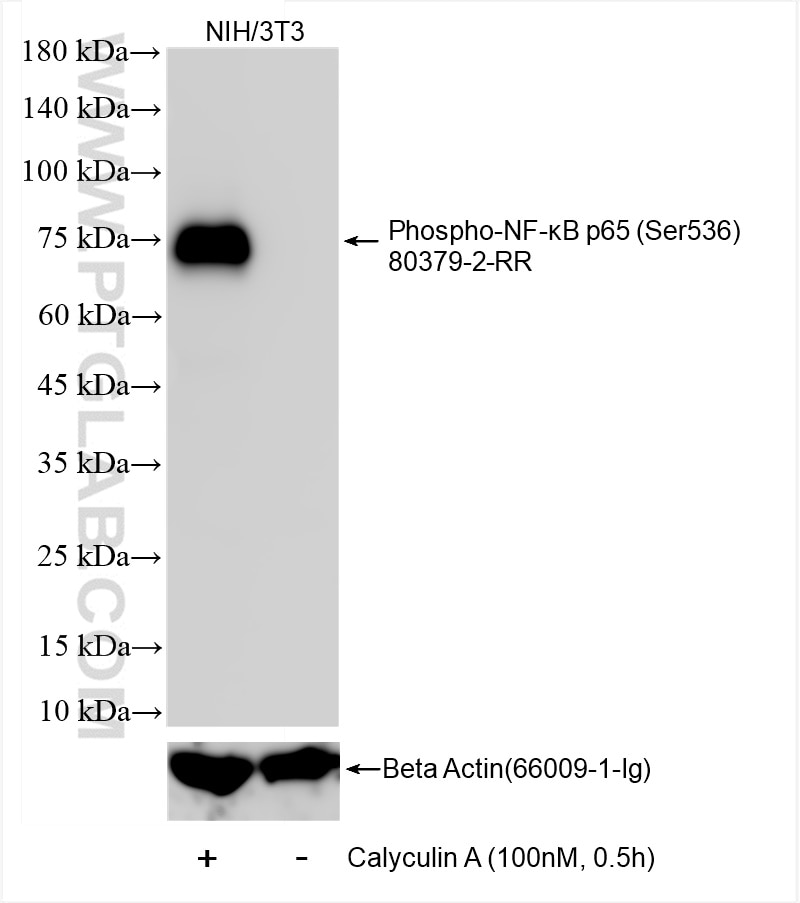
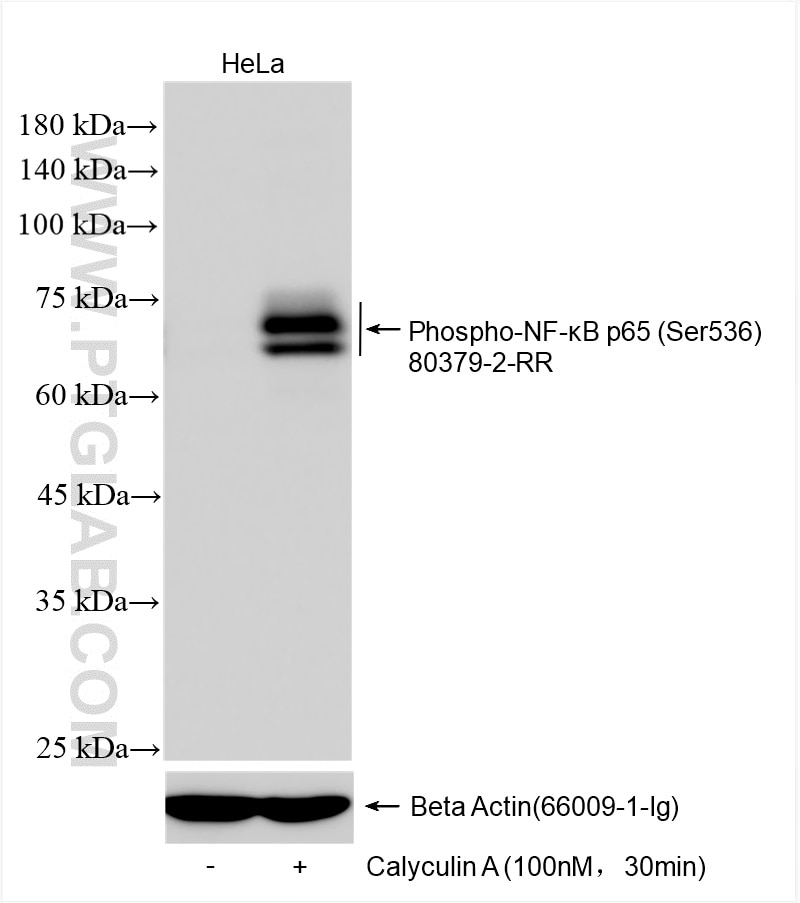
| Positive WB detected in | Calyculin A treated NIH/3T3 cells, Calyculin A treated HeLa cells |
| Positive IHC detected in | human placenta tissue Note: suggested antigen retrieval with TE buffer pH 9.0; (*) Alternatively, antigen retrieval may be performed with citrate buffer pH 6.0 |
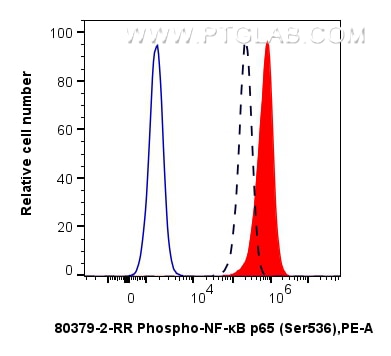
| Positive FC (Intra) detected in | PC-3 cells |
| Positive ChIP-qPCR detected in | hTNF-α, 30 ng/ml, 1 h HeLa cells |
Recommended dilution
| Application | Dilution |
|---|---|
| Western Blot (WB) | WB : 1:2000-1:10000 |
| Immunohistochemistry (IHC) | IHC : 1:400-1:1600 |
| Flow Cytometry (FC) (INTRA) | FC (INTRA) : 0.25 ug per 10^6 cells in a 100 µl suspension |
| CHIP-QPCR | CHIP-QPCR : 1:10-1:100 |
| It is recommended that this reagent should be titrated in each testing system to obtain optimal results. | |
| Sample-dependent, Check data in validation data gallery. | |
Published Applications
| WB | See 75 publications below |
| IF | See 4 publications below |
Product Information
80379-2-RR targets Phospho-NF-κB p65 (Ser536) in WB, IHC, IF, FC (Intra), ELISA, ChIP-qPCR applications and shows reactivity with human, mouse samples.
| Tested Reactivity | human, mouse |
| Cited Reactivity | human, mouse, rat |
| Host / Isotype | Rabbit / IgG |
| Class | Recombinant |
| Type | Antibody |
| Immunogen |
Peptide 相同性解析による交差性が予測される生物種 |
| Full Name | v-rel reticuloendotheliosis viral oncogene homolog A (avian) |
| Calculated molecular weight | 65 kDa |
| Observed molecular weight | 75 kDa |
| GenBank accession number | BC011603 |
| Gene Symbol | NF-κB p65 |
| Gene ID (NCBI) | 5970 |
| RRID | AB_3670476 |
| Conjugate | Unconjugated |
| Form | |
| Form | Liquid |
| Purification Method | Protein A purification |
| UNIPROT ID | Q04206 |
| Storage Buffer | PBS with 0.02% sodium azide and 50% glycerol{{ptg:BufferTemp}}7.3 |
| Storage Conditions | Store at -20°C. Stable for one year after shipment. Aliquoting is unnecessary for -20oC storage. |
Background Information
Nuclear factor kB (NF-kB) is a collective term for a small family of dimeric transcription factors [comprising p65 (RelA) and RelB, c-Rel, p50/p105 (NF-κB1), and p52/p100 (NF-κB2)]. All NF-κB proteins share a Rel homology domain (RHD), which is responsible for DNA binding and dimerization. Only p65, RelB, and c-Rel contain potent transactivation domains within sequences from the C-terminal to the RHD. Exterior signals lead to the phosphorylation and degradation of the inhibitory complex IκB, which is modulated by the IκB kinase (IKK), and its degradation allows for the release of the typical NF-κB heterodimer, p65/p50, to translocate into the nucleus. NF-κB binds to its cognate DNA elements and can transcriptionally activate different target genes among which 200-500 genes have been implicated in cell survival/apoptosis, cell growth, immune response, and inflammation.
Protocols
| Product Specific Protocols | |
|---|---|
| IHC protocol for Phospho-NF-κB p65 (Ser536) antibody 80379-2-RR | Download protocol |
| WB protocol for Phospho-NF-κB p65 (Ser536) antibody 80379-2-RR | Download protocol |
| Standard Protocols | |
|---|---|
| Click here to view our Standard Protocols |
Publications
| Species | Application | Title |
|---|---|---|
J Hematol Oncol Glutathione reductase deficiency potentiates the immunogenicity of ferroptosis and cuproptosis via amplified reactive oxygen species accumulation and cGAS-STING pathway activation | ||
Adv Mater Suppression of Sepsis Cytokine Storm by Escherichia Coli Cell Wall-Derived Carbon Dots | ||
Cell Mol Immunol SPT6 maintains epidermal homeostasis by inhibiting an NF-κB-positive feedback loop to prevent excessive inflammation. | ||
Cell Host Microbe Oat-β-glucan potentiates anti-PD-1 efficacy through Faecalibacterium prausnitzii-derived butyrate and indole-3-propionic acid. | ||
Drug Resist Updat The RELA-FTH1 axis in senescent cancer-associated fibroblasts creates a stromal iron sink that drives ferroptosis resistance and therapy failure across solid malignant tumors. | ||
J Adv Res Ginsenoside Rh1 ameliorates polystyrene nanoplastics-caused vascular injury by regulating HSP70 to suppress endoplasmic reticulum stress and pyroptosis. |