
Validation Data Gallery
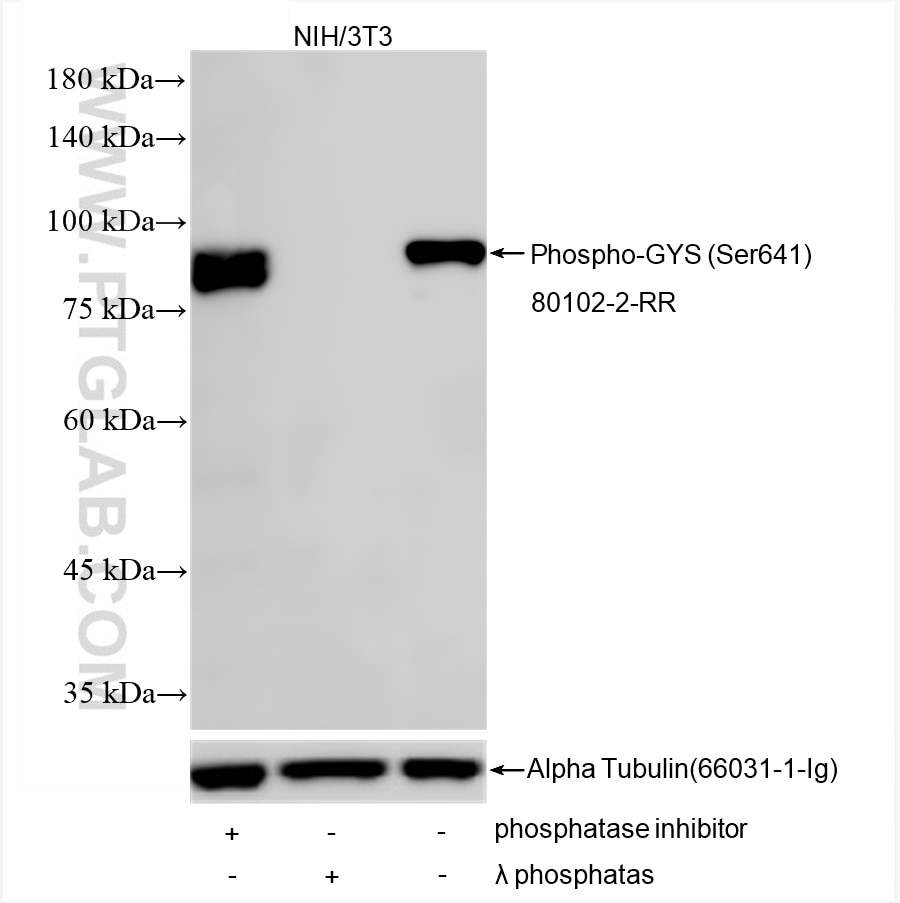
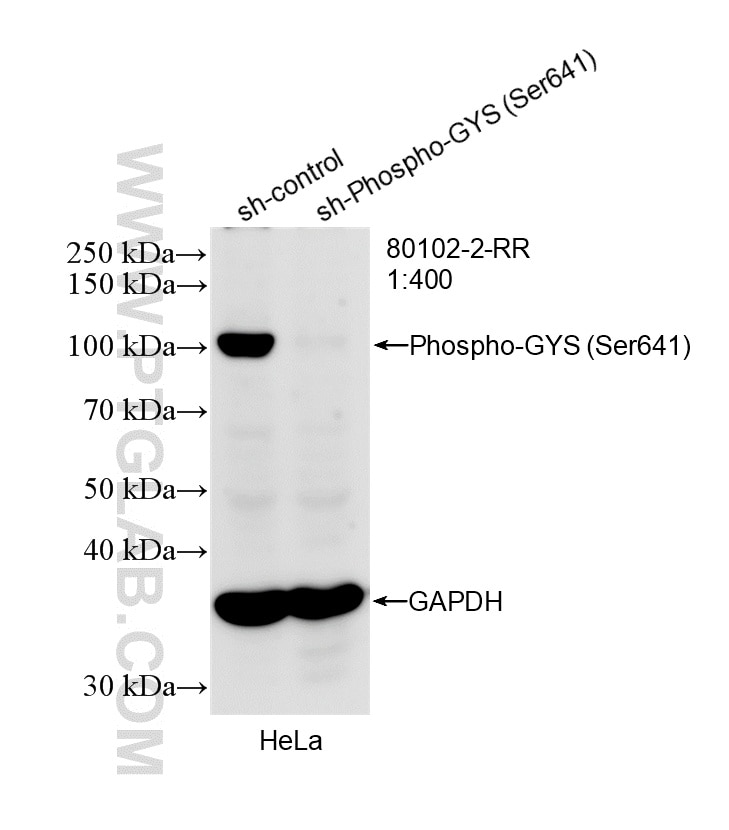
Tested Applications
| Positive WB detected in | NIH/3T3 cells, HeLa cells, λ phosphatase NIH/3T3 cells |
Recommended dilution
| Application | Dilution |
|---|---|
| Western Blot (WB) | WB : 1:1000-1:4000 |
| It is recommended that this reagent should be titrated in each testing system to obtain optimal results. | |
| Sample-dependent, Check data in validation data gallery. | |
Product Information
80102-2-RR targets Phospho-GYS (Ser641) in WB, ELISA applications and shows reactivity with human, mouse samples.
| Tested Reactivity | human, mouse |
| Host / Isotype | Rabbit / IgG |
| Class | Recombinant |
| Type | Antibody |
| Immunogen |
Peptide 相同性解析による交差性が予測される生物種 |
| Full Name | glycogen synthase 1 (muscle) |
| Calculated molecular weight | 84 kDa |
| Observed molecular weight | 84 kDa |
| GenBank accession number | BC007688 |
| Gene Symbol | GYS1 |
| Gene ID (NCBI) | 2997 |
| RRID | AB_3743330 |
| Conjugate | Unconjugated |
| Form | |
| Form | Liquid |
| Purification Method | Protein A purification |
| UNIPROT ID | P13807 |
| Storage Buffer | PBS with 0.02% sodium azide and 50% glycerol{{ptg:BufferTemp}}7.3 |
| Storage Conditions | Store at -20°C. Stable for one year after shipment. Aliquoting is unnecessary for -20oC storage. |
Background Information
Glycogen synthase 1 (GYS1, GS) catalyzes the key step of glycogen synthesis and plays an important role in glycogen metabolism in the liver and muscle. In kidney tissues, glycogen synthase 1 (GYS1) is the most important rate-limiting enzyme functioning in the last step of glycogen synthesis. Pathologically, its deficiency has been shown to cause muscle glycogen storage disease type 0 and death. Studies of tumors showed that GYS1 was rapidly induced under hypoxic conditions and positively correlated with glycogen accumulation in glioblastoma, breast, and colon cancer cell lines. GYS1 is phosphorylated at nine sites, and insulin stimulates the dephosphorylation of glycogen synthase. Insulin stimulates dephosphorylation of glycogen synthase via PKB-mediated phosphorylation of GSK3. Phosphorylation of GSK3 decreases kinase activity, which will decrease phosphorylation of GS and increase glycogen synthase fractional activity. (PMID: 32802186, PMID: 30443599, PMID:22232606)
Protocols
| Product Specific Protocols | |
|---|---|
| WB protocol for Phospho-GYS (Ser641) antibody 80102-2-RR | Download protocol |
| Standard Protocols | |
|---|---|
| Click here to view our Standard Protocols |