
Validation Data Gallery


Tested Applications
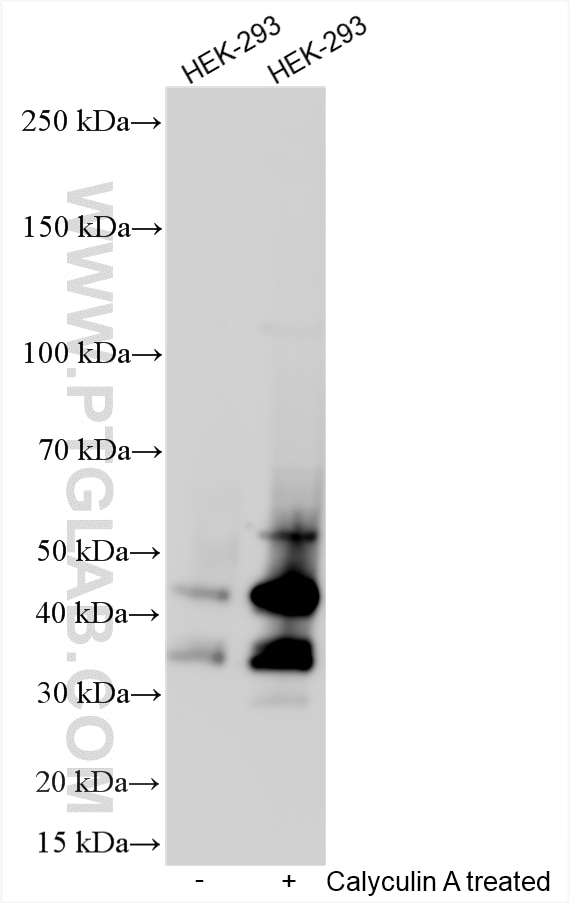
| Positive WB detected in | Calyculin A treated HEK-293 cells, Forskolin treated HSC-T6 cells, HeLa cells, NIH/3T3 cells, Forskolin treated NIH/3T3 cells |
| Positive IHC detected in | human liver tissue Note: suggested antigen retrieval with TE buffer pH 9.0; (*) Alternatively, antigen retrieval may be performed with citrate buffer pH 6.0 |
Recommended dilution
| Application | Dilution |
|---|---|
| Western Blot (WB) | WB : 1:1000-1:4000 |
| Immunohistochemistry (IHC) | IHC : 1:50-1:500 |
| It is recommended that this reagent should be titrated in each testing system to obtain optimal results. | |
| Sample-dependent, Check data in validation data gallery. | |
Published Applications
| WB | See 90 publications below |
| IHC | See 3 publications below |
| IF | See 7 publications below |
Product Information
28792-1-AP targets Phospho-CREB1 (Ser133) in WB, IHC, IF, ELISA applications and shows reactivity with human, mouse, rat samples.
| Tested Reactivity | human, mouse, rat |
| Cited Reactivity | human, mouse, rat |
| Host / Isotype | Rabbit / IgG |
| Class | Polyclonal |
| Type | Antibody |
| Immunogen |
Peptide 相同性解析による交差性が予測される生物種 |
| Full Name | cAMP responsive element binding protein 1 |
| Calculated molecular weight | 341 aa, 35 kDa |
| Observed molecular weight | 35-46 kDa |
| GenBank accession number | BC010636 |
| Gene Symbol | CREB1 |
| Gene ID (NCBI) | 1385 |
| RRID | AB_2918203 |
| Conjugate | Unconjugated |
| Form | |
| Form | Liquid |
| Purification Method | Antigen affinity purification |
| UNIPROT ID | P16220 |
| Storage Buffer | PBS with 0.02% sodium azide and 50% glycerol{{ptg:BufferTemp}}7.3 |
| Storage Conditions | Store at -20°C. Stable for one year after shipment. Aliquoting is unnecessary for -20oC storage. |
Background Information
The cAMP-response element binding protein (CREB) is localized in the nucleus and acts as a transcription factor, which binds to the cAMP response element (CRE) of the promoters of its target genes, upon phosphorylation at Ser133 by different receptor-activated protein kinases, such as protein kinase A (PKA), calmodulin-dependent protein kinase (CaMK), mitogen-activated protein kinases (MAPK), and other kinases. The activity of CREB1 in neurons has been correlated with various intracellular processes, including proliferation, differentiation, survival, long-term synaptic potentiation, neurogenesis, and neuronal plasticity. CREB1 belongs to the CREB/activating transcription factor (ATF) family of transcription factors. (PMID: 30214393, PMID: 33917483, PMID: 32605164) The antibody also detects the phosphorylated form of the CREB-related protein ATF1.
Protocols
| Product Specific Protocols | |
|---|---|
| IHC protocol for Phospho-CREB1 (Ser133) antibody 28792-1-AP | Download protocol |
| WB protocol for Phospho-CREB1 (Ser133) antibody 28792-1-AP | Download protocol |
| Standard Protocols | |
|---|---|
| Click here to view our Standard Protocols |
Publications
| Species | Application | Title |
|---|---|---|
Gut ISG15 deficiency in hepatic stellate cells promotes TGFβ2-induced liver fibrosis by counteracting CREB1 ISGylation | ||
Cancer Res Cancer-Associated Fibroblasts Expressing Sulfatase 1 Facilitate VEGFA-Dependent Microenvironmental Remodeling to Support Colorectal Cancer | ||
Drug Resist Updat Sciatic nerve stimulation enhances NK cell cytotoxicity through dopamine signaling and synergizes immunotherapy in triple-negative breast cancer | ||
Autophagy CENPN suppresses autophagy and increases paclitaxel resistance in nasopharyngeal carcinoma cells by inhibiting the CREB-VAMP8 signaling axis | ||
Autophagy PINK1-deficiency facilitates mitochondrial iron accumulation and colon tumorigenesis | ||
Nat Commun Cdo1-Camkk2-AMPK axis confers the protective effects of exercise against NAFLD in mice |