
Validation Data Gallery
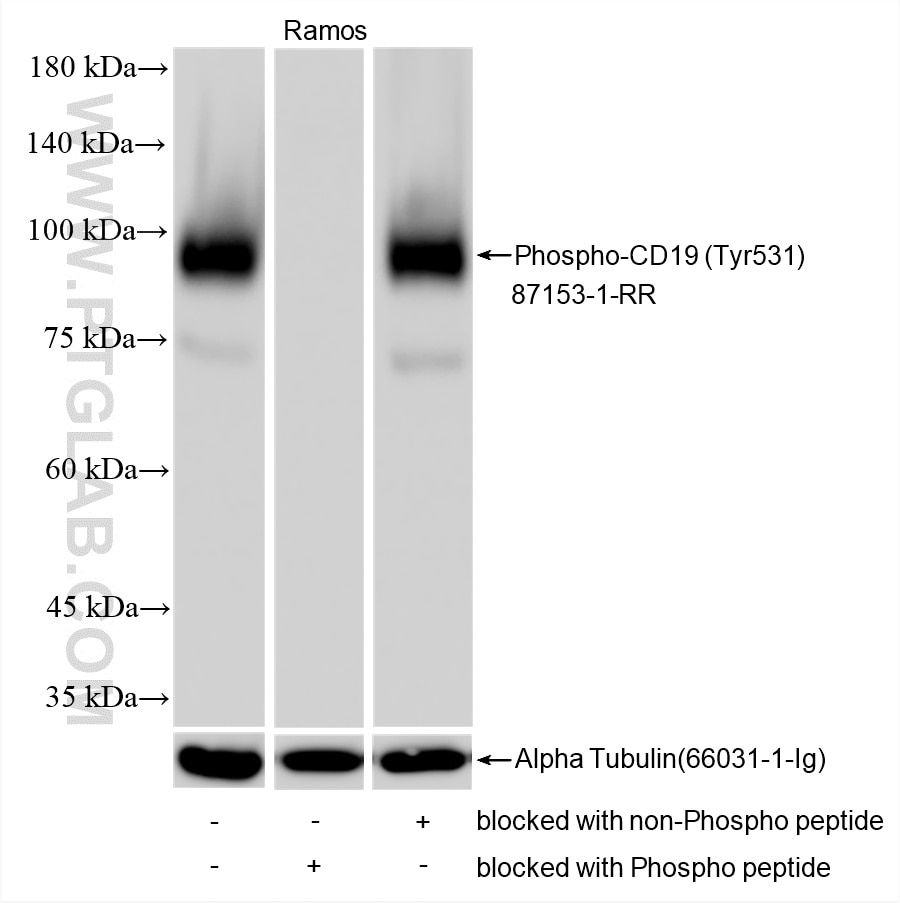
Tested Applications
| Positive WB detected in | Ramos cells |
Recommended dilution
| Application | Dilution |
|---|---|
| Western Blot (WB) | WB : 1:5000-1:50000 |
| It is recommended that this reagent should be titrated in each testing system to obtain optimal results. | |
| Sample-dependent, Check data in validation data gallery. | |
Product Information
87153-1-RR targets Phospho-CD19 (Tyr531) in WB, ELISA applications and shows reactivity with human samples.
| Tested Reactivity | human |
| Host / Isotype | Rabbit / IgG |
| Class | Recombinant |
| Type | Antibody |
| Immunogen |
Peptide 相同性解析による交差性が予測される生物種 |
| Full Name | CD19 molecule |
| Calculated molecular weight | 556 aa, 61 kDa |
| Observed molecular weight | 95 kDa |
| GenBank accession number | NM_001770 |
| Gene Symbol | CD19 |
| Gene ID (NCBI) | 930 |
| ENSEMBL Gene ID | ENSG00000177455 |
| RRID | AB_3745374 |
| Conjugate | Unconjugated |
| Form | |
| Form | Liquid |
| Purification Method | Protein A purification |
| UNIPROT ID | P15391 |
| Storage Buffer | PBS with 0.02% sodium azide and 50% glycerol{{ptg:BufferTemp}}7.3 |
| Storage Conditions | Store at -20°C. Stable for one year after shipment. Aliquoting is unnecessary for -20oC storage. |
Background Information
CD19 is a 95 kDa type I transmembrane glycoprotein belonging to the immunoglobulin superfamily. Phospho-CD19 (Tyr531) is a phosphorylated form of CD19, which is a protein involved in B cell receptor (BCR) signaling and plays a crucial role in B cell development and function. Phosphorylation of CD19 at Tyr531 is known to recruit PI3K activity leading to Akt activation and attendant S473 phosphorylation. This activation of BCR induces multiple oncogenic signals and treatment with ibrutinib prevents preferentially the activation of BTK in both patients with ABC-like and GCB-like molecular features. (PMID: 20038598)
Protocols
| Product Specific Protocols | |
|---|---|
| WB protocol for Phospho-CD19 (Tyr531) antibody 87153-1-RR | Download protocol |
| Standard Protocols | |
|---|---|
| Click here to view our Standard Protocols |