
Validation Data Gallery
Tested Applications
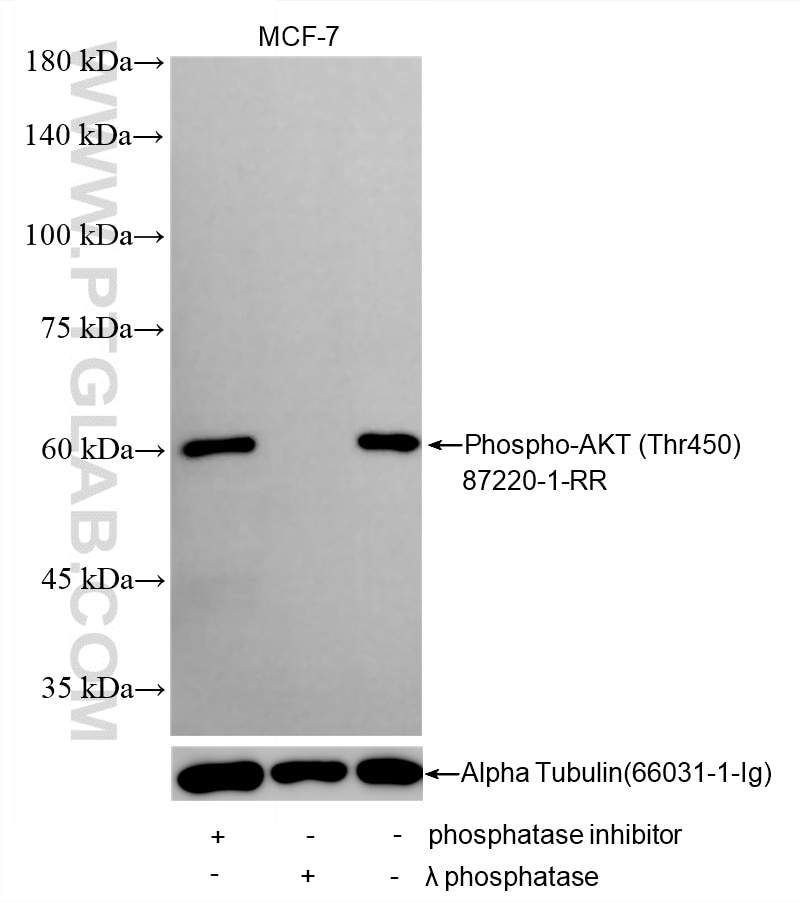
| Positive WB detected in | MCF-7 cells, λ phosphatase treated MCF-7 cells |
Recommended dilution
| Application | Dilution |
|---|---|
| Western Blot (WB) | WB : 1:1000-1:4000 |
| It is recommended that this reagent should be titrated in each testing system to obtain optimal results. | |
| Sample-dependent, Check data in validation data gallery. | |
Product Information
87220-1-RR targets Phospho-AKT (Thr450) in WB, ELISA applications and shows reactivity with human samples.
| Tested Reactivity | human |
| Host / Isotype | Rabbit / IgG |
| Class | Recombinant |
| Type | Antibody |
| Immunogen |
Peptide 相同性解析による交差性が予測される生物種 |
| Full Name | v-akt murine thymoma viral oncogene homolog 1 |
| Calculated molecular weight | 56 kDa |
| Observed molecular weight | 60 kDa |
| GenBank accession number | NM_005163 |
| Gene Symbol | AKT1 |
| Gene ID (NCBI) | 207 |
| RRID | AB_3745414 |
| Conjugate | Unconjugated |
| Form | |
| Form | Liquid |
| Purification Method | Protein A purification |
| UNIPROT ID | P31749 |
| Storage Buffer | PBS with 0.02% sodium azide and 50% glycerol{{ptg:BufferTemp}}7.3 |
| Storage Conditions | Store at -20°C. Stable for one year after shipment. Aliquoting is unnecessary for -20oC storage. |
Background Information
The serine-threonine protein kinase AKT1 is catalytically inactive in serum-starved primary and immortalized fibroblasts. Phospho-AKT (Thr450) is recognized as the phosphorylation site on AKT (protein kinase B) at the threonine 450 residue. This site is referred to as the turn phosphorylation site and was previously thought to be a result of autophosphorylation, but more recent work has shown that its phosphorylation is controlled by TORC2 activity. This phosphorylation site is important in other AGC kinases, but the role in AKT signaling had not been determined. (PMID: 21670491)
Protocols
| Product Specific Protocols | |
|---|---|
| WB protocol for Phospho-AKT (Thr450) antibody 87220-1-RR | Download protocol |
| Standard Protocols | |
|---|---|
| Click here to view our Standard Protocols |