
Validation Data Gallery
Tested Applications
Recommended dilution
| Application | Dilution |
|---|---|
| It is recommended that this reagent should be titrated in each testing system to obtain optimal results. | |
Product Information
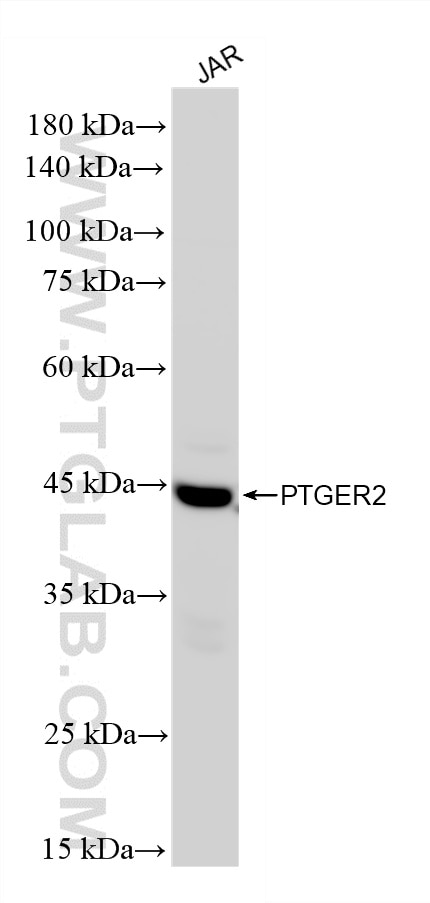
87864-1-PBS targets PTGER2 in WB, Indirect ELISA applications and shows reactivity with human samples.
| Tested Reactivity | human |
| Host / Isotype | Rabbit / IgG |
| Class | Recombinant |
| Type | Antibody |
| Immunogen |
CatNo: Ag35470 Product name: Recombinant human PTGER2 protein Source: e coli.-derived, PET28a Tag: 6*His Domain: 287-358 aa of NM_000956.3 Sequence: NETSSRKEKWDLQALRFLSINSIIDPWVFAILRPPVLRLMRSVLCCRISLRTQDATQTSCSTQSDASKQADL 相同性解析による交差性が予測される生物種 |
| Full Name | prostaglandin E receptor 2 (subtype EP2), 53kDa |
| Calculated molecular weight | 40kDa,358aa |
| Observed molecular weight | 45 kDa |
| GenBank accession number | NM_000956.3 |
| Gene Symbol | PTGER2 |
| Gene ID (NCBI) | 5732 |
| RRID | AB_3745796 |
| Conjugate | Unconjugated |
| Form | |
| Form | Liquid |
| Purification Method | Protein A purification |
| UNIPROT ID | P43116 |
| Storage Buffer | PBS only{{ptg:BufferTemp}}7.3 |
| Storage Conditions | Store at -80°C. |
Background Information
PTGER2 (prostaglandin E receptor 2) is a gene that encodes the EP2 receptor, a G protein-coupled receptor (GPCR) that binds prostaglandin E2 (PGE2) . Located on chromosome 14q22.1, this receptor primarily couples to the Gs protein and activates adenylate cyclase, leading to increased intracellular cAMP levels . PTGER2 plays diverse roles in inflammation, cancer, neuroprotection, and immune regulation; its activation can either promote tumor cell proliferation and invasion or mediate anti-inflammatory effects depending on the context . Mutations in this gene are associated with aspirin‑induced asthma susceptibility, making it a significant therapeutic target for inflammatory diseases, cancer, and conditions like glaucoma and pulmonary hypertension. PTGER2 has multiple glycosylation sites.