
Validation Data Gallery
Tested Applications
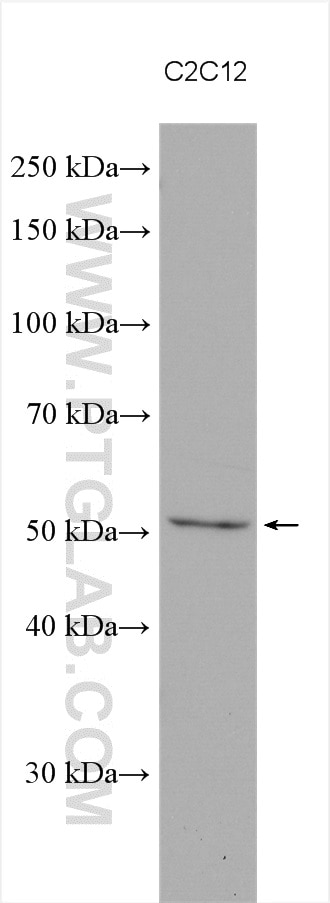
| Positive WB detected in | C2C12 cells |
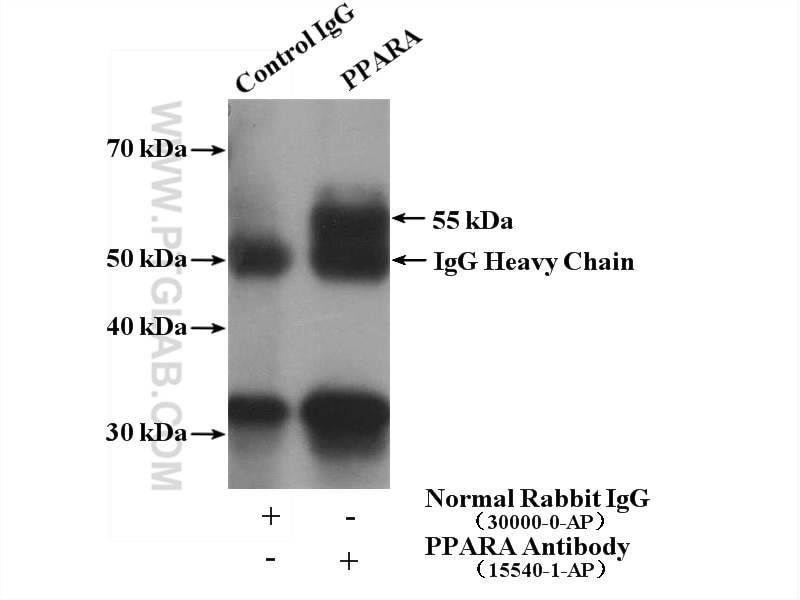
| Positive IP detected in | U-937 cells |
Recommended dilution
| Application | Dilution |
|---|---|
| Western Blot (WB) | WB : 1:500-1:1000 |
| Immunoprecipitation (IP) | IP : 0.5-4.0 ug for 1.0-3.0 mg of total protein lysate |
| It is recommended that this reagent should be titrated in each testing system to obtain optimal results. | |
| Sample-dependent, Check data in validation data gallery. | |
Published Applications
| KD/KO | See 14 publications below |
| WB | See 199 publications below |
| IF | See 14 publications below |
| IP | See 1 publications below |
| CoIP | See 1 publications below |
| ChIP | See 2 publications below |
Product Information
15540-1-AP targets PPARA in WB, IF, IP, CoIP, ChIP, ELISA applications and shows reactivity with human, mouse, rat samples.
| Tested Reactivity | human, mouse, rat |
| Cited Reactivity | human, mouse, rat, pig, chicken, bovine, hamster, goat |
| Host / Isotype | Rabbit / IgG |
| Class | Polyclonal |
| Type | Antibody |
| Immunogen |
CatNo: Ag7896 Product name: Recombinant human PPARA protein Source: e coli.-derived, PGEX-4T Tag: GST Domain: 1-258 aa of BC000052 Sequence: MVDTESPLCPLSPLEAGDLESPLSEEFLQEMGNIQEISQSIGEDSSGSFGFTEYQYLGSCPGSDGSVITDTLSPASSPSSVTYPVVPGSVDESPSGALNIECRICGDKASGYHYGVHACEGCKGFFRRTIRLKLVYDKCDRSCKIQKKNRNKCQYCRFHKCLSVGMSHNAIRFGRMPRSEKAKLKAEILTCEHDIEDSETADLKSLAKRIYEAYLKNFNMNKVKARVILSGKASNNPVGVCGCSGFSWQHGTSVVEDD 相同性解析による交差性が予測される生物種 |
| Full Name | peroxisome proliferator-activated receptor alpha |
| Calculated molecular weight | 52 kDa |
| Observed molecular weight | 52 kDa |
| GenBank accession number | BC000052 |
| Gene Symbol | PPARA |
| Gene ID (NCBI) | 5465 |
| RRID | AB_2252506 |
| Conjugate | Unconjugated |
| Form | |
| Form | Liquid |
| Purification Method | Antigen affinity purification |
| UNIPROT ID | Q07869 |
| Storage Buffer | PBS with 0.02% sodium azide and 50% glycerol{{ptg:BufferTemp}}7.3 |
| Storage Conditions | Store at -20°C. Stable for one year after shipment. Aliquoting is unnecessary for -20oC storage. |
Background Information
Peroxisome proliferator-activated receptor alpha (PPARA) is a ligand-activated transcription factor that belongs to the PPAR nuclear receptor superfamily. PPARA is essential in the modulation of lipid transport and metabolism, mainly through activating mitochondrial and peroxisomal fatty acid β-oxidation pathways. In addition, PPARA seems to decrease inflammation mainly through direct interaction with NF-κB, causing inhibition of its signaling pathway or reducing the activated levels of NF-κB and subsequent inflammation. Furthermore, PPARA was implicated in the attenuation of oxidative stress in alcoholic liver disease when treated with polyenephosphatidylcholine through downregulation of ROS-generating enzymes such as ethanol-inducible cytochrome P450 2E1 (CYP2E1), acyl-CoA oxidase, and NADPH oxidase. PPARA exists two isoforms and molecular weight of PPARA isoforms are 52 kDa and 22 kDa. The ability of a retinoid X receptor (RXR) to heterodimerize with many nuclear receptors, including LXR, PPAR, NGF1B and RAR, underscores its pivotal role within the nuclear receptor superfamily. Among these heterodimers, PPAR:RXR is considered an important signalling mediator of both PPAR ligands, such as fatty acids, and 9-cis retinoic acid (9-cis RA), an RXR ligand. (PMID: 15103326 ). PPARA can form Heterodimer with RXRA and molecular weight of Heterodimer is about 110 kDa.
Publications
| Species | Application | Title |
|---|---|---|
Signal Transduct Target Ther FGF1ΔHBS prevents diabetic cardiomyopathy by maintaining mitochondrial homeostasis and reducing oxidative stress via AMPK/Nur77 suppression. | ||
Cancer Commun (Lond) PTPRO represses colorectal cancer tumorigenesis and progression by reprogramming fatty acid metabolism. | ||
Nat Metab Early-activated extracellular matrix proteins shape the metabolic and spatial dynamics of the kidney fibrotic microenvironment. | ||
Nat Metab Inhibition of hepatic oxalate overproduction ameliorates metabolic dysfunction-associated steatohepatitis | ||
Cancer Res Long noncoding RNA HULC modulates abnormal lipid metabolism in hepatoma cells through an miR-9-mediated RXRA signaling pathway. | ||
Nat Commun N1-methyladenosine methylation in tRNA drives liver tumourigenesis by regulating cholesterol metabolism. |