
Validation Data Gallery
Tested Applications
Recommended dilution
| Application | Dilution |
|---|---|
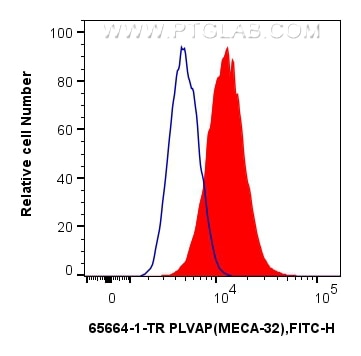
| This reagent has been tested for flow cytometric analysis. It is recommended that this reagent should be titrated in each testing system to obtain optimal results. | |
Product Information
65664-1-PBS targets PLVAP in FC applications and shows reactivity with mouse samples.
| Tested Reactivity | mouse |
| Host / Isotype | Rat / IgG2a |
| Class | Recombinant |
| Type | Antibody |
| Immunogen |
N/A 相同性解析による交差性が予測される生物種 |
| Full Name | plasmalemma vesicle associated protein |
| GenBank accession number | BC013517 |
| Gene Symbol | Plvap |
| Gene ID (NCBI) | 84094 |
| RRID | AB_3743284 |
| Conjugate | Unconjugated |
| Form | |
| Form | Liquid |
| Purification Method | Protein A purification |
| UNIPROT ID | Q91VC4 |
| Storage Buffer | PBS only{{ptg:BufferTemp}}7.3 |
| Storage Conditions | Store at -80°C. |
Background Information
Plasmalemma vesicle-associated protein (PLVAP), also known as PV-1, PAL-E and MECA-32 antigen, is an endothelial cell-specific type II membrane N-glycosylated glycoprotein with a molecular weight of approximately 50-65 kDa, that forms homodimers in situ (PMID: 7626790; 30231925). The MECA-32 antibody, derived from rats immunized with murine lymph node stroma, shows high specificity for mouse endothelium in both embryonic and mature tissues (PMID: 2683264; 7626790). It recognizes most endothelial cells in the embryonic and in the adult mouse, with the exception of the brain, skeletal, and cardiac muscle, where the MECA-32 antigen has a more restricted distribution. In skeletal and cardiac muscle only small arterioles and venules express the MECA-32 antigen, while in the brain its expression is negatively correlated with the differentiation of the vasculature to form the blood brain barrier (PMID: 7626790).