
Validation Data Gallery
Tested Applications
Recommended dilution
| Application | Dilution |
|---|---|
| It is recommended that this reagent should be titrated in each testing system to obtain optimal results. | |
Product Information
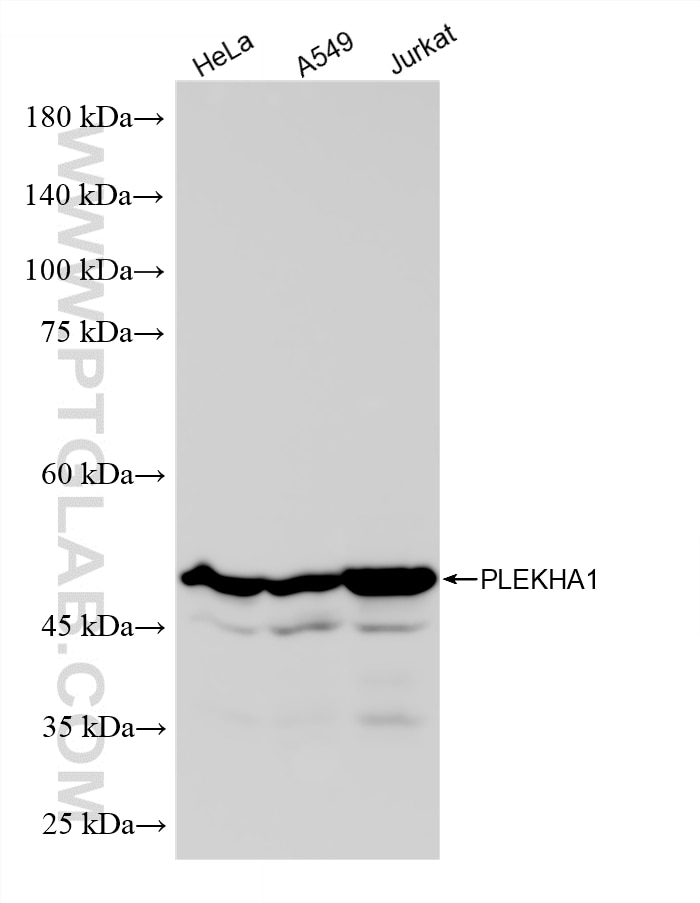
88114-1-PBS targets PLEKHA1 in WB, Indirect ELISA applications and shows reactivity with human samples.
| Tested Reactivity | human |
| Host / Isotype | Rabbit / IgG |
| Class | Recombinant |
| Type | Antibody |
| Immunogen |
CatNo: Ag0318 Product name: Recombinant human PLEKHA1 protein Source: e coli.-derived, PGEX-4T Tag: GST Domain: 1-193 aa of BC001136 Sequence: MPYVDRQNRICGFLDIEENENSGKFLRRYFILDTREDSFVWYMDNPQNLPSGSSRVGAIKLTYISKVSDATKLRPKAEFCFVMNAGMRKYFLQANDQQDLVEWVNVLNKAIKITVPKQSDSQPNSDNLSRHGECGKKQVSYRTDIVGGVPIITPTQKEEVNECGESIDRNNLKRSQSHLPYFTPKPPQDSAVI 相同性解析による交差性が予測される生物種 |
| Full Name | pleckstrin homology domain containing, family A (phosphoinositide binding specific) member 1 |
| Calculated molecular weight | 46 kDa |
| Observed molecular weight | 46 kDa |
| GenBank accession number | BC001136 |
| Gene Symbol | PLEKHA1 |
| Gene ID (NCBI) | 59338 |
| Conjugate | Unconjugated |
| Form | |
| Form | Liquid |
| Purification Method | Protein A purification |
| UNIPROT ID | Q9HB21 |
| Storage Buffer | PBS only{{ptg:BufferTemp}}7.3 |
| Storage Conditions | Store at -80°C. |
Background Information
Pleckstrin homology (PH) domain is commonly found in eukaryotic signaling proteins and possesses multiple functions including the abilities to bind inositol phosphates and various proteins. The tandem PH domain containing protein-1 (TAPP1) or PH domain containing-family A (phosphoinositide binding specific) member 1 (PLEKHA1), interacts strongly and specifically with phosphatidylinositol 3,4-trisphosphate [PtdIns(3,4)P(2)], which is one of the immediate breakdown products of PtdIns(3,4,5) P (3) and functions as a signalling molecule in insulin- and growth-factor-stimulated pathways. TAPP1 is also associated with the protein-tyrosine-phosphatase-like protein-1 (PTPL1 also known as FAP-1) and maintains PTPL1 in cytoplasm. By binding to PtdIns(3,4) P (2) and PTPL1, TAPP1 may regulate the membrane localization of PTPL1.