
Validation Data Gallery
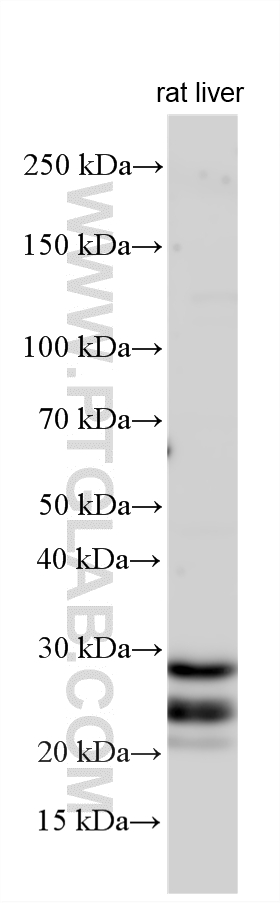
Tested Applications
Recommended dilution
| Application | Dilution |
|---|---|
| It is recommended that this reagent should be titrated in each testing system to obtain optimal results. | |
Product Information
33859-1-PBS targets PID1 in WB, Indirect ELISA applications and shows reactivity with human, rat samples.
| Tested Reactivity | human, rat |
| Host / Isotype | Rabbit / IgG |
| Class | Polyclonal |
| Type | Antibody |
| Immunogen |
CatNo: Ag40871 Product name: Recombinant human PID1 protein Source: e coli.-derived, PGEX-4T Tag: GST Domain: 1-168 aa of BC040164 Sequence: MWQPATERLQVTYLGKVSTTGMQFLSGCTEKPVIELWKKHTLAREDVFPANALLEIRPFQVWLHHLDHKGEATVHMDTFQVARIAYCTADHNVSPNIFAWVYREINDDLSYQMDCHAVECESKLEAKKLAHAMMEAFRKTFHSMKSDGRIHSNSSSEEVSQELESDDG 相同性解析による交差性が予測される生物種 |
| Full Name | phosphotyrosine interaction domain containing 1 |
| Calculated molecular weight | 168 aa, 19 kDa |
| Observed molecular weight | 25 kDa, 28 kDa |
| GenBank accession number | BC040164 |
| Gene Symbol | PID1 |
| Gene ID (NCBI) | 55022 |
| RRID | AB_3743098 |
| Conjugate | Unconjugated |
| Form | |
| Form | Liquid |
| Purification Method | Antigen affinity Purification |
| UNIPROT ID | Q7Z2X4 |
| Storage Buffer | PBS only{{ptg:BufferTemp}}7.3 |
| Storage Conditions | Store at -80°C. |
Background Information
PID1 is a cytoplasmic PTB-domain adaptor that negatively regulates insulin and IGF1 signaling, modulating AKT activity, glucose uptake, and mitochondrial function. Enriched in muscle, adipose tissue, and liver, PID1 promotes insulin resistance, impacts lipid handling, and contributes to metabolic disease. Its dysregulation also influences tumor metabolism and stress responses, underscoring PID1 as an important node linking growth factor signaling, energy homeostasis, and pathophysiology.