
Validation Data Gallery
Tested Applications
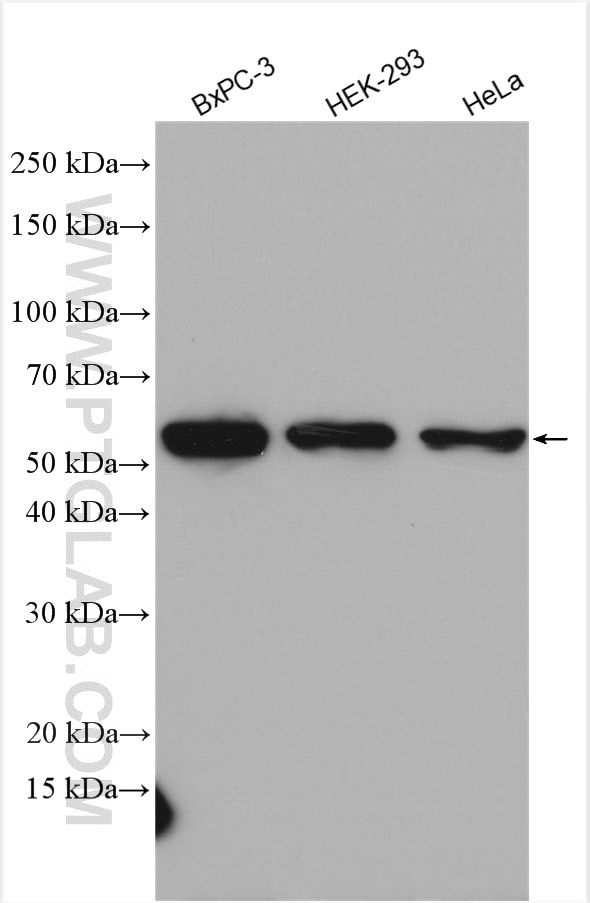
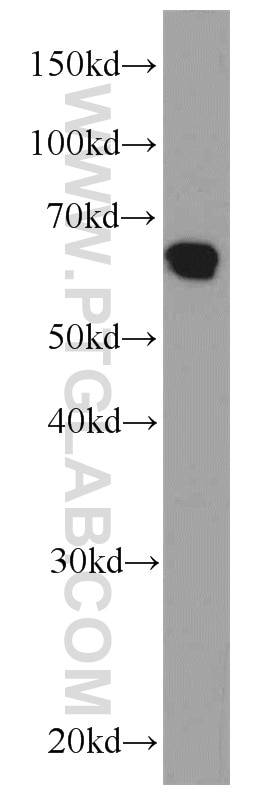
| Positive WB detected in | BxPC-3 cells, MCF-7 cells, HEK293 cells, HEK-293 cells, HeLa cells |
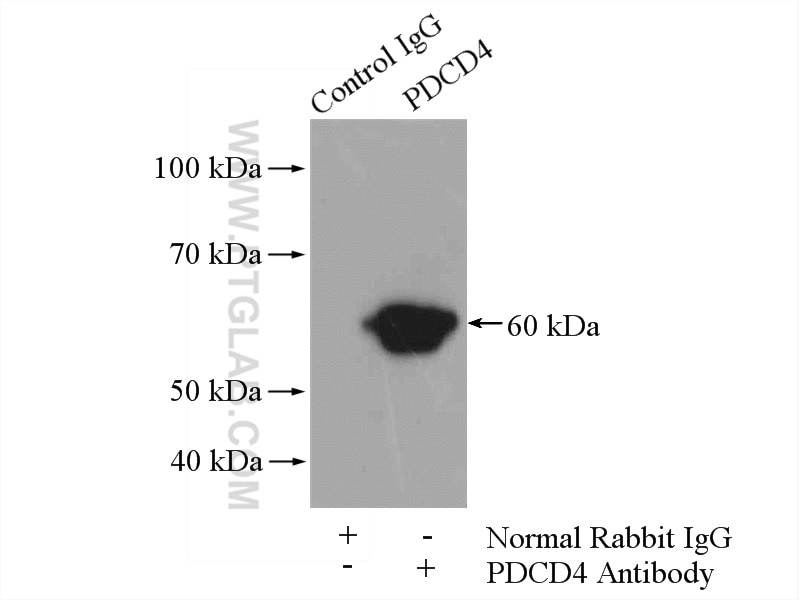
| Positive IP detected in | HeLa cells |
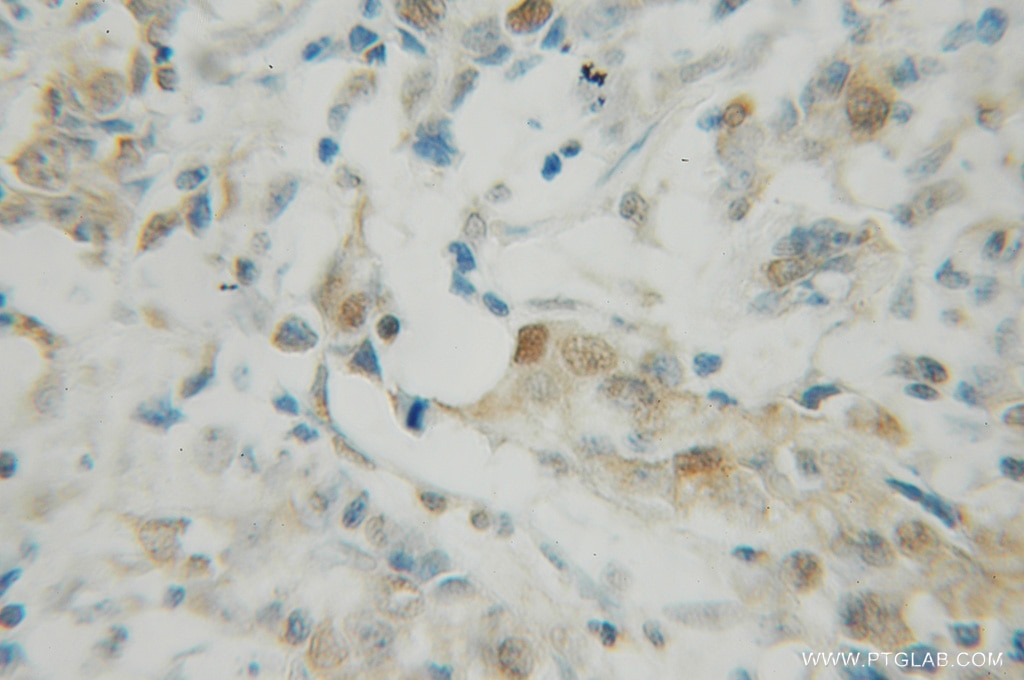
| Positive IHC detected in | human breast cancer tissue Note: suggested antigen retrieval with TE buffer pH 9.0; (*) Alternatively, antigen retrieval may be performed with citrate buffer pH 6.0 |
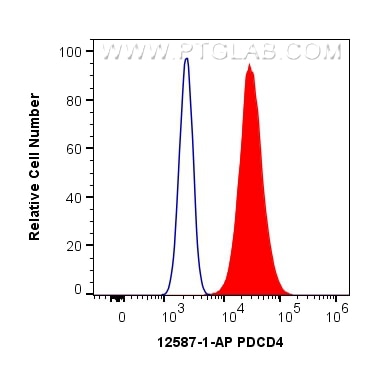
| Positive FC (Intra) detected in | MCF-7 cells |
Recommended dilution
| Application | Dilution |
|---|---|
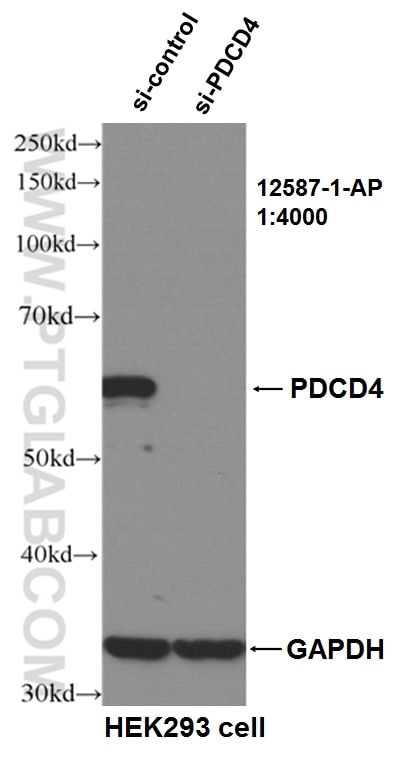
| Western Blot (WB) | WB : 1:1000-1:4000 |
| Immunoprecipitation (IP) | IP : 0.5-4.0 ug for 1.0-3.0 mg of total protein lysate |
| Immunohistochemistry (IHC) | IHC : 1:20-1:200 |
| Flow Cytometry (FC) (INTRA) | FC (INTRA) : 0.40 ug per 10^6 cells in a 100 µl suspension |
| It is recommended that this reagent should be titrated in each testing system to obtain optimal results. | |
| Sample-dependent, Check data in validation data gallery. | |
Published Applications
| KD/KO | See 9 publications below |
| WB | See 34 publications below |
| IHC | See 9 publications below |
| IF | See 3 publications below |
| IP | See 3 publications below |
Product Information
12587-1-AP targets PDCD4 in WB, IHC, IF, FC (Intra), IP, ELISA applications and shows reactivity with human samples.
| Tested Reactivity | human |
| Cited Reactivity | human, mouse, rat |
| Host / Isotype | Rabbit / IgG |
| Class | Polyclonal |
| Type | Antibody |
| Immunogen |
CatNo: Ag3288 Product name: Recombinant human PDCD4 protein Source: e coli.-derived, PGEX-4T Tag: GST Domain: 169-469 aa of BC026104 Sequence: TPIIQEYFEHGDTNEVAEMLRDLNLGEMKSGVPVLAVSLALEGKASHREMTSKLLSDLCGTVMSTTDVEKSFDKLLKDLPELALDTPRAPQLVGQFIARAVGDGILCNTYIDSYKGTVDCVQARAALDKATVLLSMSKGGKRKDSVWGSGGGQQSVNHLVKEIDMLLKEYLLSGDISEAEHCLKELEVPHFHHELVYEAIIMVLESTGESTFKMILDLLKSLWKSSTITVDQMKRGYERIYNEIPDINLDVPHSYSVLERFVEECFQAGIISKQLRDLCPSRGRKRFVSEGDGGRLKPESY 相同性解析による交差性が予測される生物種 |
| Full Name | programmed cell death 4 (neoplastic transformation inhibitor) |
| Calculated molecular weight | 469 aa, 52 kDa |
| Observed molecular weight | 54-64 kDa |
| GenBank accession number | BC026104 |
| Gene Symbol | PDCD4 |
| Gene ID (NCBI) | 27250 |
| RRID | AB_2162296 |
| Conjugate | Unconjugated |
| Form | |
| Form | Liquid |
| Purification Method | Antigen affinity purification |
| UNIPROT ID | Q53EL6 |
| Storage Buffer | PBS with 0.02% sodium azide and 50% glycerol{{ptg:BufferTemp}}7.3 |
| Storage Conditions | Store at -20°C. Stable for one year after shipment. Aliquoting is unnecessary for -20oC storage. |
Background Information
Programmed cell death 4 (Pdcd4) is a novel tumor suppressor that inhibits translation, progression and invasion. It was first identified as being differnetially upregulated during apoptosis. Pdcd4 interferes with the activity of the eukaryotic initiation factor (eIF) 4A by displacing the scaffold protein eIF4G from its binding to the RNA helicase eIF4A. The calculated molecular wight of unmodified PDCD4 protein is 52 kDa, but the modified protein is about 54-64 kDa.
Protocols
| Product Specific Protocols | |
|---|---|
| FC protocol for PDCD4 antibody 12587-1-AP | Download protocol |
| IHC protocol for PDCD4 antibody 12587-1-AP | Download protocol |
| IP protocol for PDCD4 antibody 12587-1-AP | Download protocol |
| WB protocol for PDCD4 antibody 12587-1-AP | Download protocol |
| Standard Protocols | |
|---|---|
| Click here to view our Standard Protocols |
Publications
| Species | Application | Title |
|---|---|---|
Nat Commun Stimulus-activated ribonuclease targeting chimeras for tumor microenvironment activated cancer therapy | ||
J Nanobiotechnology Cold exposure protects against medial arterial calcification development via autophagy | ||
Nucleic Acids Res Functional characterisation of tumour suppressor PDCD4 reveals previously undisclosed role in the control of cell adhesion.
| ||
Theranostics Localized injection of miRNA-21-enriched extracellular vesicles effectively restores cardiac function after myocardial infarction. | ||
Adv Sci (Weinh) Icaritin Represses Autophagy to Promote Colorectal Cancer Cell Apoptosis and Sensitized Low-Temperature Photothermal Therapy via Targeting HSP90-TXNDC9 Interactions | ||
Adv Sci (Weinh) Spatial Transcriptomics Reveals Transcriptomic and Immune Microenvironment Reprogramming during Thyroid Carcinoma Dedifferentiation.
|