
Validation Data Gallery
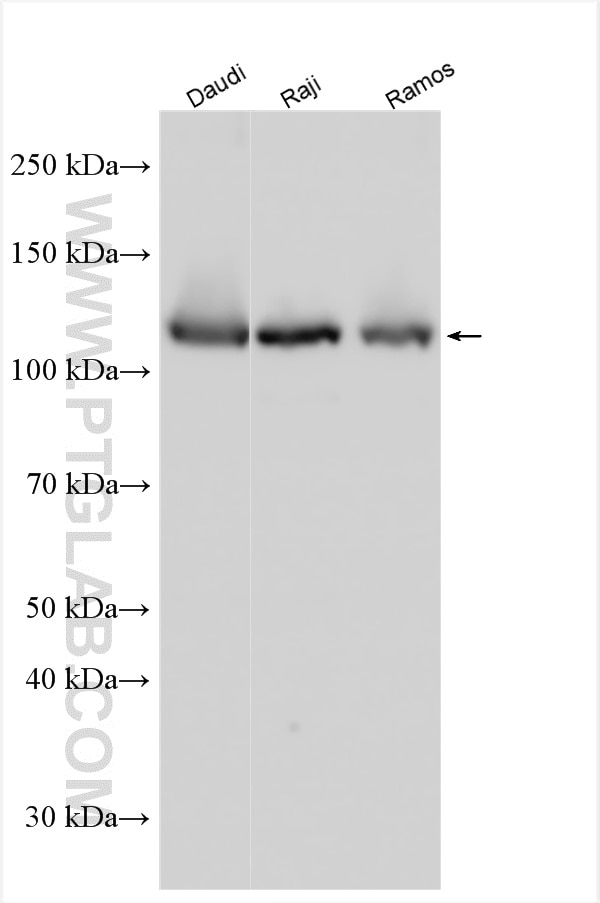
Tested Applications
Recommended dilution
| Application | Dilution |
|---|---|
| It is recommended that this reagent should be titrated in each testing system to obtain optimal results. | |
Product Information
31937-1-PBS targets PAPLN in WB, Indirect ELISA applications and shows reactivity with human samples.
| Tested Reactivity | human |
| Host / Isotype | Rabbit / IgG |
| Class | Polyclonal |
| Type | Antibody |
| Immunogen |
CatNo: Ag36224 Product name: Recombinant human PAPLN protein Source: e coli.-derived, PGEX-4T Tag: GST Domain: 760-870 aa of BC136623 Sequence: HGSCADWAARWYFVASVGQCNRFWYGGCHGNANNFASEQECMSSCQGSLHGPRRPQPGASGRSTHTDGGGSSPAGEQEPSQHRTGAAVQRKPWPSGGLWRQDQQPGPGEAP 相同性解析による交差性が予測される生物種 |
| Full Name | papilin, proteoglycan-like sulfated glycoprotein |
| Calculated molecular weight | 137 kDa / 119 kDa |
| Observed molecular weight | 120 kDa |
| GenBank accession number | BC136623 |
| Gene Symbol | PAPLN |
| Gene ID (NCBI) | 89932 |
| RRID | AB_3742497 |
| Conjugate | Unconjugated |
| Form | |
| Form | Liquid |
| Purification Method | Antigen affinity Purification |
| UNIPROT ID | O95428 |
| Storage Buffer | PBS only{{ptg:BufferTemp}}7.3 |
| Storage Conditions | Store at -80°C. |
Background Information
PAPLN (papilin, proteoglycan like sulfated glycoprotein) is a protein-coding gene located on human chromosome 14q24.2 that encodes a secreted glycoprotein belonging to the papilin family . Predicted to function as a serine-type endopeptidase inhibitor, PAPLN contains multiple conserved domains including thrombospondin type 1 repeats, Kunitz/BPTI domains, and immunoglobulin-like domains, which are characteristic of protease inhibitors involved in extracellular matrix organization . The protein is primarily localized to the basement membrane and plays a role in extracellular matrix organization and nervous system development . PAPLN is broadly expressed across human tissues, with highest expression levels observed in the spleen and kidney . Emerging research suggests its involvement in pelvic organ prolapse etiopathogenesis, highlighting its potential significance in connective tissue integrity .