
Validation Data Gallery
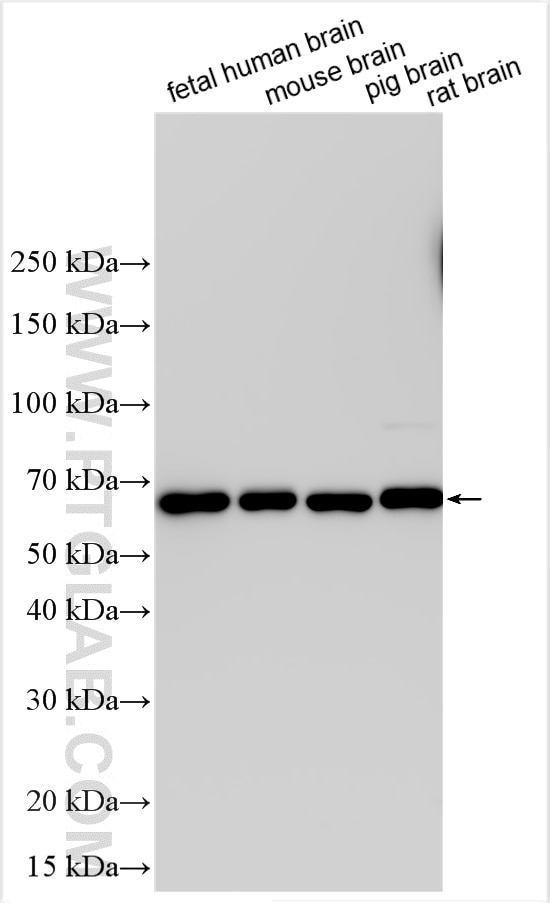
Tested Applications
Recommended dilution
| Application | Dilution |
|---|---|
| It is recommended that this reagent should be titrated in each testing system to obtain optimal results. | |
Product Information
32848-1-PBS targets PAK3 in WB, Indirect ELISA applications and shows reactivity with human, mouse, rat, pig samples.
| Tested Reactivity | human, mouse, rat, pig |
| Host / Isotype | Rabbit / IgG |
| Class | Polyclonal |
| Type | Antibody |
| Immunogen |
CatNo: Ag38566 Product name: Recombinant human PAK3 protein Source: e coli.-derived, PGEX-4T Tag: GST Domain: 1-55 aa of NM_001128173.2 Sequence: MSDGLDNEEKPPAPPLRMNSNNRDSSALNHSSKPLPMAPEEKNKKARLRSIFPGG 相同性解析による交差性が予測される生物種 |
| Full Name | p21 protein (Cdc42/Rac)-activated kinase 3 |
| Calculated molecular weight | 62kDa,559aa |
| Observed molecular weight | 64 kDa |
| GenBank accession number | NM_001128173.2 |
| Gene Symbol | PAK3 |
| Gene ID (NCBI) | 5063 |
| RRID | AB_3742762 |
| Conjugate | Unconjugated |
| Form | |
| Form | Liquid |
| Purification Method | Antigen affinity Purification |
| UNIPROT ID | O75914 |
| Storage Buffer | PBS only{{ptg:BufferTemp}}7.3 |
| Storage Conditions | Store at -80°C. |
Background Information
PAK3, also known as p21-activated kinase 3, is a member of the PAK family of serine/threonine protein kinases, classified as Group I PAK kinases along with PAK1 and PAK2. PAK3 is predominantly expressed in neural cells, especially in regions such as the brain. PAK3 plays a crucial role in dendritic spine development and synaptic plasticity. PAK3 plays an important role in cell migration and morphology. It regulates dynamic changes in the actomyosin cytoskeleton, microtubules, and adhesion interactions with the microenvironment. In neurons and other cell types, PAK3 contributes to cell migration, neurite growth, and dendritic spine morphogenesis by participating in signaling cascades that control cell adhesion and cell motility. Mutations in PAK3 are associated with X-linked non-syndromic intellectual disability.