
Validation Data Gallery
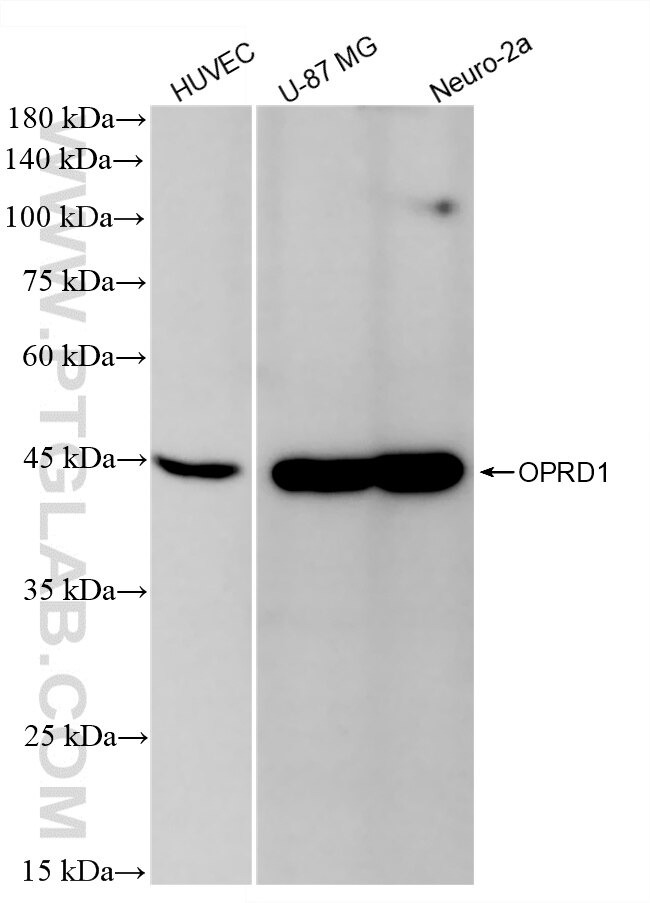
Tested Applications
Recommended dilution
| Application | Dilution |
|---|---|
| It is recommended that this reagent should be titrated in each testing system to obtain optimal results. | |
Product Information
87435-1-PBS targets OPRD1 in WB, Indirect ELISA applications and shows reactivity with human, mouse samples.
| Tested Reactivity | human, mouse |
| Host / Isotype | Rabbit / IgG |
| Class | Recombinant |
| Type | Antibody |
| Immunogen |
Peptide 相同性解析による交差性が予測される生物種 |
| Full Name | opioid receptor, delta 1 |
| Observed molecular weight | 45 kDa |
| GenBank accession number | NM_000911 |
| Gene Symbol | OPRD1 |
| Gene ID (NCBI) | 4985 |
| RRID | AB_3745544 |
| Conjugate | Unconjugated |
| Form | |
| Form | Liquid |
| Purification Method | Protein A purification |
| UNIPROT ID | P41143 |
| Storage Buffer | PBS only{{ptg:BufferTemp}}7.3 |
| Storage Conditions | Store at -80°C. |
Background Information
Opioid receptor delta 1 (OPRD1), also known as the δ-opioid receptor (DOR), is a class A G protein-coupled receptor (GPCR) that mediates the biological effects of endogenous opioid peptides such as enkephalins. OPRD1 primarily couples to Gi/Go proteins, leading to inhibition of adenylyl cyclase, reduced intracellular cAMP production, modulation of ion channel activity, and suppression of neurotransmitter release. It is widely expressed in the central and peripheral nervous systems, including the cortex, striatum, hippocampus, spinal cord, and sensory neurons, where it regulates analgesia, mood, reward, emotional processing, and neuroprotection. Compared with other opioid receptors, OPRD1 has attracted particular interest as a target for pain management with potentially reduced respiratory depression and abuse liability, although its pharmacology is complex and context dependent. Dysregulated OPRD1 signaling has been implicated in chronic pain, depression, anxiety, addiction, epilepsy, and neuroinflammatory disorders.