
Validation Data Gallery
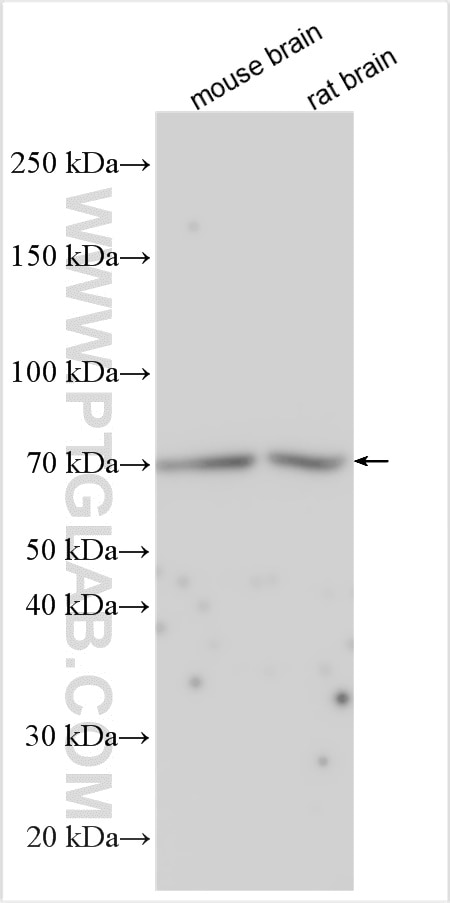
Tested Applications
Recommended dilution
| Application | Dilution |
|---|---|
| It is recommended that this reagent should be titrated in each testing system to obtain optimal results. | |
Product Information
31893-1-PBS targets NTN3 in WB, Indirect ELISA applications and shows reactivity with human, mouse, rat samples.
| Tested Reactivity | human, mouse, rat |
| Host / Isotype | Rabbit / IgG |
| Class | Polyclonal |
| Type | Antibody |
| Immunogen |
CatNo: Ag34435 Product name: Recombinant human NTN3 protein Source: e coli.-derived, PGEX-4T Tag: GST Domain: 28-207 aa of Netrin-3 Sequence: DPCHDEGGAPRGCVPGLVNAALGREVLASSTCGRPATRACDASDPRRAHSPALLTSPGGTASPLCWRSESLPRAPLNVTLTVPLGKAFELVFVSLRFCSAPPASVALLKSQDHGRSWAPLGFFSSHCDLDYGRLPAPANGPAGPGPEALCFPAPLAQPDGSGLLAFSMQDSSPPGLDLDS 相同性解析による交差性が予測される生物種 |
| Full Name | netrin 3 |
| Calculated molecular weight | 61 kDa |
| Observed molecular weight | 62-70 kDa |
| GenBank accession number | Netrin-3 |
| Gene Symbol | NTN3 |
| Gene ID (NCBI) | 4917 |
| RRID | AB_3670136 |
| Conjugate | Unconjugated |
| Form | |
| Form | Liquid |
| Purification Method | Antigen affinity Purification |
| UNIPROT ID | O00634 |
| Storage Buffer | PBS only{{ptg:BufferTemp}}7.3 |
| Storage Conditions | Store at -80°C. |
Background Information
NTN3 (Netrin-3), also known as NTN2L. NTN3 (Netrin-3) is predicted to be located in the Golgi apparatus and extracellular region, and it is also predicted to be active in the basement membrane. It is detected in various amounts in the skin, esophagus, bronchus, nasal cavity, kidney, and vagina in healthy human tissues (PMID: 37345154). The protein is predicted to enable signaling receptor binding activity and is involved in animal organ morphogenesis, neuron projection development, and tissue development. Netrins, including NTN3, are a group of proteins that exhibit structural homology to the extracellular matrix protein laminin and influence neurological and tumor progression. NTN3, along with other netrin family members, may play a role in tumor growth and migration in specific organs where they are expressed, potentially affecting disease progression. However, further research is needed to elucidate the precise prognostic and biological implications of NTN3 in various diseases, including cancer (PMID: 32251318). The molecular weight of NTN3 is 62 kDa. It is possible that the protein has glycosylation modification.