
Validation Data Gallery
Tested Applications
Recommended dilution
| Application | Dilution |
|---|---|
| It is recommended that this reagent should be titrated in each testing system to obtain optimal results. | |
Product Information
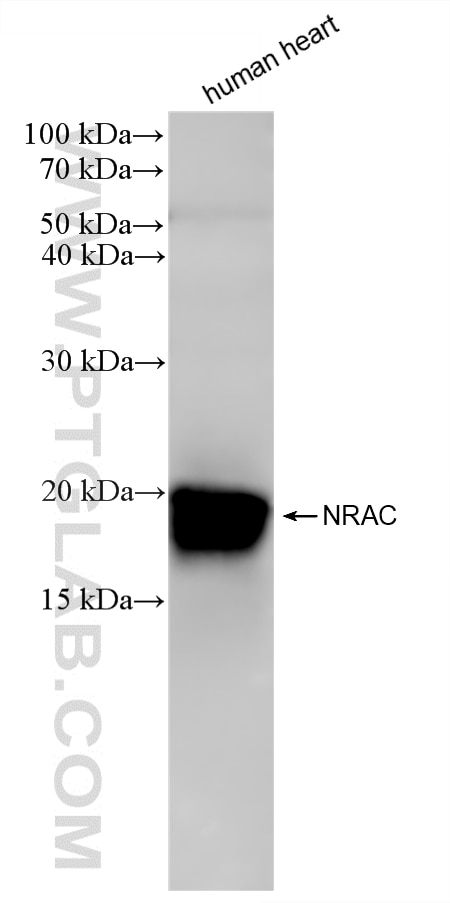
87528-1-PBS targets NRAC in WB, Indirect ELISA applications and shows reactivity with human samples.
| Tested Reactivity | human |
| Host / Isotype | Rabbit / IgG |
| Class | Recombinant |
| Type | Antibody |
| Immunogen |
CatNo: Eg6025 Product name: Recombinant human NRAC protein (C-rFc) Source: mammalian cells-derived, V37 Tag: C-rFc Domain: 1-100 aa of NM_001008404.2 Sequence: MRTAAGAVSPDSRPETRRQTRKNEEAAWGPRVCRAEREDNRKCPPSILKRSRPEHHRPEAKPQRTSRRVWFREPPAVTVHYIADKNATATVRVPGRPRPH 相同性解析による交差性が予測される生物種 |
| Full Name | chromosome 14 open reading frame 180 |
| Calculated molecular weight | 18 kDa |
| Observed molecular weight | 18 kDa |
| GenBank accession number | NM_001008404.2 |
| Gene Symbol | C14orf180 |
| Gene ID (NCBI) | 400258 |
| RRID | AB_3745600 |
| Conjugate | Unconjugated |
| Form | |
| Form | Liquid |
| Purification Method | Protein A purification |
| UNIPROT ID | Q8N912 |
| Storage Buffer | PBS only{{ptg:BufferTemp}}7.3 |
| Storage Conditions | Store at -80°C. |
Background Information
NRAC (Nutritionally Regulated Adipose and Cardiac enriched protein, with the human homologous gene designated as C14ORF180) is a recently identified adipocyte-specific double-pass transmembrane protein. Both its N- and C-termini are located intracellularly, containing only a short extracellular loop and no known enzymatic domains. Its expression is significantly induced during the differentiation of white and brown adipocytes and is regulated by nutritional status: fasting and obesity both downregulate its mRNA levels, suggesting its role as a "fat sensor" in energy homeostasis. Mechanistically, NRAC forms a trimeric complex via its first transmembrane domain with the fatty acid transporter core protein CD36 and the membrane microdomain protein caveolin-1. When extracellular fatty acid concentrations increase, NRAC undergoes ubiquitination and internalization, causing CD36 to dissociate from caveolin-1 and switch to clathrin-mediated endocytosis. This process enhances fatty acid uptake, leading to adipocyte hypertrophy and increased overall adipose mass.