
Validation Data Gallery
Tested Applications
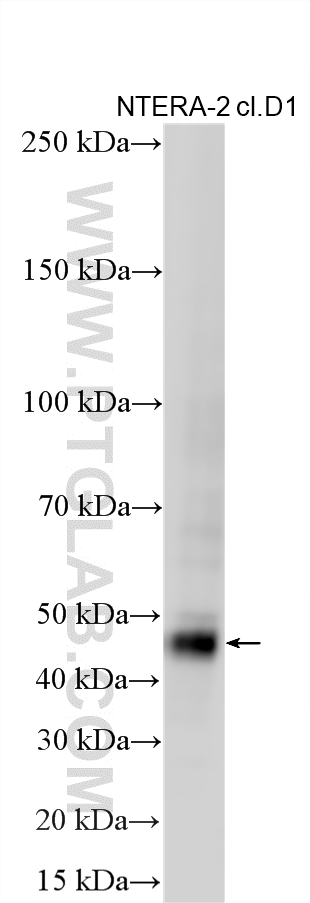
| Positive WB detected in | NTERA-2 cl.D1 cells |
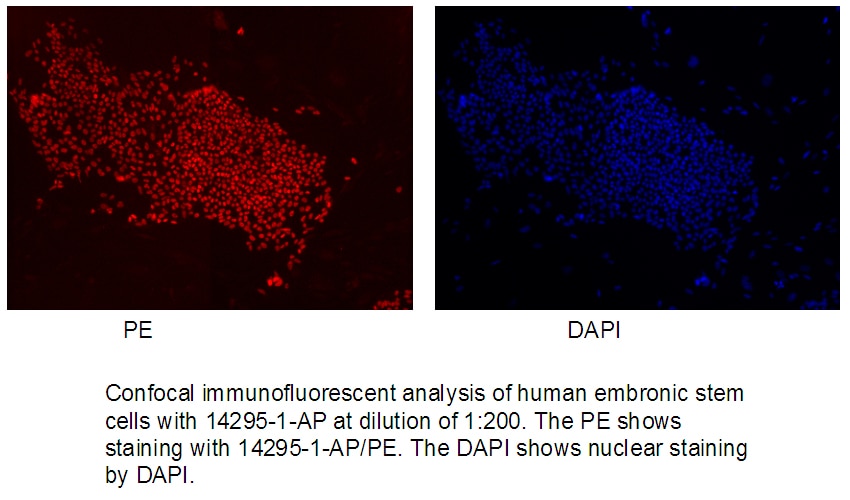
| Positive IF/ICC detected in | human embronic stem cells |
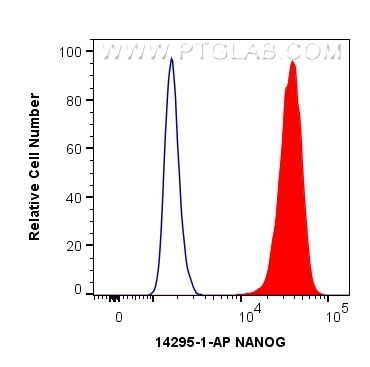
| Positive FC (Intra) detected in | NCCIT cells |
Recommended dilution
| Application | Dilution |
|---|---|
| Western Blot (WB) | WB : 1:1000-1:6000 |
| Immunofluorescence (IF)/ICC | IF/ICC : 1:20-1:200 |
| Flow Cytometry (FC) (INTRA) | FC (INTRA) : 0.40 ug per 10^6 cells in a 100 µl suspension |
| It is recommended that this reagent should be titrated in each testing system to obtain optimal results. | |
| Sample-dependent, Check data in validation data gallery. | |
Published Applications
| KD/KO | See 5 publications below |
| WB | See 219 publications below |
| IHC | See 27 publications below |
| IF | See 114 publications below |
Product Information
14295-1-AP targets Nanog in WB, IHC, IF/ICC, FC (Intra), ELISA applications and shows reactivity with human samples.
| Tested Reactivity | human |
| Cited Reactivity | human, mouse, rat, pig, chicken, marmoset |
| Host / Isotype | Rabbit / IgG |
| Class | Polyclonal |
| Type | Antibody |
| Immunogen |
CatNo: Ag5645 Product name: Recombinant human NANOG protein Source: e coli.-derived, PGEX-4T Tag: GST Domain: 1-305 aa of BC160187 Sequence: MSVDPACPQSLPCFEASDCKESSPMPVICGPEENYPSLQMSSAEMPHTETVSPLPSSMDLLIQDSPDSSTSPKGKQPTSAEKSVAKKEDKVPVKKQKTRTVFSSTQLCVLNDRFQRQKYLSLQQMQELSNILNLSYKQVKTWFQNQRMKSKRWQKNNWPKNSNGVTQKASAPTYPSLYSSYHQGCLVNPTGNLPMWSNQTWNNSTWSNQTQNIQSWSNHSWNTQTWCTQSWNNQAWNSPFYNCGEESLQSCMQFQPNSPASDLEAALEAAGEGLNVIQQTTRYFSTPQTMDLFLNYSMNMQPEDV 相同性解析による交差性が予測される生物種 |
| Full Name | Nanog homeobox |
| Calculated molecular weight | 35 kDa |
| Observed molecular weight | 42 kDa |
| GenBank accession number | BC160187 |
| Gene Symbol | Nanog |
| Gene ID (NCBI) | 79923 |
| RRID | AB_1607719 |
| Conjugate | Unconjugated |
| Form | |
| Form | Liquid |
| Purification Method | Antigen affinity purification |
| UNIPROT ID | Q9H9S0 |
| Storage Buffer | PBS with 0.02% sodium azide and 50% glycerol{{ptg:BufferTemp}}7.3 |
| Storage Conditions | Store at -20°C. Stable for one year after shipment. Aliquoting is unnecessary for -20oC storage. |
Background Information
Nanog is a member of the homeobox family of DNA binding transcription factors and has been shown to maintain embryonic stem (ES) cell self-renewal independently of leukemia inhibitory factor (LIF)/Stat3. Nanog mRNA is present in pluripotent mouse and human cell lines, and absent from differentiated cells. Functionally, Nanog works together with other key pluripotent factors (Oct4, Sox2, and Lin28) to reprogram human fibroblasts and generate induced pluripotent stem (iPS) cells. These key factors form a regulatory network to support or limit each other's expression level, which maintains the properties of ES cells. Affinity purified rabbit anti-Nanog can be used to demonstrate pluripotency of ES and IPS cells. There are two kinds of variants that can be recognized by NANOG, one is a normal form (~39 kDa), the other is a post-translation modified form (~48 kDa) (21136380 ). Nanog has two isoforms with molecular weights of 34.4 kDa and 31.9 kDa. (PMID: 21969378)
Protocols
| Product Specific Protocols | |
|---|---|
| FC protocol for Nanog antibody 14295-1-AP | Download protocol |
| WB protocol for Nanog antibody 14295-1-AP | Download protocol |
| Standard Protocols | |
|---|---|
| Click here to view our Standard Protocols |
Publications
| Species | Application | Title |
|---|---|---|
Signal Transduct Target Ther WIP1 promotes cancer stem cell properties by inhibiting p38 MAPK in NSCLC. | ||
Mol Cancer Myeloid-derived suppressor cells endow stem-like qualities to multiple myeloma cells by inducing piRNA-823 expression and DNMT3B activation. | ||
Mol Cancer Integrated single-cell and spatial transcriptomic profiling decodes lineage plasticity and immune microenvironment remodeling in prostate cancer progression. | ||
Mol Cancer Circular RNA circIPO11 drives self-renewal of liver cancer initiating cells via Hedgehog signaling. | ||
Cancer Commun (Lond) PLEK2 promotes cancer stemness and tumorigenesis of head and neck squamous cell carcinoma via the c-Myc-mediated positive feedback loop | ||
Nat Genet A GGC-repeat expansion in ZFHX3 encoding polyglycine causes spinocerebellar ataxia type 4 and impairs autophagy |