
Recombinant mouse HE4/WFDC2 protein
Species
Mouse
Purity
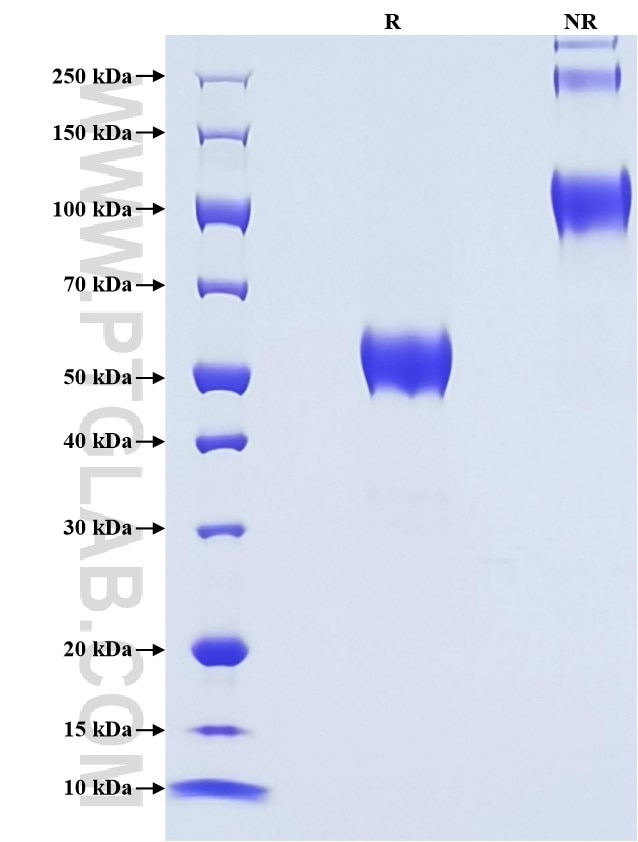
>90 %, SDS-PAGE
Tag
mFc Tag
Activity
not tested
Cat no : Eg3534
Validation Data Gallery
Product Information
| Purity | >90 %, SDS-PAGE |
| Endotoxin | <0.1 EU/μg protein, LAL method |
| Activity |
Not tested |
| Expression | HEK293-derived Mouse HE4 protein Thr26-Phe174 (Accession# Q9DAU7) with a mouse IgG Fc tag at the C-terminus. |
| GeneID | 67701 |
| Accession | Q9DAU7 |
| PredictedSize | 42.1 kDa |
| SDS-PAGE | 50-60 kDa, reducing (R) conditions |
| Formulation | Lyophilized from 0.22 μm filtered solution in PBS, pH 7.4. Normally 5% trehalose and 5% mannitol are added as protectants before lyophilization. |
| Reconstitution | Briefly centrifuge the tube before opening. Reconstitute at 0.1-0.5 mg/mL in sterile water. |
| Storage Conditions |
It is recommended that the protein be aliquoted for optimal storage. Avoid repeated freeze-thaw cycles.
|
| Shipping | The product is shipped at ambient temperature. Upon receipt, store it immediately at the recommended temperature. |
Background
Wfdc2 (Whey Acidic Protein Four Disulfide Core Domain 2) is a protease inhibitor that is highly expressed in the lung and is enriched in the nasopharynx. It is the most highly expressed family member in differentiated epithelial cells isolated from the trachea, nasal passages, and middle ear. Wfdc2 consists of 5 exons with exon 3 encoding an unstructured linker region that separates the two WFDC domains. This genomic organization appears to be restricted to the Muridae and Cricetidae families of rodents. Similar to the situation in humans, mouse Wfdc2 can be alternatively spliced to yield a number of distinct transcripts that have the potential to generate a repertoire of distinct protein isoforms.
References:
1. Jeong H, et al. (2021) Gastroenterology. 161(3):953-967.e15.
2. Zhang T, et al. (2020) Biochem Biophys Res Commun. 522(2):456-462.
3. Nakajima K, et al. (2019) Dis Model Mech. 12(11): dmm040139.