
Recombinant Mouse TNFR2/CD120b protein (His Tag)
Species
Mouse
Purity
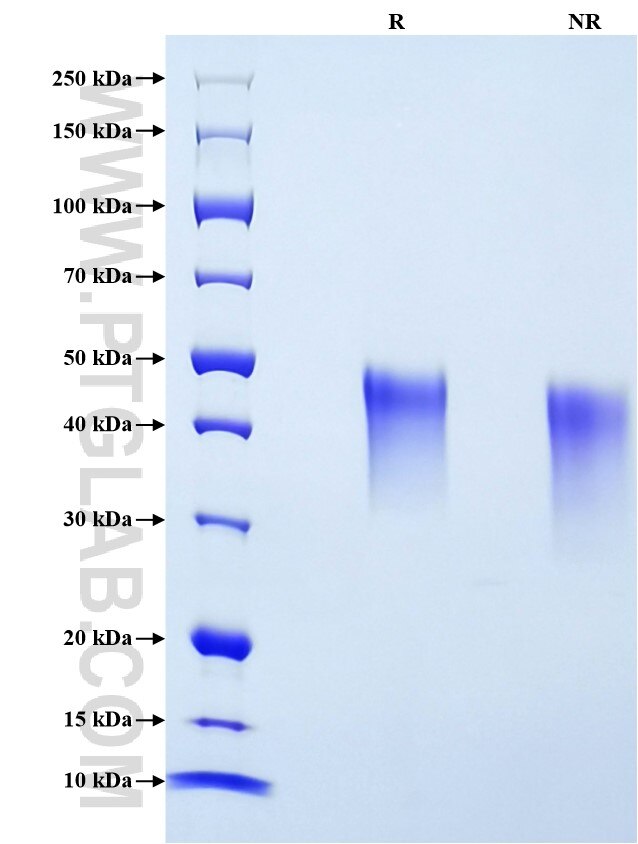
>90 %, SDS-PAGE
Tag
His Tag
Activity
not tested
Cat no : Eg0683
Validation Data Gallery
Product Information
| Purity | >90 %, SDS-PAGE |
| Endotoxin | <0.1 EU/μg protein, LAL method |
| Activity |
Not tested |
| Expression | HEK293-derived Mouse TNFR2 protein Val23-Gly258 (Accession# Q545P4) with a His tag at the C-terminus. |
| GeneID | 21938 |
| Accession | Q545P4 |
| PredictedSize | 26.4 kDa |
| SDS-PAGE | 40-50 kDa, reducing (R) conditions |
| Formulation | Lyophilized from 0.22 μm filtered solution in PBS, pH 7.4. Normally 5% trehalose and 5% mannitol are added as protectants before lyophilization. |
| Reconstitution | Briefly centrifuge the tube before opening. Reconstitute at 0.1-0.5 mg/mL in sterile water. |
| Storage Conditions |
It is recommended that the protein be aliquoted for optimal storage. Avoid repeated freeze-thaw cycles.
|
| Shipping | The product is shipped at ambient temperature. Upon receipt, store it immediately at the recommended temperature. |
Background
TNFR2, also known as CD120b, TNFRSF1B or p75, is a member of the tumor necrosis factor receptor superfamily, which also contains TNFRSF1A. Tumor necrosis factor (TNF, TNFSF2) is a multifunctional cytokine that plays a key role in regulating inflammation, immune functions, host defense, and apoptosis. TNF signals through TNFRSF1A and TNFRSF1B. TNFRSF1A is widely expressed, whereas TNFRSF1B exhibits more restricted expression, being found on CD4 and CD8 T lymphocytes, endothelial cells, microglia, oligodendrocytes, neuron subtypes, cardiac myocytes, thymocytes and human mesenchymal stem cells. Both TNFRSF1A and TNFRSF1B can also exist in soluble forms, probably derived by proteolytic cleavage from the cell surface forms. Various defects in the TNFRSF1B pathway, due to polymorphisms in the TNFRSF1B gene, upregulated expression of TNFRSF1B and TNFRSF1B shedding, have been implicated in the pathology of several autoimmune disorders.
References:
1. Islam A, et al. (2006) J Biol Chem. 281 (10):6860-6873.
2. Faustman D, et al. (2010) Nat Rev Drug Discov. 9 (6):482-493.
3. Cabal-Hierro L, et al. (2012) Cell Signal. 24 (6):1297-1305.
4. Diez-Ruiz A, et al. (1995) Eur J Haematol. 54 (1):1-8.