
Recombinant Mouse Serpina1a protein (rFc Tag)
Species
Mouse
Purity
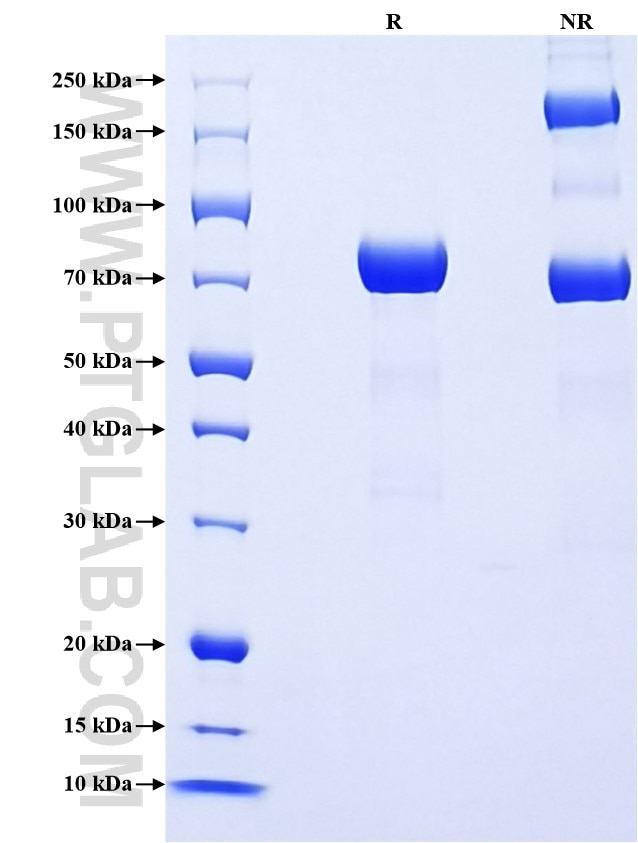
>90 %, SDS-PAGE
Tag
rFc Tag
Activity
not tested
Cat no : Eg3047
Validation Data Gallery
Product Information
| Purity | >90 %, SDS-PAGE |
| Endotoxin | <0.1 EU/μg protein, LAL method |
| Activity |
Not tested |
| Expression | HEK293-derived Mouse Serpina1a protein Glu25-Lys413 (Accession# P07758) with a rabbit IgG Fc tag at the C-terminus. |
| GeneID | 20700 |
| Accession | P07758 |
| PredictedSize | 69.5 kDa |
| SDS-PAGE | 68-85 kDa, reducing (R) conditions |
| Formulation | Lyophilized from 0.22 μm filtered solution in PBS, pH 7.4. Normally 5% trehalose and 5% mannitol are added as protectants before lyophilization. |
| Reconstitution | Briefly centrifuge the tube before opening. Reconstitute at 0.1-0.5 mg/mL in sterile water. |
| Storage Conditions |
It is recommended that the protein be aliquoted for optimal storage. Avoid repeated freeze-thaw cycles.
|
| Shipping | The product is shipped at ambient temperature. Upon receipt, store it immediately at the recommended temperature. |
Background
Serpina1a alo known as Alpha-1-antitrypsin (A1AT), it is an acute phase serine proteinase inhibitor, which is synthesized and secreted as a glycoprotein by hepatocytes and alveolar macrophages in humans to protect tissue from degradation by endogenous neutrophil elastase (NE). Severe A1AT deficiency is a congenital disorder, which occurs due to certain missense point mutations in the serum protease inhibitor, member 1 (SERPINA1) gene. The most predominant of these mutations is the Z-mutation, accounting for >95% of clinical A1AT deficiency cases. This point mutation results in substitution of glutamic acid at position 342 with lysine (E342K), which destabilizes the adjacent reactive centre loop (RCL).
References:
1. Eggenschwiler R. et al. (2019) Sci Rep. 9(1):7486.
2. Murphy MP. et al. (2024) Am J Physiol Lung Cell Mol Physiol. 327(4):L600-L606.
3. Zieger M. et al. (2022) Mol Ther Methods Clin Dev. 25:425-438.