
Recombinant Mouse SEMA4G protein (rFc Tag)
Species
Mouse
Purity
>90 %, SDS-PAGE
Tag
rFc Tag
Activity
not tested
Cat no : Eg2777
Validation Data Gallery
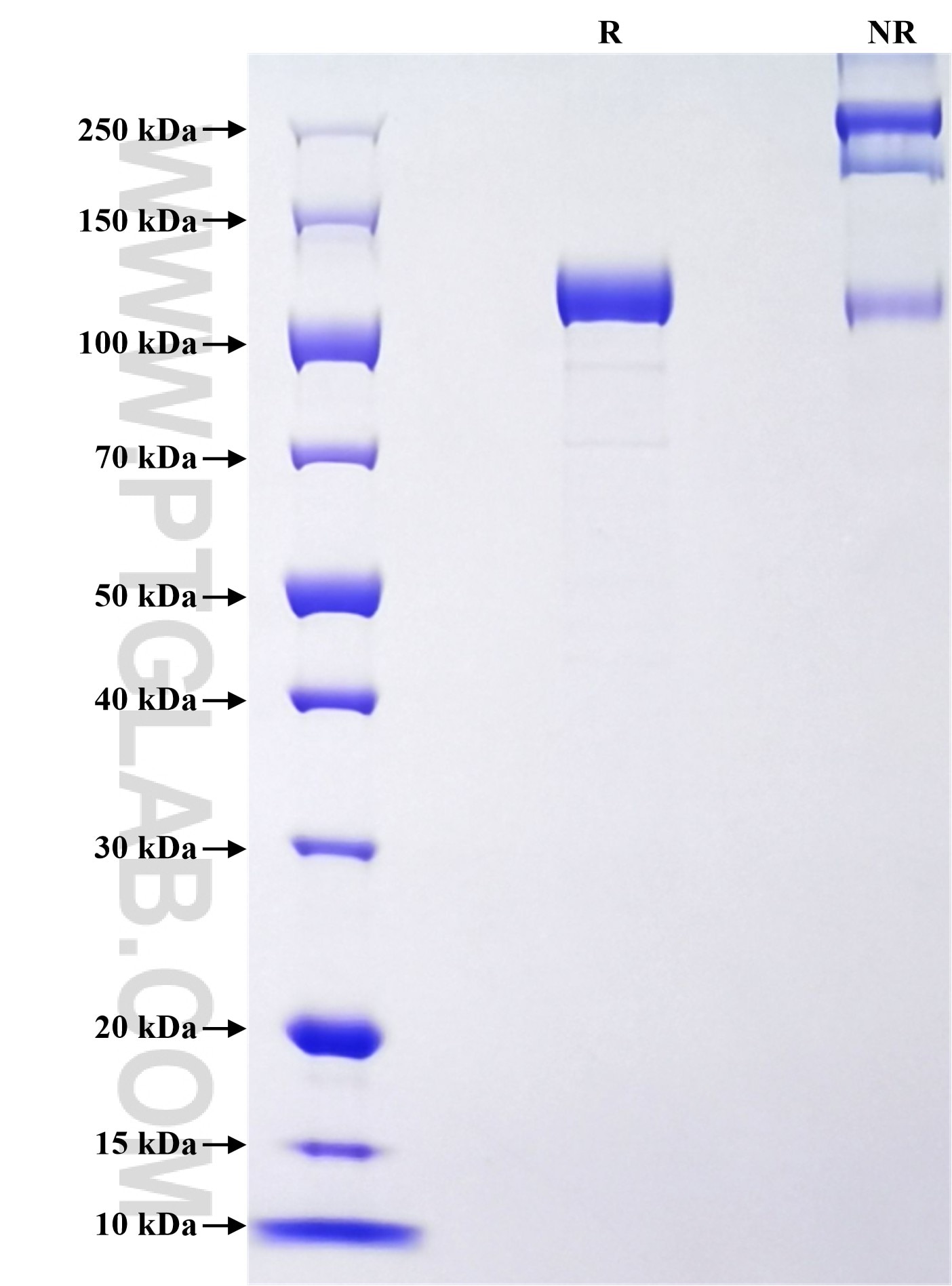
Product Information
| Purity | >90 %, SDS-PAGE |
| Endotoxin | <0.1 EU/μg protein, LAL method |
| Activity |
Not tested |
| Expression | HEK293-derived Mouse SEMA4G protein Val18-Met673 (Accession# Q9WUH7) with a rabbit IgG Fc tag at the C-terminus. |
| GeneID | 26456 |
| Accession | Q9WUH7 |
| PredictedSize | 98.8 kDa |
| SDS-PAGE | 110-130 kDa, reducing (R) conditions |
| Formulation | Lyophilized from 0.22 μm filtered solution in PBS, pH 7.4. Normally 5% trehalose and 5% mannitol are added as protectants before lyophilization. |
| Reconstitution | Briefly centrifuge the tube before opening. Reconstitute at 0.1-0.5 mg/mL in sterile water. |
| Storage Conditions |
It is recommended that the protein be aliquoted for optimal storage. Avoid repeated freeze-thaw cycles.
|
| Shipping | The product is shipped at ambient temperature. Upon receipt, store it immediately at the recommended temperature. |
Background
Semaphorins constitute a large and growing gene family, several members of which are axon guidance molecules. SEMA4G, a novel class IV member of the semaphorin gene family, located on mouse chromosome 19. SEMA4G is expressed early in development in the brain, spinal cord, and several sensory organs as well as specific populations of projection neurons, compatible with the well-established function of semaphorins as axon guidance molecules.
References:
1. Li, H et al. Mechanisms of development vol. 87,1-2 (1999): 169-73.
2. Jiang, Dongjun et al. Neoplasma vol. 71,1 (2024): 1-12.
3. Nojima, Satoshi. Pathology international vol. 72,10 (2022): 471-487.