
Recombinant Mouse Selp/P-selectin protein (His Tag)
Species
Mouse
Purity
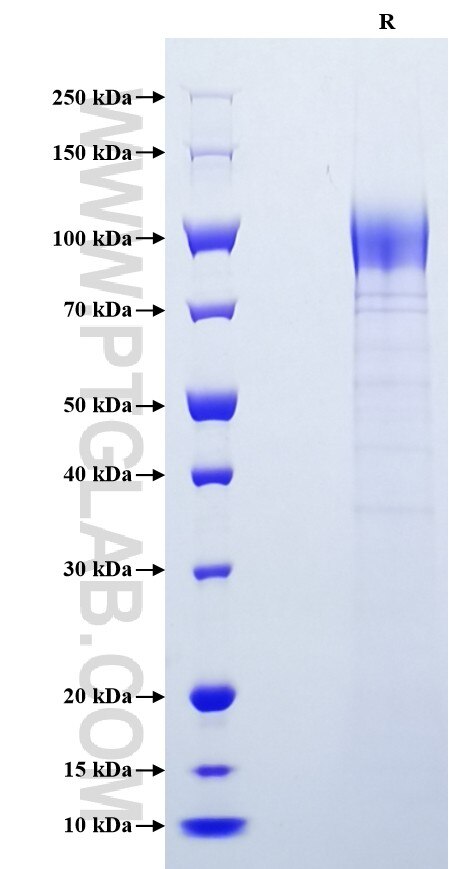
>90 %, SDS-PAGE
Tag
His Tag
Activity
not tested
Cat no : Eg0691
Validation Data Gallery
Product Information
| Purity | >90 %, SDS-PAGE |
| Endotoxin | <0.1 EU/μg protein, LAL method |
| Activity |
Not tested |
| Expression | HEK293-derived Mouse Selp protein Trp42-Ala709 (Accession# Q01102) with a His tag at the C-terminus. |
| GeneID | 20344 |
| Accession | Q01102 |
| PredictedSize | 73.6 kDa |
| SDS-PAGE | 85-120 kDa, reducing (R) conditions |
| Formulation | Lyophilized from 0.22 μm filtered solution in PBS, pH 7.4. Normally 5% trehalose and 5% mannitol are added as protectants before lyophilization. |
| Reconstitution | Briefly centrifuge the tube before opening. Reconstitute at 0.1-0.5 mg/mL in sterile water. |
| Storage Conditions |
It is recommended that the protein be aliquoted for optimal storage. Avoid repeated freeze-thaw cycles.
|
| Shipping | The product is shipped at ambient temperature. Upon receipt, store it immediately at the recommended temperature. |
Background
P-sectieln, also named as SELP, GMP-140 or CD62P, is a transmembrane glycoprotein that mediates the interaction of activated endothelial cells or platelets with leukocytes. It is an adhesion molecule involved in the pathogenesis of inflammation, thrombosis, and oncogenesis. P-selectin is stored in the alpha-granules of platelets and Weibel-Palade bodies of endothelial cells. Upon cell activation by agonists, P-selectin is transported rapidly to the cell surface. Soluble P-selectin is produced by platelets and endothelial cells and circulates in normal plasma.
References:
1. Koedam, J A et al. The Journal of cell biology vol. 116,3 (1992): 617-25.
2. Dunlop, L C et al. The Journal of experimental medicine vol. 175,4 (1992): 1147-50.
3. Davì, G et al. Circulation vol. 97,10 (1998): 953-7.
4. Pasquali, Alessandra et al. Molecular and cellular probes vol. 24,3 (2010): 161-5.
5. Panicker, Sumith R et al. Blood vol. 130,2 (2017): 181-191.