
Recombinant Mouse RAMP2 protein (rFc Tag)
Species
Mouse
Purity
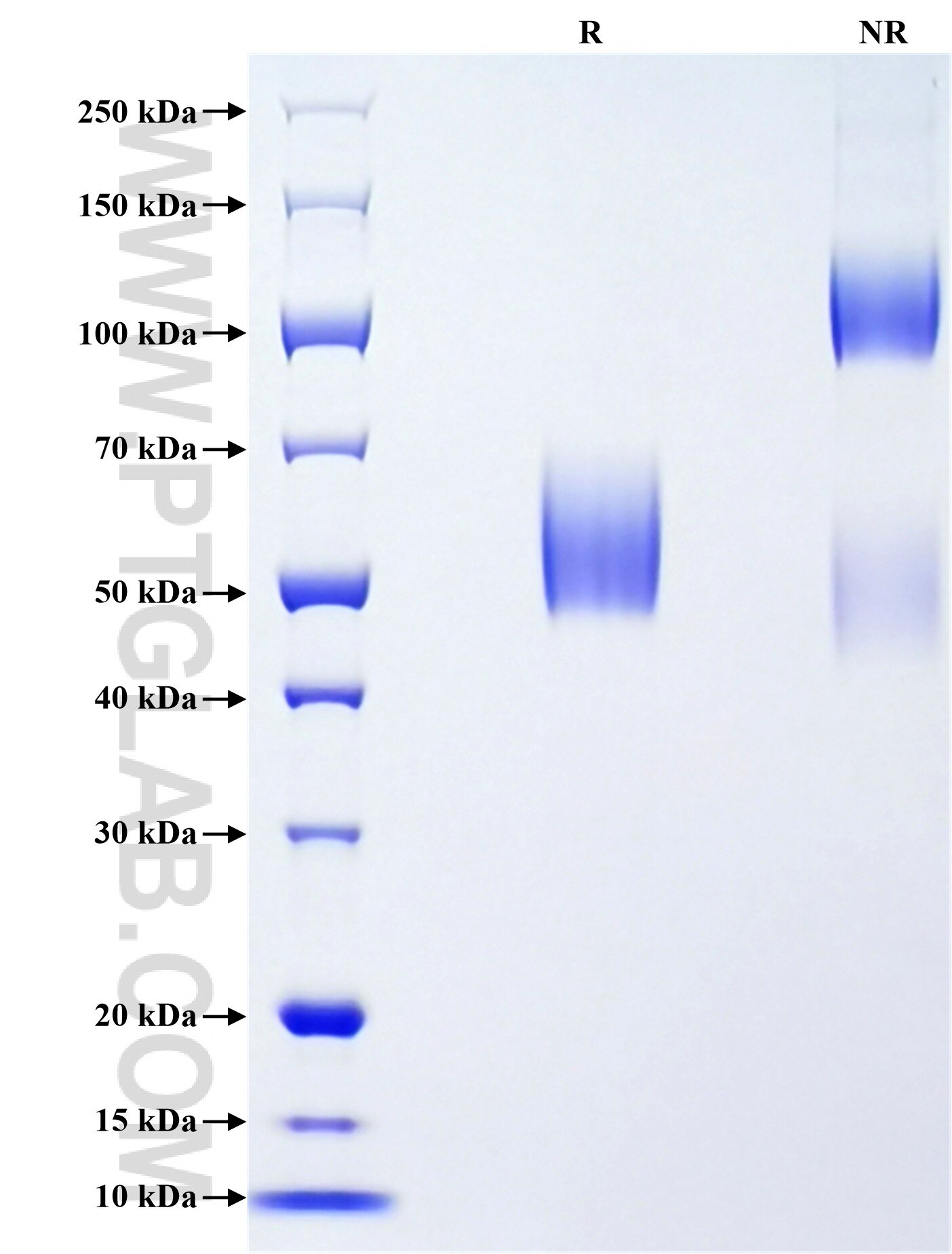
>90 %, SDS-PAGE
Tag
rFc Tag
Activity
not tested
Cat no : Eg9065
Validation Data Gallery
Product Information
| Purity | >90 %, SDS-PAGE |
| Endotoxin | <0.1 EU/μg protein, LAL method |
| Activity |
Not tested |
| Expression | HEK293-derived Mouse RAMP2 protein Ser45-Glu157 (Accession# Q9WUP0) with a rabbit IgG Fc tag at the C-terminus. |
| GeneID | 54409 |
| Accession | Q9WUP0 |
| PredictedSize | 38.5 kDa |
| SDS-PAGE | 48-68 kDa, reducing (R) conditions |
| Formulation | Lyophilized from 0.22 μm filtered solution in PBS, pH 7.4. Normally 5% trehalose and 5% mannitol are added as protectants before lyophilization. |
| Reconstitution | Briefly centrifuge the tube before opening. Reconstitute at 0.1-0.5 mg/mL in sterile water. |
| Storage Conditions |
It is recommended that the protein be aliquoted for optimal storage. Avoid repeated freeze-thaw cycles.
|
| Shipping | The product is shipped at ambient temperature. Upon receipt, store it immediately at the recommended temperature. |
Background
RAMP2 (receptor-activity-modifying protein) is a member of the RAMP family of single-transmembrane-domain proteins which consist of an N-terminal extracellular domain, a transmembrane region and a short intracellular C-terminal tail. RAMPs are required to transport calcitonin-receptor-like receptor (CRLR) to the plasma membrane. CRLR, a G protein-coupled receptor, can function as either a calcitonin gene-related peptide (CGRP) receptor or an adrenomedullin receptor, depending on which members of the RAMP family are expressed. RAMP1 transports the CRLR to the plasma membrane and then remains associated with it to function as a terminally glycosylated CGRP receptor, while RAMP2 and RAMP3 transfer the CRLR to the cell surface to generate receptors that are preferentially selective for adrenomedullin.
References:
1. McLatchie, L M et al. Nature vol. 393,6683 (1998): 333-9.
2. Bouschet, Tristan et al. Journal of cell science vol. 118,Pt 20 (2005): 4709-20.