
Recombinant Mouse PLGF/PGF protein (His Tag)
Species
Mouse
Purity
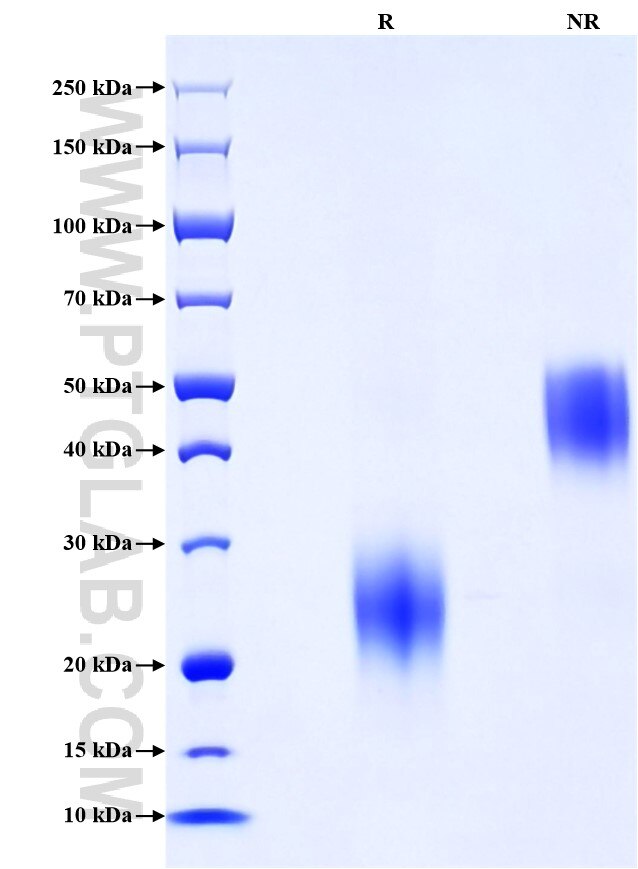
>90 %, SDS-PAGE
Tag
His Tag
Activity
not tested
Cat no : Eg0672
Validation Data Gallery
Product Information
| Purity | >90 %, SDS-PAGE |
| Endotoxin | <0.1 EU/μg protein, LAL method |
| Activity |
Not tested |
| Expression | HEK293-derived Mouse PLGF protein Ala27-Pro158 (Accession# Q544A5) with a His tag at the C-terminus. |
| GeneID | 18654 |
| Accession | Q544A5 |
| PredictedSize | 16.2 kDa |
| SDS-PAGE | 20-30 kDa, reducing (R) conditions |
| Formulation | Lyophilized from 0.22 μm filtered solution in PBS, pH 7.4. Normally 5% trehalose and 5% mannitol are added as protectants before lyophilization. |
| Reconstitution | Briefly centrifuge the tube before opening. Reconstitute at 0.1-0.5 mg/mL in sterile water. |
| Storage Conditions |
It is recommended that the protein be aliquoted for optimal storage. Avoid repeated freeze-thaw cycles.
|
| Shipping | The product is shipped at ambient temperature. Upon receipt, store it immediately at the recommended temperature. |
Background
PlGF (placenta growth factor), also named as PGF, is an angiogenic factor which belongs to vascular endothelial growth factor (VEGF) family. The human PlGF gene is located on chromosome 14q14 and encodes 4 isoforms of PlGF. The protein is secreted as a glycosylated homodimer and PlGF-1 and -3 are diffusible isoforms whereas PlGF-2 and PlGF-4 have heparin binding domains. PlGF was originally identified in the placenta, where it regulates growth and differentiation of trophoblasts. It is also expressed in umbilical vein endothelial cells and other non-placental tissues, like the thyroid gland and developing lung tissue. PlGF has angiogenic properties, enhancing survival, growth and migration of endothelial cells in vitro, and promotes vessel formation in certain in-vivo models. Serum levels of PIGF and sFlt-1 (also known as soluble VEGF receptor-1) are altered in women with preeclampsia. PIGF is a potential biomarker for preeclampsia, a condition in which blood vessels in the placenta are too narrow, resulting in high blood pressure.
References:
1. Khalil A. et al. (2008) PLoS One. 23;3(7):e2766.
2. Dewerchin M. et al. (2012) Cold Spring Harb Perspect Med. 1;2(8).
3. Oura H. et .at. (2003) Blood.101(2):560-7.
4. Duhig KE. et al. (2019) Lancet. 393(10183):1807-1818.