
Recombinant Mouse NKG2A protein (rFc Tag)
Species
Mouse
Purity
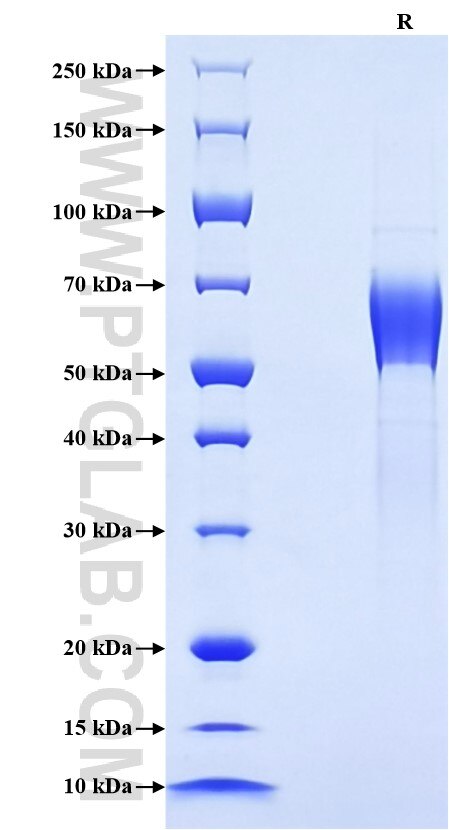
>90 %, SDS-PAGE
Tag
rFc Tag
Activity
not tested
Cat no : Eg1508
Validation Data Gallery
Product Information
| Purity | >90 %, SDS-PAGE |
| Endotoxin | <0.1 EU/μg protein, LAL method |
| Activity |
Not tested |
| Expression | HEK293-derived Mouse NKG2A protein Ala94-Ile244 (Accession# Q9Z202) with a rabbit IgG Fc tag at the N-terminus. |
| GeneID | 16641 |
| Accession | Q9Z202 |
| PredictedSize | 44.4 kDa |
| SDS-PAGE | 50-70 kDa, reducing (R) conditions |
| Formulation | Lyophilized from 0.22 μm filtered solution in PBS, pH 7.4. Normally 5% trehalose and 5% mannitol are added as protectants before lyophilization. |
| Reconstitution | Briefly centrifuge the tube before opening. Reconstitute at 0.1-0.5 mg/mL in sterile water. |
| Storage Conditions |
It is recommended that the protein be aliquoted for optimal storage. Avoid repeated freeze-thaw cycles.
|
| Shipping | The product is shipped at ambient temperature. Upon receipt, store it immediately at the recommended temperature. |
Background
KLRC1, also known as NKG2A (NKG2) and CD159A, is a single-pass type II membrane protein with extracellular C-type lectin domain. It belongs to the natural killer cell lectin-like receptor family, which is a group of transmembrane proteins preferentially expressed in NK cells. KLRC1 can form a heterodimer with CD94. The NKG2A/CD94 complex is an inhibitory receptor that recognizes HLA-E and is expressed by NK cells and a subset of T cells NKG2A specifically binds HLA-E, a non-classical HLA class I molecule frequently overexpressed in tumors, leading to the transmission of inhibitory signals that strongly impair NK cell function.
References:
1.Kyrysyuk O, Wucherpfennig KW. (2023) Annu Rev Immunol. 41:17-38.
2.Mac Donald A, et al. (2023) Front Immunol. 14:1231916.