
Recombinant Mouse Haptoglobin protein (His Tag)
Species
Mouse
Purity
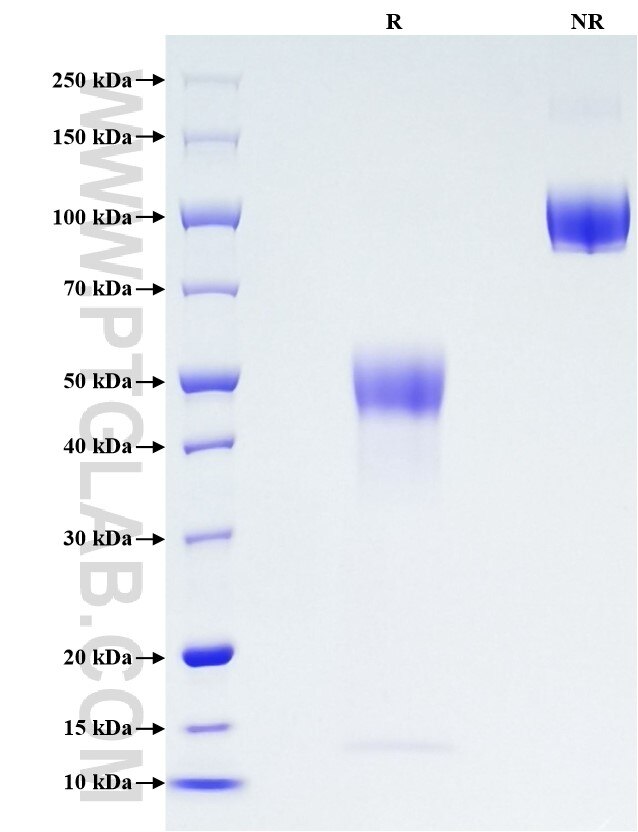
>90 %, SDS-PAGE
Tag
His Tag
Activity
not tested
Cat no : Eg1197
Validation Data Gallery
Product Information
| Purity | >90 %, SDS-PAGE |
| Endotoxin | <0.1 EU/μg protein, LAL method |
| Activity |
Not tested |
| Expression | HEK293-derived Mouse Haptoglobin protein Val19-Asn347 (Accession# Q61646) with a His tag at the C-terminus. |
| GeneID | 15439 |
| Accession | Q61646 |
| PredictedSize | 37.9 kDa |
| SDS-PAGE | 45-55 kDa, reducing (R) conditions |
| Formulation | Lyophilized from 0.22 μm filtered solution in PBS, pH 7.4. Normally 5% trehalose and 5% mannitol are added as protectants before lyophilization. |
| Reconstitution | Briefly centrifuge the tube before opening. Reconstitute at 0.1-0.5 mg/mL in sterile water. |
| Storage Conditions |
It is recommended that the protein be aliquoted for optimal storage. Avoid repeated freeze-thaw cycles.
|
| Shipping | The product is shipped at ambient temperature. Upon receipt, store it immediately at the recommended temperature. |
Background
Haptoglobin(HP), also named as zonulin, is a plasma glycoprotein and belongs to the peptidase S1 family. As a kind of acute-phase response protein, serum Hp is mainly synthesized by hepatocytes and is widely distributed in the circulation in humans. The main physiological function of serum Hp is binding free hemoglobin released from red blood cell lysis and protecting tissues and vessels from oxidative damage. The level of Hp is a useful biomarker for some diseases diagnosis, such as Hepatocellular carcinoma, Pancreatic cancer, Type 2 diabetes mellitus, Diabetes kidney disease, and so on.
References:
1. Andersen C B, et al. (2017). Antioxidants & Redox Signaling. 26(14):814.
2. Alayash A I, et al. (2013).Trends in Biotechnolog. 31(1):2-3.
3. Wang S, et al. (2019). Cardiovascular Diabetolog. 18(1).
4. Moriwaki K, et al. (2006). Japan Journal of Molecular Tumor Marker Research. 21(11):2803-2808.
5. Dalal K, et al. (2019). Clinica Chimica Acta. 495:309-317.
6. Shinton N K, et al. (1965). Journal of Clinical Pathology. 18(1):114-118.
7. Bhensdadia N M, et al. (2013). Kidney International. 83(6):1136-1143.
8. Gurung R L, et al. (2018). Scientific Reports. 8(1):5109.