
Recombinant Mouse Complement factor I protein (rFc Tag)
Species
Mouse
Purity
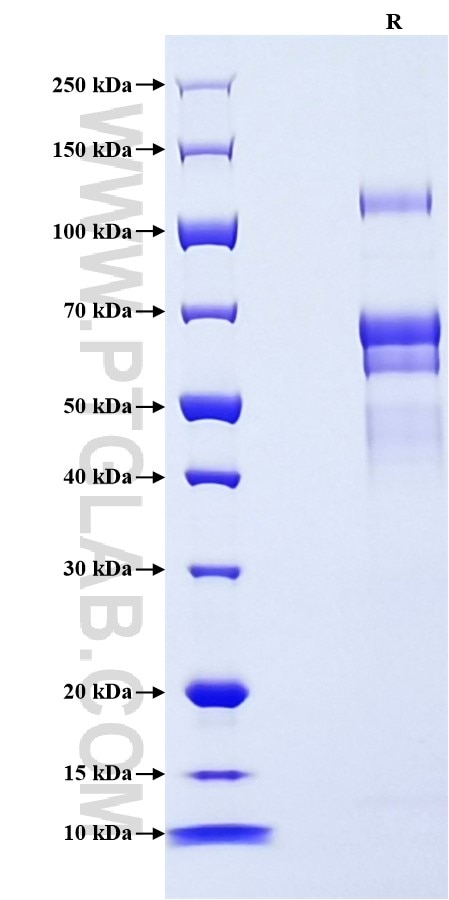
>90 %, SDS-PAGE
Tag
rFc Tag
Activity
not tested
Cat no : Eg2685
Validation Data Gallery
Product Information
| Purity | >90 %, SDS-PAGE |
| Endotoxin | <0.1 EU/μg protein, LAL method |
| Activity |
Not tested |
| Expression | HEK293-derived Mouse Complement factor I protein Arg19-Val603 (Accession# Q61129) with a rabbit IgG Fc tag at the C-terminus. |
| GeneID | 12630 |
| Accession | Q61129 |
| PredictedSize | 91.3 kDa |
| SDS-PAGE | 40-50 kDa, 55-70 kDa and 110-120 kDa, reducing (R) conditions |
| Formulation | Lyophilized from 0.22 μm filtered solution in PBS, pH 7.4. Normally 5% trehalose and 5% mannitol are added as protectants before lyophilization. |
| Reconstitution | Briefly centrifuge the tube before opening. Reconstitute at 0.1-0.5 mg/mL in sterile water. |
| Storage Conditions |
It is recommended that the protein be aliquoted for optimal storage. Avoid repeated freeze-thaw cycles.
|
| Shipping | The product is shipped at ambient temperature. Upon receipt, store it immediately at the recommended temperature. |
Background
Complement factor I (FI) is the nexus for classical, lectin and alternative pathway complement regulation. FI is produced and secreted predominantly and constitutively by hepatocytes (PMID: 11532284). FI is an 88 kDa plasma protein that circulates in an inactive configuration until it forms a trimolecular complex with its cofactor and substrate whereupon a structural reorganization allows the catalytic triad to cleave its substrates, C3b and C4b. In keeping with its role as the master complement regulatory enzyme, deficiency has been linked to immunopathology. In the setting of complete FI deficiency, a consumptive C3 deficiency results in recurrent infections with encapsulated microorganisms. Aseptic cerebral inflammation and vasculitic presentations are also less commonly observed. Heterozygous mutations in the factor I gene (CFI) have been demonstrated to be enriched in atypical haemolytic uraemic syndrome, albeit with a very low penetrance. Haploinsufficiency of CFI has also been associated with decreased retinal thickness and is a strong risk factor for the development of age-related macular degeneration (PMID: 37478687).
References:
1.Schlaf G. et al. (2021). Mol Immunol. 38(2-3):231-9.
2. Hallam TM. et al. (2023). Immunobiology. 228(5):152410.