
Recombinant Mouse Cfd protein (rFc Tag)
Species
Mouse
Purity
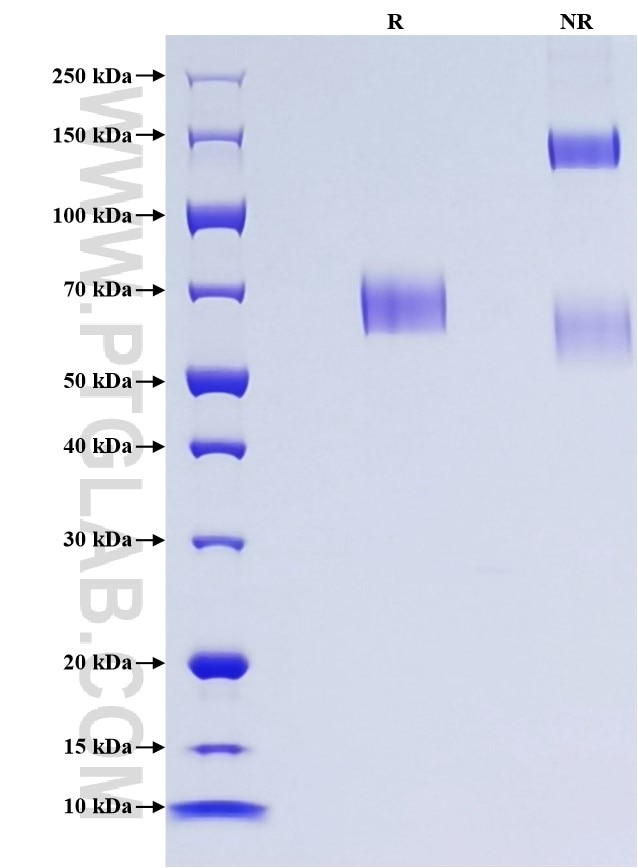
>90 %, SDS-PAGE
Tag
rFc Tag
Activity
not tested
Cat no : Eg3077
Validation Data Gallery
Product Information
| Purity | >90 %, SDS-PAGE |
| Endotoxin | <0.1 EU/μg protein, LAL method |
| Activity |
Not tested |
| Expression | HEK293-derived Mouse Cfd protein Gln21-Ser259 (Accession# P03953-1) with a rabbit IgG Fc tag at the C-terminus. |
| GeneID | 11537 |
| Accession | P03953-1 |
| PredictedSize | 52.1 kDa |
| SDS-PAGE | 60-75 kDa, reducing (R) conditions |
| Formulation | Lyophilized from 0.22 μm filtered solution in PBS, pH 7.4. Normally 5% trehalose and 5% mannitol are added as protectants before lyophilization. |
| Reconstitution | Briefly centrifuge the tube before opening. Reconstitute at 0.1-0.5 mg/mL in sterile water. |
| Storage Conditions |
It is recommended that the protein be aliquoted for optimal storage. Avoid repeated freeze-thaw cycles.
|
| Shipping | The product is shipped at ambient temperature. Upon receipt, store it immediately at the recommended temperature. |
Background
Cfd is a crucial component of the complement system, playing a significant role in host defense and immune regulation. The protein encoded by the Cfd gene is a member of the chymotrypsin family of serine proteases. It plays an essential role in host defense as the rate-limiting enzyme in the alternative pathway of complement activation. Complement factor D activates a convertase (C3bBb) responsible for cleavage of the complement protein C3, which leads to the activation of terminal complement component C5-9 to form the membrane attack complex on microbial or cellular surfaces. Cfd knockout mice display impaired alternative pathway activation of the complement system and increased susceptibility to pneumococcal infection. These mice have a defect in the activation of the alternative pathway, leading to a reduced ability to clear pathogens. Mouse models have been used to study the function of Cfd in various disease states, and its human ortholog CFD is a promising candidate for the development of therapeutic strategies for metabolic and inflammatory diseases.
References:
1. Wang L, Gao P, et al. (2023) J Cachexia Sarcopenia Muscle. 14(5):2152-2167.
2. Cho M, Hwang JS, et al. (2024) Int J Mol Sci. 25(18):9877.
3. Ito S, Hashimoto H, et al. (2022) Nat Commun. 13(1):5409.
4. Ma L, Gilani A, et al. (2024) JCI Insight. 9(11):e178925.