
Recombinant Mouse CXCL9 protein (rFc Tag)
Cat no : Eg3314
Validation Data Gallery
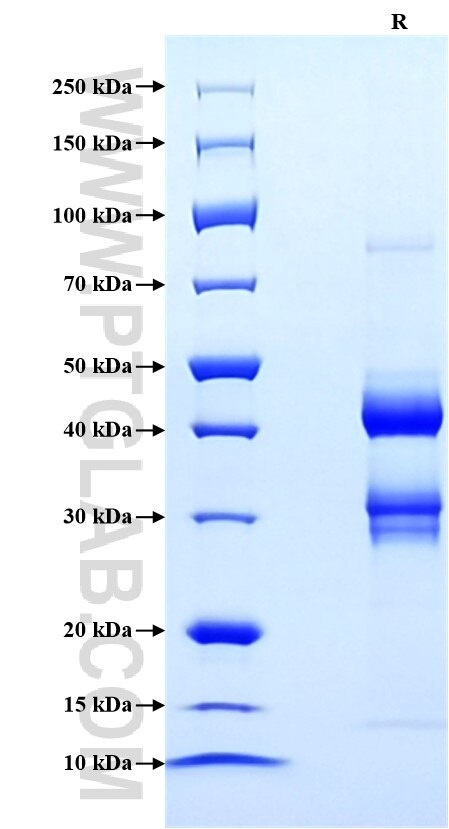
Product Information
| Purity | >90 %, SDS-PAGE |
| Endotoxin | <0.1 EU/μg protein, LAL method |
| Activity |
Not tested |
| Expression | CHO-derived Mouse CXCL9 protein Thr22-Thr126 (Accession# P18340) with a rabbit IgG Fc tag at the C-terminus. |
| GeneID | 17329 |
| Accession | P18340 |
| PredictedSize | 38.4 kDa |
| SDS-PAGE | 28-32 kDa and 40-46 kDa, reducing (R) conditions |
| Formulation | Lyophilized from 0.22 μm filtered solution in 30 mM Tris, 0.5 M Arg, pH 8.0. Normally 5% trehalose and 5% mannitol are added as protectants before lyophilization. |
| Reconstitution | Briefly centrifuge the tube before opening. Reconstitute at 0.1-0.5 mg/mL in sterile water. |
| Storage Conditions |
It is recommended that the protein be aliquoted for optimal storage. Avoid repeated freeze-thaw cycles.
|
| Shipping | The product is shipped at ambient temperature. Upon receipt, store it immediately at the recommended temperature. |
Background
CXCL9, also known as gamma-interferon induced monokine (MIG), is a member of the CXC family and plays an important role in the chemotaxis of the immune cells. It is produced by various immune and non-immune cells. CXCL9 can bind to the G protein-coupled receptor CXCR3 and recruit CXCR3 receptor expressed cells including activated T cells and NK cells. It has been shown to play a role in the immune checkpoint therapy. As a tumor suppressor, CXCL9 can recruit the tumor-infiltrating CD8+ T cells and NK cells, and CXCL9/CXCR3-B can inhibit the endothelial cell proliferation and tumor angiogenesis. As a tumor promoter, CXCL9/CXCR3-A can promote the tumor migration and invasion through the PI3K pathway, MAPK pathway, etc.
References:
1. Chateauvieux S. et al. (2011) Biochem Pharmacol. 15; 82(10): 1291-303.
2. Ding Q. et al. (2016) Cancer Med. 5(11):3246-3259.
3. Müller M. et al. (2010) Neuropathol Appl Neurobiol. 36(5): 368-87.
4. Shahabuddin S. et al. (2006) Am J Physiol Cell Physiol. 291(1): C34-9.
Publications
| Species | Title |
|---|---|
Mol Cell Endocrinol Liraglutide promotes osteogenic differentiation of mesenchymal stem cells by inhibiting M1 macrophage polarization and CXCL9 release in vitro. |