
Recombinant Mouse CD81 protein (rFc Tag)
Species
Mouse
Purity
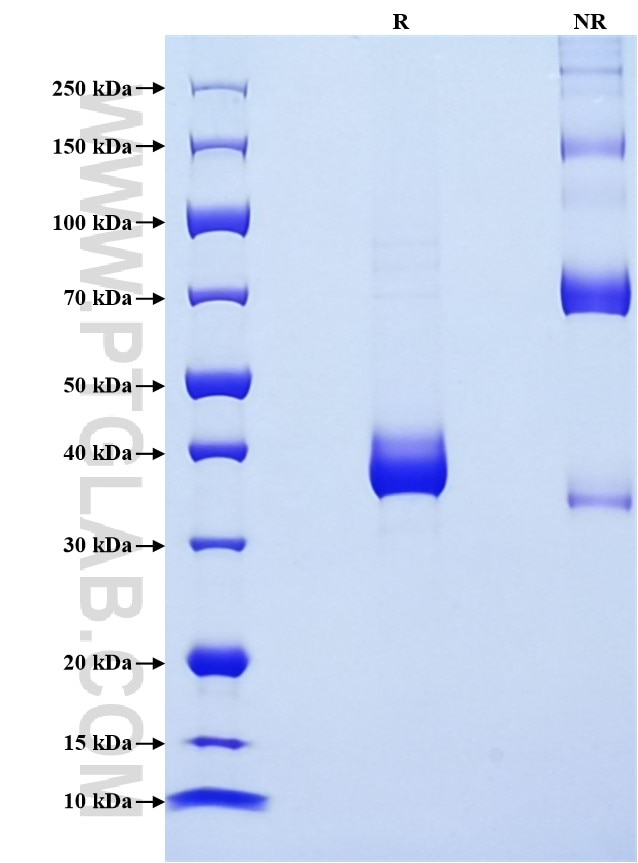
>90 %, SDS-PAGE
Tag
rFc Tag
Activity
not tested
Cat no : Eg3833
Validation Data Gallery
Product Information
| Purity | >90 %, SDS-PAGE |
| Endotoxin | <0.1 EU/μg protein, LAL method |
| Activity |
Not tested |
| Expression | HEK293-derived Mouse CD81 protein Val106-Val211 (Accession# P35762) with a rabbit IgG Fc tag at the N-terminus. |
| GeneID | 12520 |
| Accession | P35762 |
| PredictedSize | 38.7 kDa |
| SDS-PAGE | 37-40 kDa, reducing (R) conditions |
| Formulation | Lyophilized from 0.22 μm filtered solution in PBS, pH 7.4. Normally 5% trehalose and 5% mannitol are added as protectants before lyophilization. |
| Reconstitution | Briefly centrifuge the tube before opening. Reconstitute at 0.1-0.5 mg/mL in sterile water. |
| Storage Conditions |
It is recommended that the protein be aliquoted for optimal storage. Avoid repeated freeze-thaw cycles.
|
| Shipping | The product is shipped at ambient temperature. Upon receipt, store it immediately at the recommended temperature. |
Background
Introduction CD81 was originally named a target of an anti-proliferative antibody-1; it was discovered by screening different monoclonal antibodies capable of inhibiting B-cell lymphoma proliferation . The importance of CD81 in the immune system was later demonstrated by knocking down the molecule in mice. Comparisons of immune functions in wild-type and CD81KO (CD81 knockout) mice have shown that CD81 is not necessary for normal development of T and B lymphocytes; however, it is important for B-cell proliferation, proper humoral immune responses and for CD19 expression on the membrane of B lymphocytes.
References:
1. Oren, R., et al. (1990). Mol. Cell. Biol. 10, 4007–4015.
2. Maecker, H.T., et al. (1997). J. Exp. Med. 185, 1505–1510.
3. Miyazaki, T., et al. (1997). EMBO, J. 16, 4217–4225.