
Recombinant Mouse ALPL protein (rFc Tag)
Species
Mouse
Purity
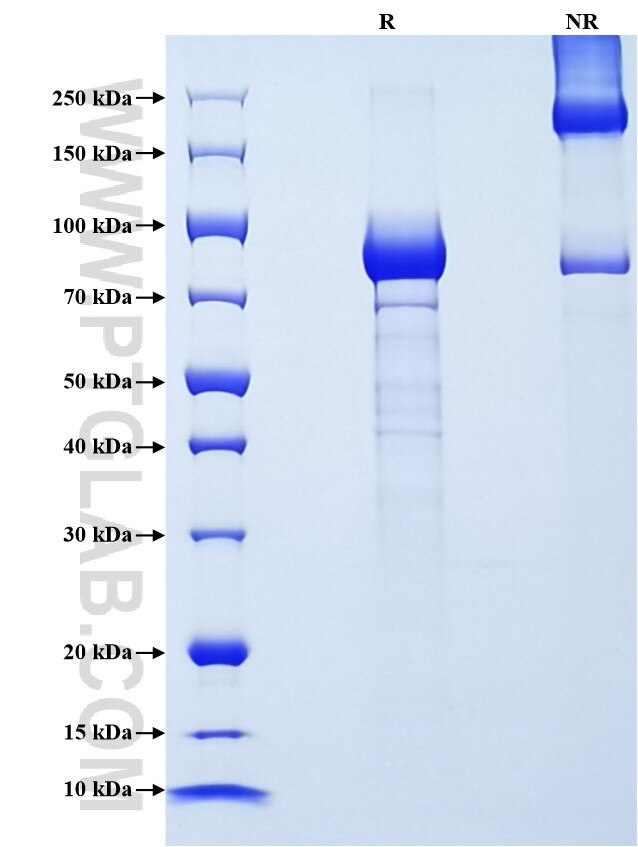
>90 %, SDS-PAGE
Tag
rFc Tag
Activity
not tested
Cat no : Eg2714
Validation Data Gallery
Product Information
| Purity | >90 %, SDS-PAGE |
| Endotoxin | <0.1 EU/μg protein, LAL method |
| Activity |
Not tested |
| Expression | HEK293-derived Mouse ALPL protein Phe18-Gly501 (Accession# P09242) with a rabbit IgG Fc tag at the C-terminus. |
| GeneID | 11647 |
| Accession | P09242 |
| PredictedSize | 79.5 kDa |
| SDS-PAGE | 85-95 kDa, reducing (R) conditions |
| Formulation | Lyophilized from 0.22 μm filtered solution in PBS, pH 7.4. Normally 5% trehalose and 5% mannitol are added as protectants before lyophilization. |
| Reconstitution | Briefly centrifuge the tube before opening. Reconstitute at 0.1-0.5 mg/mL in sterile water. |
| Storage Conditions |
It is recommended that the protein be aliquoted for optimal storage. Avoid repeated freeze-thaw cycles.
|
| Shipping | The product is shipped at ambient temperature. Upon receipt, store it immediately at the recommended temperature. |
Background
ALPL(Alkaline phosphatase, tissue-nonspecific isozyme) is also named as AP-TNAP, TNSALP and belongs to the alkaline phosphatase family. It can exsit as a homodimer with the molecular weight of 140 kDa. ALPL was synthesized as a 66-kDa endo-b-N-acetylglucos-aminidase H (Endo H)-sensitive form, and processed to an 80-kDa mature form, which is anchored to the plasma membrane via glycosylphosphatidylinositol (GPI).This antibody can bind the four mentioned alkaline phosphatases.
References:
1. Sogabe N, et al. (2008). Biomed Res. 29(4):213-9.
2. Fukushi-Irié M, et al. (2000). Biochem J. 15;348 Pt 3(Pt 3):633-42.