
Recombinant Mouse ALPPL2 protein (rFc Tag)
Species
Mouse
Purity
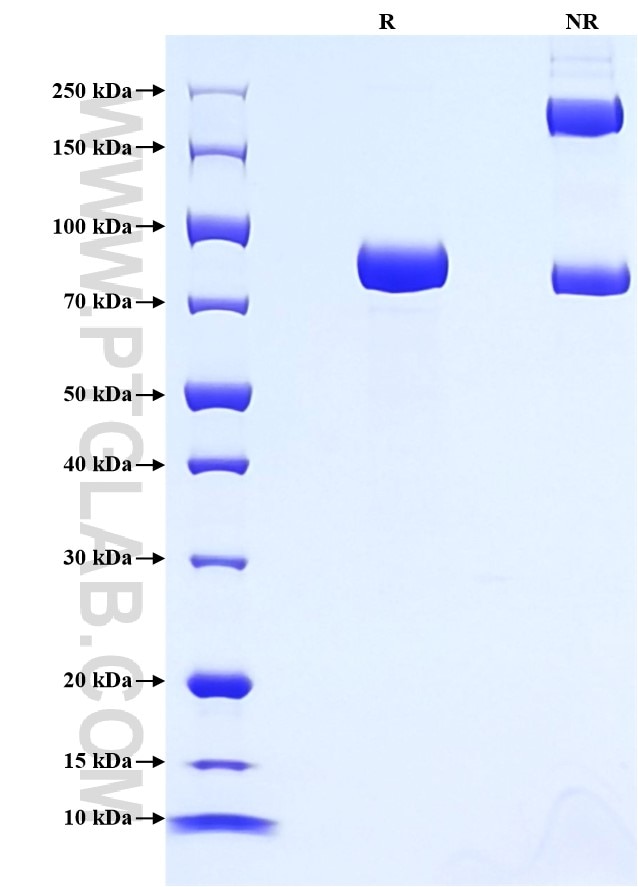
>90 %, SDS-PAGE
Tag
rFc Tag
Activity
not tested
Cat no : Eg2961
Validation Data Gallery
Product Information
| Purity | >90 %, SDS-PAGE |
| Endotoxin | <0.1 EU/μg protein, LAL method |
| Activity |
Not tested |
| Expression | HEK293-derived Mouse ALPPL2 protein Val19-Ser502 (Accession# P24823) with a rabbit IgG Fc tag at the C-terminus. |
| GeneID | 11650 |
| Accession | P24823 |
| PredictedSize | 78.6 kDa |
| SDS-PAGE | 75-85 kDa, reducing (R) conditions |
| Formulation | Lyophilized from 0.22 μm filtered solution in PBS, pH 7.4. Normally 5% trehalose and 5% mannitol are added as protectants before lyophilization. |
| Reconstitution | Briefly centrifuge the tube before opening. Reconstitute at 0.1-0.5 mg/mL in sterile water. |
| Storage Conditions |
It is recommended that the protein be aliquoted for optimal storage. Avoid repeated freeze-thaw cycles.
|
| Shipping | The product is shipped at ambient temperature. Upon receipt, store it immediately at the recommended temperature. |
Background
Akp5, also known as mouse alkaline phosphatase (embryonic type), is an alkaline phosphatase isoenzyme found in mice. The predicted molecular weight of AKP 5 mouse protein is 53.64 kDa, but due to glycosylation, it migrates to 55-70 kDa in SDS-PAGE results. Clinical determination of Akp5 mouse is mainly used for the diagnosis and differential diagnosis of bone and hepatobiliary diseases, especially for the differential diagnosis of jaundice. For the unexplained high serum level of Akp5 mouse, isoenzymes can be determined to help clarify its organ source. Pathological changes: Akp5 mouse will change under various pathological conditions, such as bone diseases, hepatobiliary diseases and so on.
References:
1.	Lei W, et al. (2013). Reproduction. 146(5):419-32.
2.	Narisawa S, et al. (2007). Am J Physiol Gastrointest Liver Physiol. 293(5):G1068-77.
3.	Ardecky RJ, et al. (2014). Bioorg Med Chem Lett. 24(3):1000-1004.